Ashwin Sanghi: Play of Plots
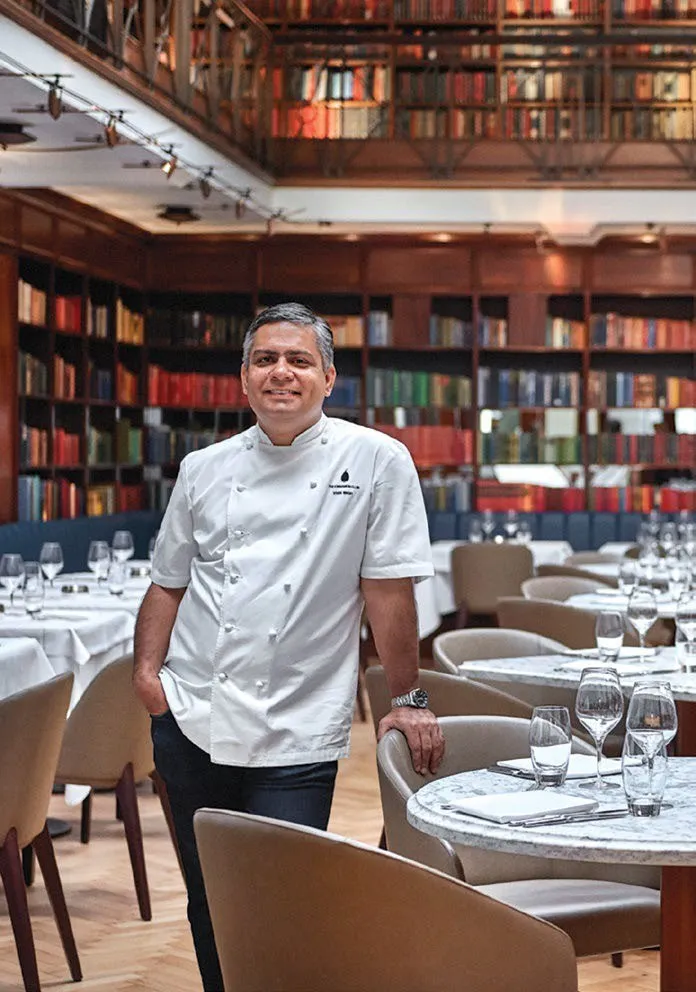




Meet the new-age ‘authorpreneur’, Ashwin Sanghi, who has exceptionally married his business acumen with the art of storytelling. His gripping storylines based on mythological themes infused with contemporary plots, hit the right notes with the everyday reader. His new book The Sialkot Saga is entertaining, educating and enlightening.
What’s the origin of The Sialkot Saga?
 L’Officiel India DigitalRead L’Officiel India in the digital libraryEvery issue and every cover story, on TCG Media.Read now
My book, The Sialkot Saga (published by Westland) is a business mystery about two men—Arbaaz and Arvind, who grow up in very different worlds. While Arvind grows up in Kolkata in Marwari aristocracy, Arbaaz fends for himself in the underworld of Dongri. They do not realise it, but their lives are connected by an ancient secret. Their quest for that secret, unfortunately, will have repercussions on everyone else.
Tell us about your experience, discussing the book with Kajol?
Kajol and her mother Tanuja have been among my earliest fans. In fact, they had read The Rozabal Line, when I was a completely unknown author. I was thus delighted when Kajol agreed to do the cover and trailer launch of The Sialkot Saga at the festival. Good storytelling ensures that readers turn the page. It’s the key ingredient in bestsellers.
Coming from a background of business and economics, what made you take up writing?
As you know, I am not a writer by profession. I was born and brought up in a business environment. I started working when I was 16 and completed my MBA when I was 22. By the time I started writing my debut novel, The Rozabal Line, in 2006, I had already been in business for over 20 years! I guess there was a part of me that was bored. A couple of years earlier, I had visited a shrine in the centre of Srinagar called Rozabal—or ‘tomb of the prophet’—purportedly the resting place of Jesus Christ. I was fascinated by that story having been heavily influenced by Holy Blood Holy Grail by Michael Baigent, Richard Leigh, and Henry Lincoln. Around that time, I also read books by Holger Kersten and was fascinated with the idea that Jesus could have been inspired by Buddhism and that he may have drawn much of his spiritual learning from India. I began to wonder whether I could marry the two theories i.e. that he survived the crucifixion and travelled to India and that he left behind a bloodline. That question was the spark that inspired me to write my first book.
How much do you believe in mythology?
I am interested in stories that thrill and mythology per se does not inspire thrills. It is the tantalising possibility of an overlap between history and mythology that provides the adrenaline rush. There is no thrill in Homer’s Iliad, but the discovery of ruins in Turkey that could be ancient Troy makes the story exciting. In similar fashion, the idea of Krishna as a mythological hero is interesting but not necessarily exciting. Couple that mythology with archaeological finds off the coast of Gujarat, that could be Krishna’s ancient city of Dwarka and you have a thriller. I have always believed that a myth is a lie that reveals a truth. That’s precisely what I try to do.
How different is the plot of Sialkot from your earlier books?
Think of The Sialkot Saga as Chanakya’s Chant, but set in the world of business instead of politics. It has the same sort of game play, cerebral strategy and tit-for-tat. I plan meticulously before I start writing. I rarely face writer’s block. The reason is my organised style of working. I spend several months collating research, then several months developing a plot outline. By the time I start writing, my job is like that of a child using crayons within a colouring book. With the outlines drawn, how difficult is it to choose which crayon to use? My forte is storytelling. I really don’t care about the words I use. All I want is for my reader to be sucked into the story.
Who are the authors you grew up reading?
It’s difficult to say because I grew up reading both classics as well as potboilers. My spiritual sense is influenced by Paramahansa Yogananda. My love for fast pace and racy plots is influenced by Dan Brown and Frederick Forsyth. My fascination with historical retelling is inspired by Dominique Lapierre. My passion for research is fuelled by Arthur Hailey and my Indianness of voice is influenced by Salman Rushdie. The truth is that I was brought up on a diet of commercial fiction and thrillers for most of my growing years: Jeffrey Archer, Sidney Sheldon, Robert Ludlum, Frederick Forsyth, Irving Wallace, Jack Higgins, Tom Clancy, Ayn Rand and Arthur Hailey to name a few. In the past decade, Dan Brown, John Grisham, Stieg Larsson, Ian Rankin and countless others were added to my list of favourites. Increasingly, I find that I am reading much more non-fiction than fiction. Some of my favourite non-fiction authors are Gary Zukav, Richard Dawkins and Brian Weiss.
My passion for reading was ignited when my maternal grandfather bombarded me with books. He would insist that after reading every book I must write a letter detailing what I liked and what I didn’t. In the beginning, it was a tedious process, but my imagination and knowledge increased over the years. It’s precisely for this reason that I believe in the blessings of my ancestors moving my pen.
You happened to interview Dan Brown, whom you are often compared to. Tell us about it?
It was a terrific interview and we realised that we had a great deal to discuss even after the interview. At one level I believe that we should not be giving out such tags—the desi Dan Brown, the Indian John Grisham, the Asian Paulo Coelho and so on. Every writer brings something unique to the table and we should celebrate that uniqueness. That is not to say that I am not flattered by a comparison to someone who has sold over 200 million copies of his books! As regards criticism, that’s par for the course with creative endeavours like books, movies or songs. In the world of commercial fiction, your only yardstick should be your sales. If sales continue ticking away, it means that your work is resonating with your readers. And in that event, criticism becomes irrelevant.
From the May 2016 issue of L’Officiel India.
Spotted a mistake, or your photo used without permission? Report a correction