In All Honesty
Interview with photographer Peter Lindbergh, whose almost four-decade career is on show in the Netherlands, on natural beauty and staying true to his vision.




With a career spanning almost four decades, Peter Lindbergh has become one of the world’s most sought-after photographers, one who has always stayed true to his artistic vision. While an impressive exhibit of his work is on display in the Netherlands, he explains how he managed to do things his way even when it seemed impossible.
As I saw Nadja Auermann standing in front of a photograph of her naked body blown-up to almost double life-size, I couldn’t help but ask her; “How does it feel, seeing yourself like that?” “Natural,” she replied. “It’s like looking at myself in the mirror.” We were at Peter Lindbergh’s exhibition at the Gagosian gallery in Athens and what Auermann said, so nonchalantly, is one of the secrets to the photographer’s success: his passion for immortalizing ‘natural’ beauty in a direct – yet poetic – way, without hiding any flaws or imperfections, such as the goose pimples on the model’s legs (“It must have been very cold,” she said laughing) or the faint scar of what might have been a C-section.
 L’Officiel India DigitalRead L’Officiel India in the digital libraryEvery issue and every cover story, on TCG Media.Read now
It was in Athens that Thierry-Maxime Loriot (whom I knew as curator extraordinaire of “The Fashion World of Jean Paul Gaultier”, a blockbuster exhibition seen by more than two million visitors around the world) gave me the initial details of what he was working on with Lindbergh: “A Different Vision on Fashion Photography”, a spectacular overview of the German photographer’s multi-faceted oeuvres from 1978 to the present day, which is currently on display at Rem Koolhaas’ Kunsthal in Rotterdam. The list of personalities who attended the opening – Auermann included – was impressive, from Tina Turner to the legendary supermodels of the 90s.
Lindbergh was fortunately able to find the time to give me an exclusive interview on what made all this possible.
How does it feel, looking back at your career through the exhibition, Peter Lindbergh - A Different Vision on Fashion Photography? Was there something that surprised or excited you while delving into your archives? Or some kind of realization you made, as you had to revisit your entire oeuvres?
Today I should not work as much as I do because I always thought that now, in this part of my life, I would have some time to reflect and to find out more about everything I have seen. But then, thinking only of photography, there is not much left to do… But let’s talk about the exhibition at the Kunsthal in Rotterdam! Thierry’s idea of the exhibition was not that of a retrospective. We worked together almost three years on it, researching images, the photographs haven’t been presented chronologically, but as he calls it, through themes, my passions and obsessions of the past decades… The Kunsthal in Rotterdam is a very sophisticated museum of modern art. I’ve been told that I am, if not the first, but one of the first artists with a solo exhibition in the Kunsthal while still living. In that regard the less fortunate artists were Pablo Picasso, Giacometti and Keith Haring, among others. Thierry came to me with the idea of showing my work in a different way, a way that even I had never thought of. It was quite interesting for me to see images I had shot recently and years ago, all together, but from a very different perspective. It is easy to put together an exhibit of photographs and to just hang them up on a wall, but the way in which this has been presented, it is not only about me, but about the different universes you discover, whether they be those of dance or the arts in Germany, cinema, social issues or beauty…
Throughout your career, you have managed to bridge the gap between “fine art” and “commercial” photography in a way that seems effortless to the viewer. What has it taken to achieve that?
Nothing changes for a photograph if it is labeled as art or not since it is not the label which makes a photograph interesting, original or moving… I never made any distinction between fashion or art photography, it is not me who decides how it will be considered...
What do the clothes that appear in your photographs mean to you? Are they a source of inspiration and is there a difference between shooting a fashion editorial or a campaign? Do you have an opinion on the current state of fashion?
I do not have a problem with being considered a fashion photographer but I do not approach photography from a fashion point of view, far from it. My inspiration comes from other places, I consider many things as interesting, as inspiring to me.
A lot has been said about how your images propelled the “supermodeldom”. Which were the key elements in your approach? At which point did you realize you were actually making (fashion) history?
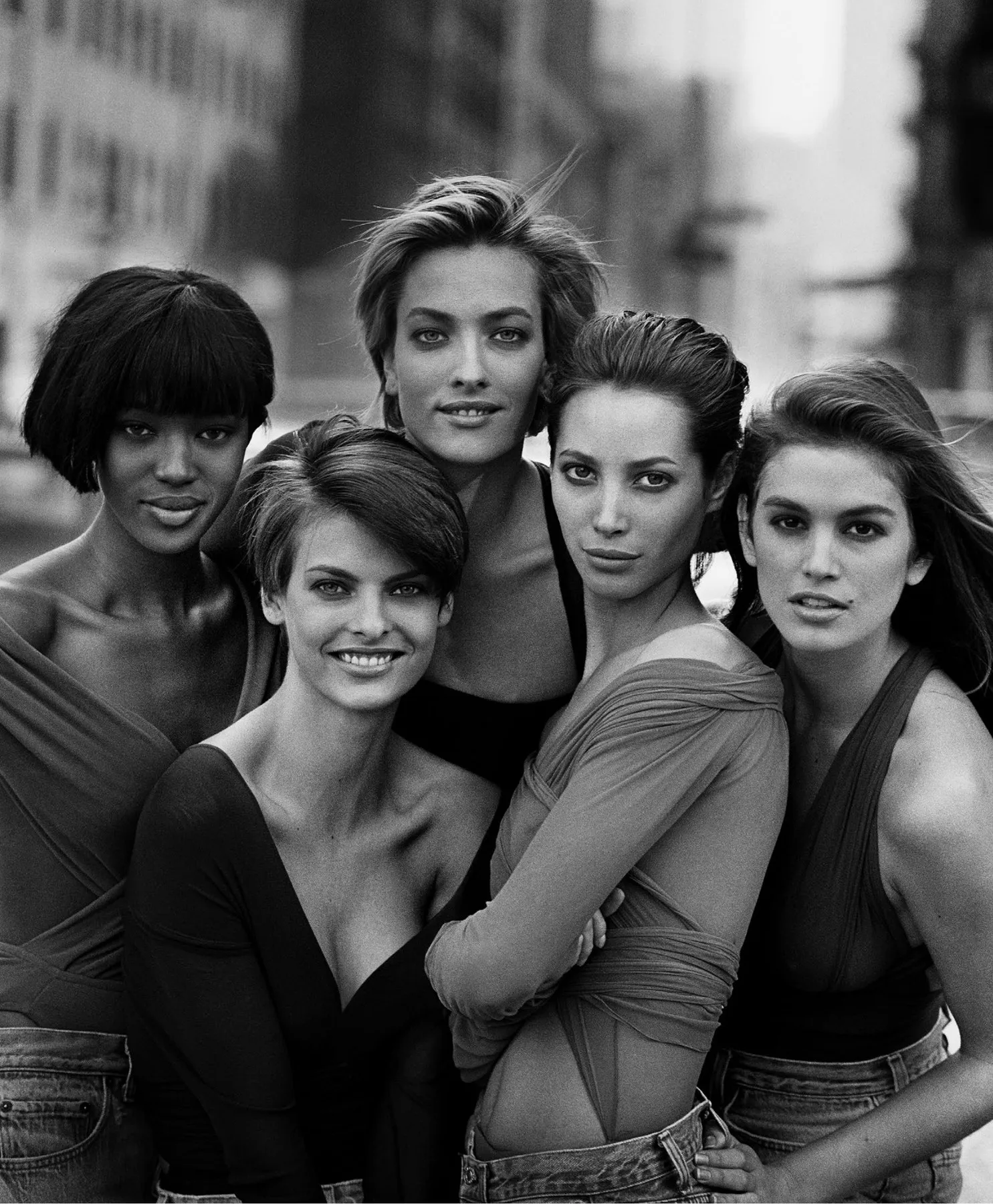
At the end of the 1980’s, the later named Supermodels represented, to me, a change from the other women in fashion magazines. They had very different personalities and they were different from the models of before. They were independent, could speak for themselves, were not in need of masculine protection and were not living and exposing their social status to exist. It was about independence, authenticity and diversity. That led to the White Shirts images shot in California in 1988, which was the first time they had been put together in a group and were later referred to as supermodels. I had, many times, refused to work with American Vogue because I could not relate to the woman they were showing in their pages. Mr. Alexander Liberman, from Condé Nast, asked me to show him what my type of a woman was. I did images of relatively new models as a group, all in white shirts. Vogue did not say much and rejected the pictures. Ironically, one of the pictures ended up, four years later, in a book celebrating the 100 year anniversary of Vogue as the most important picture of the decade… Using black-and-white photography was really important to create the supermodels. Every time I tried to shoot them in colour, it ended up looking like a cosmetics advert. With black and white, you could really see more of who they were. It toned down the commercial interpretation that colour gives
When photographing a celebrity, what do you think makes a good portrait?
I would try to define it as the experience of understanding another person’s condition from their perspective. That seems to be the most important gift you need, to come to a “symbiotic relationship” with your subjects. It creates amazing moments and a feeling that everything can happen at any moment. It is something very beautiful, and by the way, very useful… I do not make a difference between an actor or a model when I shoot, I love storytelling, narratives, it is about showing something real, situations where I leave some space for improvisation, I give the guidelines, suggest and then they have to pretend that I am just not there, photographing them.
You have often expressed your disapproval of airbrushed images and spotless beauty. Why do you think they have prevailed in the media and how easy or difficult has it been for you to adhere to a natural, not-photoshopped approach?
Since the arrival of the digital processing of images, a lot has changed. Especially with new tools, like photoshop, which are too often used in a destructive way since too much freedom is given to digital retouchers. This has a very sad, dehumanising effect. You can see every day, everywhere that this has become automatic. The retouching has kidnapped the life from the faces of women and cleared them from past experiences and emotions. The image of women in our time has become an insult for every person who loves and respects them. Real beauty, wisdom, sensibility, love or intelligence in someone’s face has been branded with, supposedly the most negative word of our time; OLD! The strong market of eternal youth has taken control of our awareness of true beauty. When you can sign on to the idea that there cannot be beauty without truth, the answer is clear. How crazy and unreal is the idea of erasing all your experiences from your face? You should also know why you want to leave them. This should be the responsibility of photographers today: to free women, and finally everyone, from the terror of youth and perfection.
At first digital photography brought the demise of film, then the social apps and media permitted anyone to take and publish an unlimited number of photos, claiming artistic merit. It seems to me that there is a “noise” which makes it harder today for photographers – especially young – to make a difference and become established.
What is your opinion on that and on the use of apps like Instagram in general?
There is a good way not to get tired. Just don’t look at all those pictures everywhere!
I have nothing against the concept that everyone is a photographer now and that this produces trillions of pictures. A real photographer, someone who has a point of view and a long history of doing interesting pictures, will always stand out if his work is interesting enough, but I must say that we, the “real” photographers can only learn from the lightness or easiness of some of those photographs you see from time to time in the sea of useless pictures everywhere.
I have learned to shoot digital with the exact poetry as before on film. It took a while to learn this but it was too important to me, to bring back the poetry in my own photography.
What drives your creativity today? What would you like to do from now on?
There is one simple sentence from the Japanese zen master, Shunryu Suzuki: “To express yourself as you are, without any intentional fancy way of adjusting yourself, is the most important thing.” I think, following Shunryu’s thinking would be the most revolutionary and useful act, with respect to photography and everything else.
“Peter Lindbergh - A Different Vision on Fashion Photography” will be on till the 12th of February 2017, www.kunsthal.nl
The exhibition is accompanied by a comprehensive book on the German photographer, compiled by the Canadian curator
Thierry-Maxime Loriot. The book is designed by Paprika Design and published by TASCHEN, hardcover, 500 pages, ISBN 978-3-8365-5282-0 (English, French, German).
Spotted a mistake, or your photo used without permission? Report a correction