Fascinating Ruins




For those who love to get lost in history, here are the places that speak about the glorious past, and its subsequent fall.
What does history mean? Victor Hugo once defined it as an echo of the past in the future, and a reflex from the future on the past. Ruins all around the world have withstood the test of time, and attract travellers from every corner. Many are fascinated by the plans that are used to create these ancient marvels, whereas others want themselves to fade away in the mists of yore. Now, it is time for us to explore those sites that ceased to function years ago, but still represent the architectural value of ancient civilisation, and are therefore badged as a World Heritage Site by UNESCO.
 L’Officiel India DigitalRead L’Officiel India in the digital libraryEvery issue and every cover story, on TCG Media.Read now
Tikal Ruins, Guatemala
The Mayans left their imprints all around central America, but Tikal might be the most magnificent example of what life was like in pre-Columbian society. Shrouded by thick rainforest and centuries of mystery, the ancient Mayan city of Tikal is one of the dominating sites of antiquity in the West. We all have heard of Machu Picchu, but the scale and preservation of Tikal outshines the famed Incan ruins in Peru. Some of the temples, which tower amidst the dense jungle canopy, were the tallest buildings in the New World until the 19th century. If you want to feel what it was like to wander the central plaza of a buzzing city from 800 A.D., then this place is a colossal time capsule for you with natural sound effects from howler monkeys, capuchins, parrots, and some 285 other species. The ambience of this place is as it was some 1,200 years ago, when for reasons still unknown, the inhabitants of Tikal disappeared at the end of the 10th century.
Terracotta Warriors, China
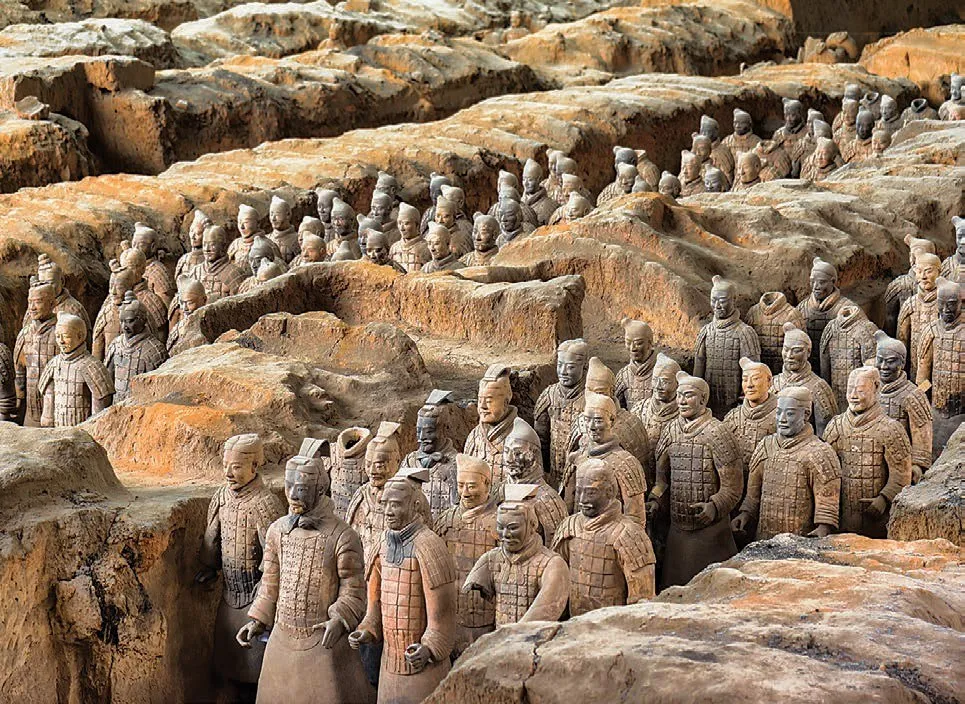
A hoard of life-size clay soldiers intended to fill an emperor’s elaborate necropolis, uncovered accidentally in the year of 1974; the Terracotta army is renowned as one of the world’s greatest archaeological finds. Discovered in the Xi’an region of central China, and dating back to its first dynasty, these ceramic figures have shed light on the country’s ancient artistic practices, and even a few age-old burial rituals. The site was built as a mausoleum for Qin Shi Huang Di—the First Emperor of Qin, and perfectly accentuates the Emperor’s obsession with immortality. The entire citadel has been uncovered, with gardens and stables, bronze ritual vessels, jade pieces of jewellery, and some of the most valuable gold and silver ornaments ever found. Though the tomb of the Emperor is yet to be unravelled, the unexpected unearthing of underground Terracotta warriors is already one of the most striking and enigmatic discoveries from the ancient world.
Hampi, India
Rising sun rays scattered through the clouds, and soft lights battling the valley, unveil a spectacular stony boulder-strewn landscape of undulating hills, lush vegetation and skeletons of once-mighty temples and watchtowers. The description befits this sacred land of gods, kings and ruins that make up the historic city of Hampi. Located in the southern state of Karnataka, Hampi was once the seat of the powerful Vijayanagara Empire. Acting as a capital since 1336, this place enjoyed fame and grandeur until its fall in 1565, after which it was dismantled, looted and eventually abandoned. Just beyond the vast Tungabhadra river stands Anjanadri Parvatha, which is believed to be the birthplace of the Hindu monkey deity Hanuman. The area is deemed as Kishkindha, the monkey kingdom from the Hindu epic Ramayan, only adding to the lore of the place. Unfortunately, the paints that once decorated the ruins have long been stripped away by the elements, making it seem like a part of the landscape itself. To be exact about its rich history, more than 1,600 monuments have been identified so far in the form of statues, carvings, forts, temples, shrines, baths, gateways and so on.
Valley of the Kings, Egypt
When it comes to marvellous yet uncanny structures, ancient Egyptians always top the chart. From building massive public monuments for their pharaohs, to spending time and treasure on creating the hidden underground mausoleums. The eminent collection of such intricate tombs is the Valley of the Kings, situated in Luxor, near the Nile’s west bank. From 1539 to 1075 B.C., during the era of the New Kingdom, this valley became a royal burial ground for pharaohs such as King Tut, Seti I, Ramses II along with many queens, high priests and other elites of the 18th, 19th and 20th dynasties. The elaborate tombs highlight their preparation for the next world, in which pharaohs were expected to become one with the Gods. The underground tombs were filled with mummies, waiting to be re-animated in the afterlife, along with material goods that a ruler might need in the next world, like priceless treasures, dazzling ornaments, and even some very mundane items like clothes, food and wine. Some tombs even contained the mummies of hunting dogs, pet baboons, and gazelles. All these make this place a nexus for all the history buffs who are looking to browse a chapter of the past.
Angkor Wat, Cambodia
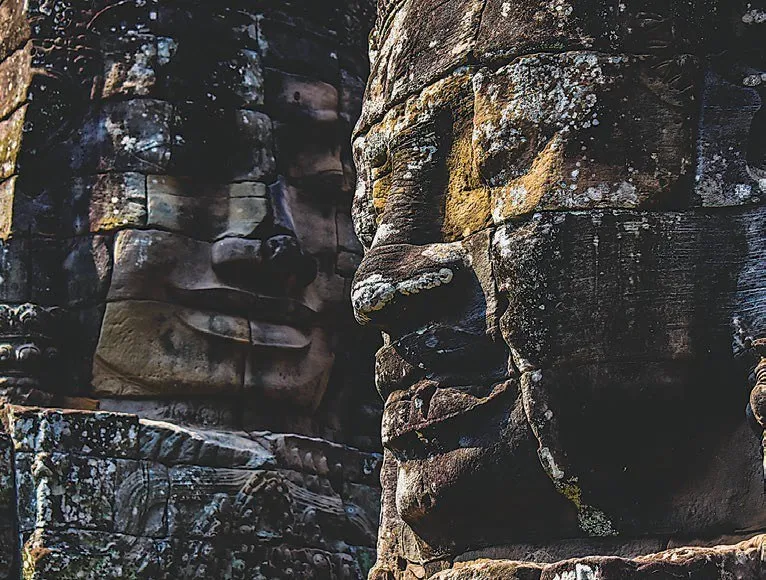
The sun rises behind the grand domes, tall palms stretch towards the crystal sky, and floating clouds reflect in the temple’s moat; with such natural beauty, Angkor Wat truly is the master of all ruins. Built in the 12th century by King Suryavarman II, this is considered as the pinnacle of Khmer architecture. The richness of Angkor Wat’s exterior has become a symbol of the country, so much so that it even appears on the Cambodian flag. On the inside, the gallery presents a pretty holistic relief of one of the most famous sacred Hindu myths—a sculpted brief of the infamous Samudra Manthan. The fascinating thing is the meticulousness of the carvings, which are set in a series, so that a walk through it feels like a walk through the narration itself. There are shapes of fish and crocodiles spinning around in the whirlpool, a four-armed Vishnu entreating the armies of good and evil, and a portrayal of the giant tortoise that holds the Mount Mandra. Furthermore, the canopy of the temple reveals beautiful apsaras dancing in the wind. Though there are some carvings that never got finished, Angkor Wat is still a magnificent work of art that has managed to withstand the ravages of time.
From the January 2020 issue of L’Officiel India.
Spotted a mistake, or your photo used without permission? Report a correction