Amit Aggarwal: Independent, Not Rebellious





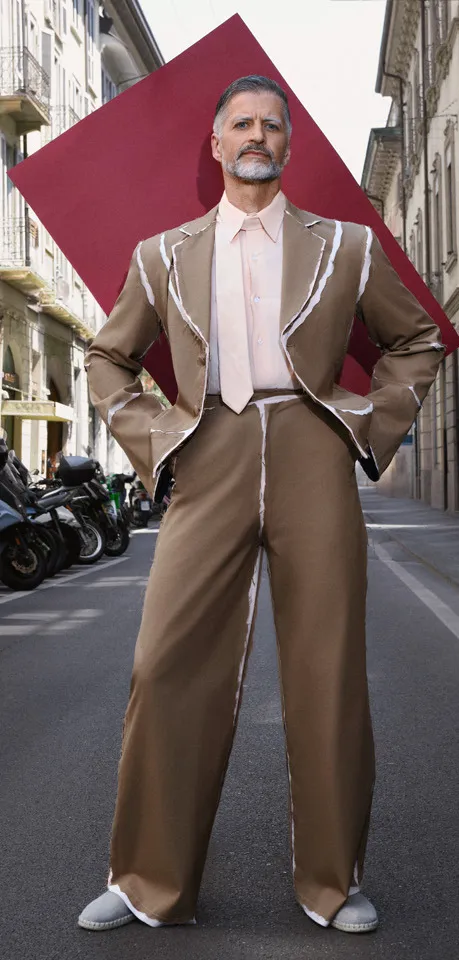
Amit Aggarwal believes that rebellion comes from unrest, independence from acceptance. This kind of maturity seems rare in the fashion world, but that’s what makes him a heretic. And the best thing? His label has a heart, too—it is ecologically attuned, and he uses waste to create architecturally soaked splendour in his ensembles.
Where did you grow up?
 L’Officiel India DigitalRead L’Officiel India in the digital libraryEvery issue and every cover story, on TCG Media.Read now
In Mumbai, where I did my undergraduate studies in commerce, before I moved to New Delhi to study fashion at the National Institute of Fashion Technology.
Why fashion designing?
I was always creatively inclined. When I was around 10, a cousin, who had done a short course in fashion, showed me some of her sketches. That was it for me. I knew ever since!
How tough was the shift to fashion, coming from a family of engineers? And also the shift to Delhi, from Mumbai?
I don’t remember it being tough at all. I come from a regular family, with special parents. My dreams were always their dreams. I had the liberty to do what I felt like and they were just behind me, each time I missed a step. Moving to Delhi was tough, initially, but then I fell in love with the winters, the wide roads and the trees. I could never go back to Mumbai!
How was NIFT? How did it change and develop your thinking process?
NIFT was probably the best education one could get in India, at the time. Besides the exposure to design, there was a lot of emphasis on the technical aspects of making clothes, which I absolutely enjoyed. And then, I cherished the company of my batchmates—heated debates, late-night conversations on design and philosophy, pushing one to work harder… NIFT gave me a lot. I was also lucky to travel from NIFT, on three long exchange programmes, to Japan, London and Italy. It really widened my perspective and exposed me to varied cultures at a very young age.
You worked with Tarun Tahiliani. How was that experience? What did you learn?
I worked with Tarun very early on in my career. I realised the power of fashion at his studio. A single sketch by the couturier could change the wearer’s life, with the dreams they had of being wrapped in his couture... He is a man filled with a love for clothes, women and life. I secretly stole a lot of love from his kitty. In retrospect, what I took back was a lot more faith in the creation of clothing.
Would you term your clothing as rebellious? Your garments are different and almost quite independent in their thinking.
Independent yes, rebellious no. Being rebellious is still trying too hard. Rebellion comes from unrest, independence from acceptance.
You have always used leather, tape, mesh and wires to create architectural shapes, when most designers remain obsessed with chiffon and organza…
I work mostly with raw material, be it acrylic, leather or materials that resemble metal. A material, in its raw form, is more malleable and it lends itself beautifully to be used differently. I’m pretty obsessed with organza, too; it’s just that my application of it isn’t in the most conventional way. I’m not scared when I put things together. I do look at the final product, but the entire studio is tuned to exploration, experimentation and evolution. However, like everyone else, I do believe most in the understanding of beauty over and above every other thing. The final product needs to, ultimately, be beautiful, as I define it. Each experiment creates a result. I don’t know which has been the worst or the best of them. The best way to enjoy it is to adapt to its outcome and not expect from it even before it has started.
How tough is it to work with alternative materials? What are your biggest challenges?
The challenges, honestly, are threefold. On the studio front, to convince the material that it could be used alternatively than the purpose it knows itself for, and to get the right staff to execute the pieces. On the creative front, the evolution of the signature, keeping its heart the same, but changing its beats. And, on the production front, getting the right people to produce the product with the same, or at least similar, integrity. People who appreciate quality over just quantity.
What would you say is your signature, and what is your niche in the fashion sphere?
My signature, I think, is abstraction. I enjoy that most people, who are aware of my work, can enjoy it without attaching too many references to it. Each of them attaches a different reference to it. To some, it’s an animal form, and to some, it’s like a modern cityscape or a piece of architecture. However, it’s never an absolute reference, it also leaves them imagining more. That bit of unsettlement makes it exciting for the viewer and the ultimate adventurous buyer. A buy like this becomes a modern classic, which could be worn through generations, without it having to succumb to time, notions, culture or history. These clothes might be considered unique, but honestly it comes from being one with yourself and with the surroundings that make you. Special or unique are overused and abused words. I think being ordinary is being the new superhero.
How are fashion and art related? How have you tried to make the two meet?
They are both born of creativity. So, of course, they’re related.
However, it’s relativity that makes something look like art or not. I enjoy making clothes. What people finally see them as, is totally up to them. I enjoy it when they wear them, I enjoy it when they say they could hang a piece in their living room, and I enjoy it when they say they love it, but don’t know what to do with it. If I’ve stirred an emotion in the viewer, my work as a creator is mostly accomplished. If it finally gets sold, that’s a job well done by the entire team behind the brand.
You are now looking at the Indian market, a shift from your earlier focus, Europe…
I never strategised such that my product would appeal to a particular market. We’ve sold our saris to women in the Middle East, and our so-called conceptual clothes to clients in India. I see the entire world as a potential buyer. To decide the ultimate purpose of clothing or trying too much to understand what clothes would sell where, would just mean undermining their prowess.
You’ve expressed a desire to do furniture and interiors, someday. Would a prêt line also be in the offing? And what do you have to say about the prêt ideology in India?
The studio has already had orders on the paintings, light décor, installations and upholstery that we’ve done. Though the concentration is on clothes, currently, we would love to extend that part of our creativity to reach more people’s homes. I recently showcased the brand’s first-ever RTW line at the Amazon India Fashion Week, for Autumn/Winter. The ideology is to define the present through an amalgamation of the past and the future, through the co-existence of the organic and the inorganic, the traditional and the unestablished, to create a wholesome living experience. The label is called AM.IT. I think, what I am enjoying is the evolution of India’s own language of RTW. It was important that we offered a bigger dimension to what Indian creativity meant to the global world. The prêt ideology is only evolving in the country and, in time, it’s going to be a huge phenomenon the world over. I am in awe of people who can create by feeling the pulse of the people. It’s a kind of detachment from the importance one attaches to oneself. RTW is just that; special because it’s not so special.
Digital seems to be the way to go. How do you plan to make your label relevant in this fast-changing scenario?
I am still conservative, in terms of not wanting to deprive the client of the experience and the joy of buying couture through meeting with the creator, or at least by wearing it and feeling it before it’s bought. My new ready-to-wear line fills in that gap. The sizes and styling are free to accommodate buyers from different demographics, cultures and likings. The clothes sit in well with their existing wardrobe and are very versatile, and are adaptable to customising. Our approach for this is mostly online retail and online promotion through digital media and digital sales.
You’re a known admirer of Azzedine Alaia. Which other designers do you admire?
Helmut Lang. I have a newfound respect for him. In a recent retrospective in Paris, a museum held an exhibit of the best pieces from across the world, illustrating the evolution of world fashion. Each one was more detailed than the other. Each, more beautiful. The creations of Helmut Lang took my breath away. A simple square slip, joined on the side seams with six eyelets… Revolutionary for that period, and still very relevant and desirable.
Your biggest strength? And weakness?
My parents, my business partner, my life partner and my friends are my strengths. They are also my biggest weakness.
From the May 2015 issue of L’Officiel India.
Spotted a mistake, or your photo used without permission? Report a correction