Amit Aggarwal: Mastering The Motion
Amit Aggarwal has not only put Indian craftsmanship in a context that appeals to modern women but also created a brand with conscience.





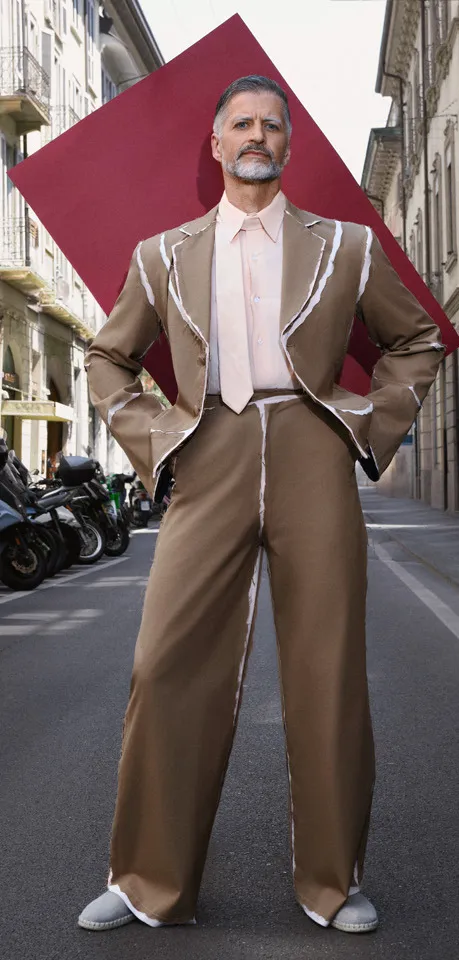
It wouldn’t be an exaggeration to call Amit Aggarwal a thinking designer. He derives his design sensibility from mathematics, biology and a love for art bringing in movement with the swiftness of an engineer working on his codes. When the world was finding ways to incorporate (or dodge) sustainability, Amit made it a part of his aesthetic narrative. For his couture and prêt lines, he works with industrial materials (wires, metals et al) as well as old fabrics, legitimising upcycling as a valid idea for luxury design. Texture and fluidity has been his strengths, something that gives his clothes a feeling of gently swaying in the wind, on its own.
It was so difficult to catch hold of you. What’s keeping you busy these days?
 L’Officiel India DigitalRead L’Officiel India in the digital libraryEvery issue and every cover story, on TCG Media.Read now
Yes (laughs)! At the moment, my focus is on the management side of the business. There are some exciting opportunities in retail that we would like to take up. We have plans for brand expansion too. On a personal level, I am currently doing up my apartment, which I have recently moved into. After I am done with all this, I will go on a much-needed holiday.
Your latest collection got everyone talking.
Our Spring/Couture 2018 line was inspired by both Ernst Haeckel’s elaborate drawings and his philosophical worldview, one that speaks of unity and symbiosis between all living things. Luxurious fabrics, defined silhouettes and embellishments, inspired by natural forms, have, therefore, been composed together to create innovative couture pieces.
We have established a tradition of creating designs by refining natural forms and articulating them through unique silhouettes and textiles. Our latest collection resonates with this vision.
Who inspired you when you were growing up?
I have always been an admirer of Azzedine Alaïa. His passion for his craft, attention to detail and commitment to craftsmanship are so inspiring.
So, it’s safe to say that fashion always fascinated you.
I think the world of fashion chose me instead of the other way round. I had a natural inclination towards fashion, art and design. I would always be drawing and was fascinated by the human form. I did it purely out of joy, never really putting much thought into what I was going to do with this interest of mine.
As it turned out, a cousin saw my drawings and suggested I enrol in a fashion school and I did take admission at NIFT Delhi. It was where I understood the technical aspects of making clothes. It gave me an insight into fashion and art history. Over the years, I developed my aesthetic.
Who did you work with before starting your own label?
My first important insight into the world of fashion was through my apprenticeship with Russian designers Serdin and Vasiliev. I worked on a capsule collection for them that was shown at Paris Couture Week. Later, as a part of Tarun Tahiliani team, I honed my skills and understood the power of fashion.
What was the turning point of your life?
I think being appointed the creative director for Morphe. It put my career onto a different trajectory.
And then you launched your label in 2012. Any challenges?

I think what was challenging was to determine a direction for the brand, understanding how to start and set a process in motion for an organisation. I practically started from scratch, buying equipment needed to create a small set up. Finding the right people who had a similar vision was another roadblock that I had to overcome. I was lucky that the industry accepted a new aesthetic that my brand has.
Today both my labels — my eponymous couture line and prêt line, AM.IT — represent the entirety of my vision as a designer. Both are about innovation and re-invention, but the approach and context of both the lines are quite distinct. The couture line aims to translate innovative ideas into modern, refined forms and silhouettes while AM.IT is about the future, having a cutting-edge design sensibility and taking our aesthetic to unexplored realms.
What’s your design sensibility?
I was greatly inspired by science and mathematics while growing up. I think it is significantly evident in my design ideology. I look at biology for inspiration and use mathematical calculations to design and find ways to use new materials.
We are guessing with your designs, a lot of mathematics is needed. How did you think of using industrial materials?
I think, there exists a symbiosis between nature and what man creates. In today’s world, industries are as crucial to our survival as a green patch of land. I grew up being enamoured by nature but also found my father’s industrial blueprints and engineering materials quite fascinating. So, industrial materials such as metal are as much part of my palette as natural forms and structures. Both are deeply ingrained in my design DNA.
Isn’t it difficult to use those materials? How do you make them suitable for weaving and tailoring?
It’s a challenge to make industrial materials look luxurious and that’s why we have an extensive development process. We look at materials as starting points. We study them carefully and work on them in different ways till they look and feel like a material one can seamlessly see on a high-end garment. I relish the challenge.
Take us through your design process.
I love exploring a woman’s shape and form through drawings and consider it to be a multi-faceted process. Silhouette exploration goes hand in hand with studying fabrics, generating fresh ideas for textiles and embellishment, and also understanding new ways of composing them all together.
How difficult was it for you to make your buyers understand your vision?
I think buyers today are intelligent. They don’t see recycled textiles as those made from ‘discarded materials’ per se. They understand the amount of thought, experimentation and designing that goes into creating our recycled pieces. It’s our constant endeavour to put this point across as effectively as possible through packaging and advertising. We also work with old Banarsi and patola saris, infusing them with new life and translating them into modern garments.
You have been working with the kaarigars and weavers. What has been your biggest take away from that process?
I think it’s been an enriching experience. As a designer it’s important to help make our traditional textiles commercially viable and scalable, both in the country and internationally. My effort has been to expand their scope and potential.
Fashion is at the brink of a shift, from extravagant to responsible. You have been one of the few designers to have seamlessly integrated fashion and sustainability. Tell us how it occurred to you?
I have always believed that as a creative person I hold a higher responsibility to project to the world the future that could be. Couture has always been an outlandish proposition but why can’t it be thoughtful too, is my question. An intelligent and sensitive person will always find a way to marry their ideals with personal aesthetic, which maybe ostentations or one-of-a-kind, like couture is. These thoughts shaped my worldview, ultimately helping me create a brand that made conscious couture its focus. This idea was close to my heart, but I didn’t imagine how deeply if would form the core of my design philosophy. And I am glad, it did.
From the April 2018 issue of L’Officiel India.
Spotted a mistake, or your photo used without permission? Report a correction