Wonder Women
There's no denying that power dressing has evolved since the days of relying on shoulder-pads and pinstripes for a little chutzpah. Today, L’Officiel speaks to the women in fashion who are doing their bit by using design as ameans to empower girls around the world.




By:ChitmanKanwar Ahuja
Mandeep Nagi, Design Director, Shades of India
The relationship between fashion and empowerment is a generational one. It is influenced by many different factors, for me, fashion isn’t about following trends, purchasing expensive shoes or handbags. It is a form of self-expression, of self-love, of liberation.
A language to express who you are, a sign of independence. Fashion is cultural, it’s seasonal and fosters dialogue. It’s beyond social, economic, financial limitations. It can stem from tradition or as a sign of protest. It’s not something that’s created for the empowered but the other way around, it’s the empowered who create and use fashion to express themselves.
 L’Officiel India DigitalRead L’Officiel India in the digital libraryEvery issue and every cover story, on TCG Media.Read now
While fashion is viewed as external. It is in reality a bridge between the inner self and outside world. Making a person be vulnerable yet empowered at the same time. It is a reverse concept for me. It encourages attention and communicates to those who see the self-expression. In the same way it can empower in many ways, like serving the purpose of confidence, a physical need, a sense of community, to evoke memories, for comfort, to mark significant days in one’s life. To not view this relationship as expansive would be an incredibly myopic view.
Fashion is a creative pursuit, often undefined, ideas sparked by people like you or I. By those who want to see their designs become reality, inspired by traditions, nature, and indigenous crafts. This in –turn requires communities to fulfil that vision and has the power to provide training, fair prices, sustainable livelihoods and financial independence.
Anavila Misra, Fashion Designer
Fashion has always been empowering expressions which are reflective of the times, sometimes overtly and sometimes in a more covert manner. Empowerment and Expression are intertwined in more ways than one and sometimes we don’t seem to see it. If you look at it, trends in fashion have always been inspired by global events, societal movements or even psychological evolution of the human being and at every stage of such a change fashion is the platform that empowers the expression. At an ideology level that’s how fashion has been empowering.
Katherine Neumann, Founder & Director, House of Wandering Silk
It’s only since moving to India and starting House of Wandering Silk that I’ve come to appreciate just how much potential the fashion industry has for positive change. India’s garment industry is one of the largest, employing 12.9 million people in factory settings and millions more in informal, home-based settings. Through what we choose to wear or not wear, every one of us makes a decision every day about what impact we want to have on these workers.
We’re all familiar with the Rana Plaza collapse in Dhaka in 2013 that killed 1,134 people and is considered the deadliest garment factory disaster in history. As recently as December 2019, a similar fire in Delhi killed 43 garment workers. Data on the exploitation and abuse of workers is abundant and symptomatic of a fashion industry which systematically disempowers its workers; a situation that has increased dramatically with the rise of fast fashion.
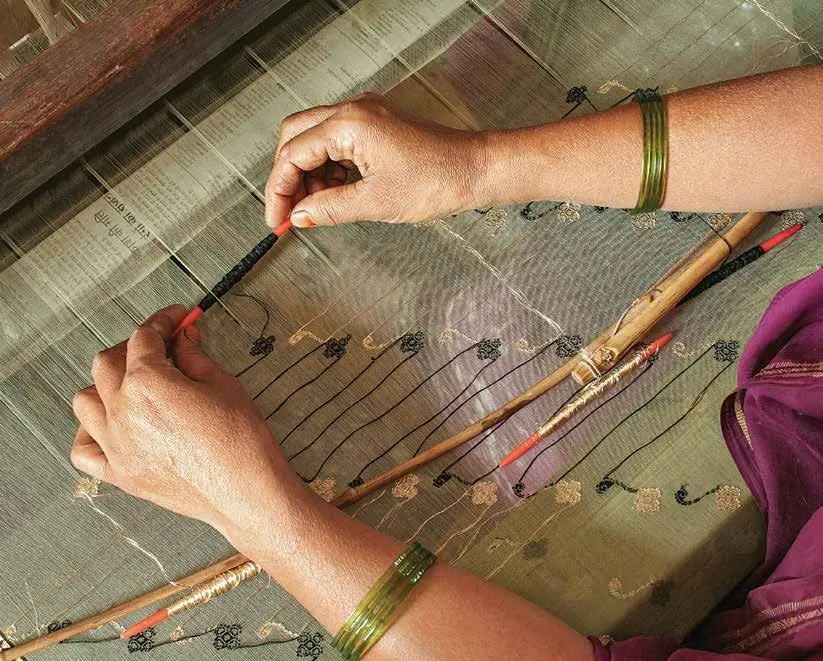
As designers and fashion houses, from boutique brands to large chains, we have the ability - and in my opinion, the responsibility - to use fashion as a tool for the empowerment of everyone along the value chain: farmers, spinners, dyers, weavers, embroiderers, pattern makers, seamstresses - the list is long.
This isn’t an easy shift: empowerment goes beyond the economics of providing fair pay and a safe working environment. Empowerment means bringing those voices into the politics of fashion - engaging them in shaping the dialogue and shifting the balance of power that now sits firmly in the laps of designers, CEOs and investors. It means addressing, also, social and cultural constraints, such as gender discrimination.
That’s not what most designers set out to do when they create a fashion label! But through ultra-transparency, open discussions and a shift in mindset towards making fashion socially and environmentally sustainable, we can turn fashion into a force for good. And as Gandhi so eloquently put it, “There is no beauty in the finest cloth if it makes hunger and unhappiness”.
Payal Singhal, Fashion Designer
Fashion is a business that is all about making people feel good. With the turbulent social and political climate we live in today, it’s really a form of expression and escapism; and thereby empowering. The Payal Singhal brand from its very launch in 1999 has had an inclusive mindset. We are built on the very premise of making something for everyone; irrespective of age, community, nationality, body type and sensibility. Customising every little detail based on our client’s disposition is of utmost importance. Because for us, it’s never about wearing Payal Singhal as we dictate it. It is about a woman wearing a garment she is confident and comfortable in.
This is one of the biggest reasons we’ve been able to build an army of loyalists called our PS Girls. It’s not a result of the hashtag culture of today, rather it’s a community of individualistic women we’ve been organically building since our initial years, during the early 2000s when I was living in New York to be precise. The women who call themselves PS Girls are so diverse, but what binds them together is their need for clothes that let their personalities shine. Which is why, though we have a very signature style, we are able to still appeal to varied tastes — be it bohemian, traditional, fusion or more urban. Take our SS20 show ‘Parvaneh’ for instance. We worked with models over 30, and showcased versatile styles within the same collection. Our real girl influencers who walked the runway also added to this diverse flavour— Mitali Sagar and Rohiny Belani are in their 30s whereas Shehnaz Treasury and Shaheen Abbas are in their 40s; and each has a very distinct personal style. Mithali Raj, the captain of the Indian women’s cricket team, was our showstopper. While she normally wears androgynous silhouettes, she told me backstage, that she just felt so much at ease in the lehenga we picked for her. She felt like herself, and that, as a designer, is the highest compliment for me.
Ridhima Bhasin, Fashion Designer
Fashion is a very powerful tool for an individual to express themselves. With fashion, one has the freedom to put them out there and project a sense of confidence in their own skin. It gives one the ability to express their creative side while honing a sense of individuality and originality. Fashion is flexible, it is an extension of one’s likes and dislikes; it is a reflection of one’s personality. A lot can be perceived about a person with the way they project and carry themselves.
Personally for me, it all about having a keen sense of aesthetic that is your own. I love bold prints and colors, fluid and structured silhouettes. I feel like mixing and matching statement pieces with your wardrobe’s basics is essential. Accessorizing can be a great way to elevate any look. One should have staple pieces in their wardrobe that can take you from day to night.
One shouldn’t get too caught up in keeping up with trends. Instead be yourself, prioritize comfort, and be bold enough to try something new from time to time. The key is to have fun with fashion and not take yourself too seriously – that in itself is the most empowering feeling.
We should feel grateful to live in a time where couture and high street brands launch collections that are gender fluid; there are plethora of options for plus sized women. Gone are the days when people were bracketed by societal norms as far as fashion is concerned. It is all about owning who you are unapologetically.
Payal Jain, Fashion Designer
Fashion is a very powerful tool for an individual to express themselves. With fashion, one has the freedom to put them out there and project a sense of confidence in their own skin. It gives one the ability to express their creative side while honing a sense of individuality and originality. Fashion is flexible, it is an extension of one’s likes and dislikes; it is a reflection of one’s personality. A lot can be perceived about a person with the way they project and carry themselves.
Personally for me, it all about having a keen sense of aesthetic that is your own. I love bold prints and colors, fluid and structured silhouettes. I feel like mixing and matching statement pieces with your wardrobe’s basics is essential. Accessorizing can be a great way to elevate any look. One should have staple pieces in their wardrobe that can take you from day to night.
One shouldn’t get too caught up in keeping up with trends. Instead be yourself, prioritize comfort, and be bold enough to try something new from time to time. The key is to have fun with fashion and not take yourself too seriously – that in itself is the most empowering feeling.
We should feel grateful to live in a time where couture and high street brands launch collections that are gender fluid; there are plethora of options for plus sized women. Gone are the days when people were bracketed by societal norms as far as fashion is concerned. It is all about owning who you are unapologetically.
Spotted a mistake, or your photo used without permission? Report a correction