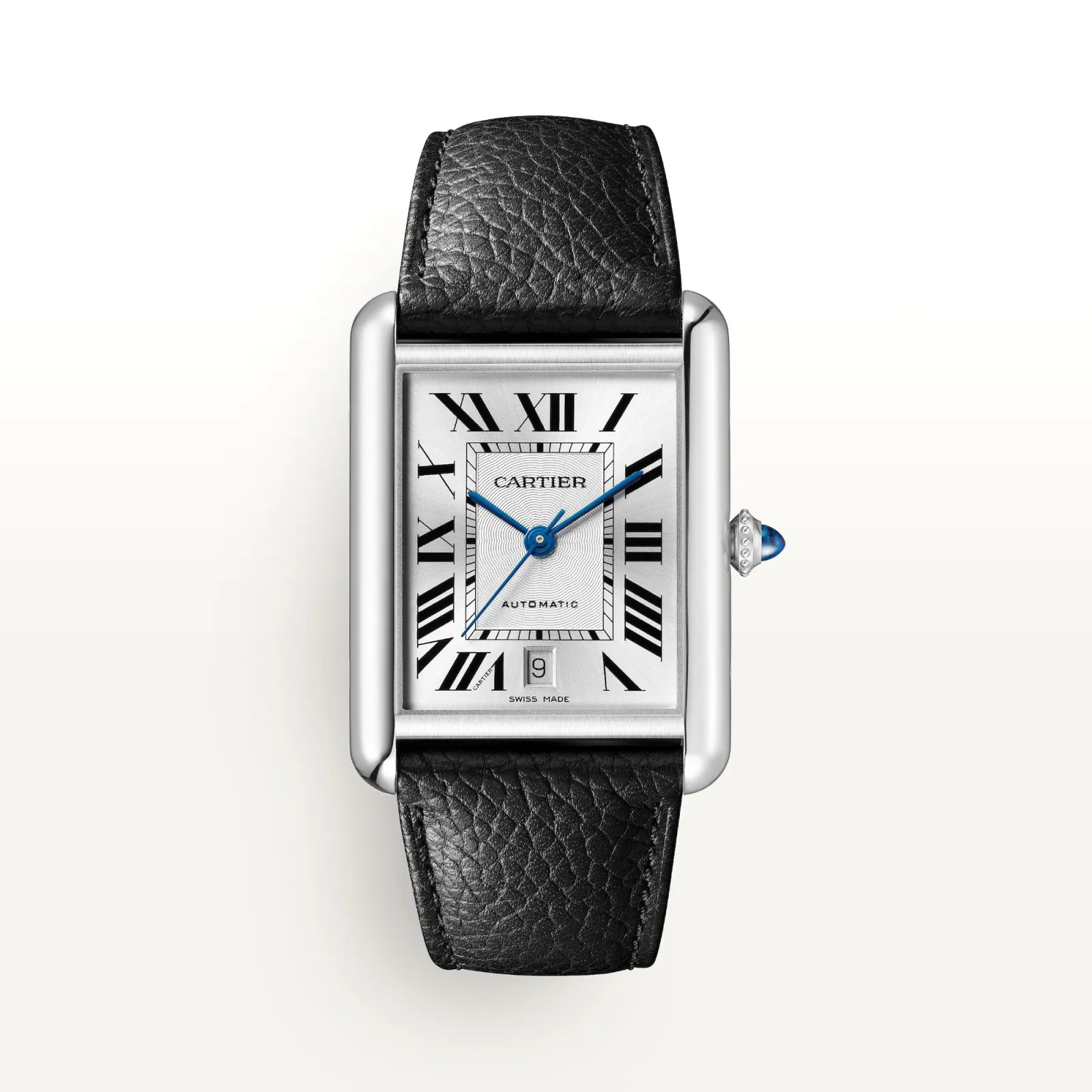
What was once considered revolutionary now feels overly cautious, with the Cartier Tank Must offering little beyond legacy, predictable design, and a luxury experience lacking depth or excitement.
The Cartier Tank Must feels less like a contemporary luxury watch and more like a design frozen in time. Decades after its silhouette first became culturally significant, the watch continues to recycle the same visual formula without introducing any real sense of progression. Instead of evolving, it simply repeats itself.
The rectangular case, Roman numerals, and stripped-back dial no longer feel distinctive—they feel predictable. What was once revolutionary now risks appearing overly safe, almost resistant to creativity. The watch relies so heavily on its historical prestige that the actual experience of wearing it often feels secondary.
Its minimalism creates an emptiness that becomes difficult to ignore over time. There is little visual depth, almost no technical intrigue, and very little emotional tension in the design. After the initial recognition factor fades, the watch offers surprisingly little to engage with on a daily level.
More dependent on nostalgia than innovation, the Tank Must struggles to feel relevant beyond its iconic name.
Mechanically, it feels underwhelming for its price category. There is no sense of innovation, complexity, or craftsmanship visibility that modern collectors increasingly expect from luxury watchmaking. The experience is functional, but emotionally flat and technically forgettable.
The proportions also feel limiting. On many wrists, the slim rectangular profile lacks presence entirely, disappearing rather than making any lasting impression. Instead of feeling refined, it can appear fragile and overly conservative, particularly in contemporary styling contexts.
Versatility is another issue. The Tank Must struggles outside highly polished, formal aesthetics. Paired with casual or modern wardrobes, it often feels disconnected and outdated rather than adaptable. The design language belongs to a very specific visual world, and outside of it, the watch loses impact quickly.
The polished surfaces scratch easily, the leather straps age inconsistently, and the overall construction demands a level of caution that becomes frustrating in regular wear. Rather than feeling effortless, ownership can feel overly delicate and restrictive.
Ultimately, the Cartier Tank Must depends almost entirely on inherited prestige. Without the weight of its name and cultural history, it becomes difficult to separate the watch itself from the mythology built around it. Beneath the legacy is a timepiece that feels static, repetitive, and emotionally distant in a luxury market that increasingly values innovation and individuality.






 L’Officiel India DigitalRead L’Officiel India in the digital libraryEvery issue and every cover story, on TCG Media.Read now