Through The Annals Of History
On 24th October 2016, designer Umang Hutheesing put preview of his new collection at Ogaan in Malcha Marg, New Delhi. But, that’s not where this story begins.




Ever heard of Lockwood de Forest? This New Yorker, from an era that Twain referred to as America’s ‘Gilded Age’ (late 19th century), made efforts to preserve certain Indian artisanal skills and indigenous motifs largely associated with wood carving. It wasn’t coincidental that this art lover, swimming against the tide of the industrial revolution, washed up on the shores of Muggunbhai Hutheesing’s court in Gujarat. The latter was the son of Kesreesing Hutheesing, who held the title of ‘Seth’, usually conferred on mill-owners and merchants. But business wasn’t the only reason why Magganbhai wanted to reach out to de Forest. Ahmedabad’s heart bled for its weavers, craftsmen and local arts that were being crushed by the machines of industry. American Art History philosopher, Roberta Mayer mentions, “Through Hutheesing, de Forest was able to have access to the services of the hereditary workmen of his family, including the mistri sub-caste within the Vaisyas (traders). The mistris were skilled wood- and stoneworkers, capable of creating designs, executing fine carvings, and overseeing constructions as both architects and engineers. De Forest first invested ₹10,000 (approximately $4,000 at that time) to purchase materials and secure the services of an accountant and several workmen. The bulk of this initial investment was for carved teakwood squares and tracery panels, paper patterns, pierced-brass panels, brass chains and wooden planks for the making of hanging seats, Malbari teak beams, panels of Valsadi teakwood, and some horse trappings, that he found quite fascinating. By September 1882, de Forest had invested approximately ₹35,020.”
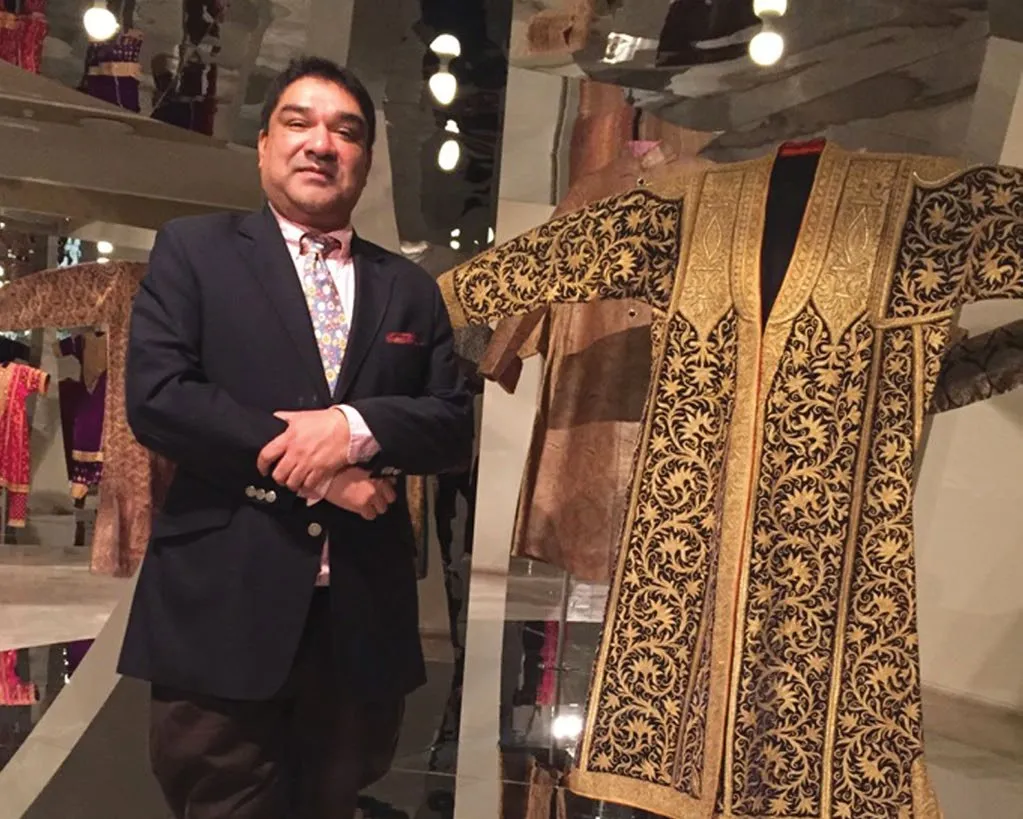
The Hutheesing Design Company (HDC) was established in 1881. Today, Umang Hutheesing manages operations. The 52-year-old doesn’t want to call himself a ‘fashion designer’ because that limits his family’s centuries-old association with craft and reduces him to a mass-market setter of trends. “Fashion is a fraction of what I do. I would like the world to understand my creations in a larger context of the global scale that I have been taking India towards,” he says. He isn’t exaggerating, the first Indian to have put an American president (Bill Clinton) in a bandhgala, Hutheesing showcased his collection at Queen Elizabeth II’s coronation festival at the Buckingham Palace in 2013. Prior to that, in 2010, he did his first show in Paris, ‘The Last Maharajas Costumes: From the Great Durbar to Independence (1911–1947)’ that showcased more than five thousand pieces: achkans, chogas, shervanis, saris, abhas in gold, silver, silk and brocade and eventually moving to khadi and white cotton. The show lasted five months and on one night there was a sit-down dinner at Versailles where Carla Bruni and Princess Chantelle, among others, sat behind an arrangement of fine silverware and a sea of crystal flutes that stilled candle flames. It is no coincidence that only after Hutheesing’s exhibit in Paris, Karl Lagerfeld presented his Paris-Mumbai collection, Hermès their saris, Canali their bandhgalas and Louis Vuitton his India collection. Over three hundred pieces of royal costume created by him, are currently being warmed by focus-bulbs at the Baroque International Museum in Mexico, National Museum of Bahrain and Miho Museum in Japan.
 L’Officiel India DigitalRead L’Officiel India in the digital libraryEvery issue and every cover story, on TCG Media.Read now
“I want to showcase Indian heritage and cultivate pride and curiosity in it. In the first month of my exhibit in Mexico, there were more than 1,60,000 visitors. What does that do to brand India?” he asks, and feels every Indian designer will benefit from such splendour.
Precisely 116 years ago, from spring to autumn, ran the World Exposition for which the Grand Palais was erected. It was here that Hutheesing’s design firm won nine gold medals. Tying up with Tiffany and Co. to do the interiors of the East Wing of the White House and Kensington Palace. Has any other design firm in Asia done that?
“People, even the richest people in the country and abroad, think my clothes are hideously expensive. When I offer to design for them, they tell me that if they buy my clothes, they won’t be able to afford the wedding,” he recounts. The truth is far from that. All one has to do is seek an appointment to visit the Hutheesing Haveli in Jesingbhai Vadi in Ahmedabad and inform the creative team about theme and budget. If a brocade sari with a marodi embroidered velvet palla is for 1.35 lakhs, a royal blue velvet lehenga with a well-rounded fall can be bought for 4.5 lakhs. Shervanis, that cost between 1.55 to 1.75 lakhs, are in velvet and silk with delicate gold thread-work and semi-precious stones. The warp, weft and wonder may invoke royalty but the clothes are as affordable and, in some cases, cheaper than other wedding season favourites, such as Sabyasachi, Anita Dongre, or even Tarun Tahiliani.
Just because the collections are placed next to swords and brooches and crowns from Mughal history, doesn’t mean they were designed only to be displayed in glass cases in museums. “People are intimidated by history in India, when actually they should be celebrating it,” explains the seasoned collector of historic goods with a recorded family history of 1,200 years.
His experience with the Indian press, he says, has been vague. He’s usually faced with questions like “Did you study design at NIFT?” “How many years have you spent designing?” “Which fashion weeks will you showcase in?” “Will you tie up with celebrities in India?” He doesn’t know how to deconstruct his unusual journey for them.
Hutheesing has been around the world 22 times, in search of experience. He worked as a chef in Mexico, worked with anthropologists of pre-colonial excavation sites in the Amazon, assisted filmmakers in Los Angeles, worked on a nature farm in Hawaii, and has been an apprentice with American painter Robert Rauschenberg. “Money can buy experiences, but it cannot buy the dedication to learn. One can snatch your wealth and power away from you but your education will never fail you,” he believes.
Hutheesing also serves as a spiritual icon for Brahma Kumaris, Osho, Dalai Lama and the BAPS Swaminarayan Sanstha. When Diana Eck and Dorothy Austin, faculty deans at Harvard, brought their students to study the sacred geography of the Kumbh Mela, it was Hutheesing who accompanied them, explaining the big and small symbolism behind the sanctioned volatility of ash-smeared nakedness. “I consider myself a cultural reformer. Each class has a role to play in Make-In-India. Doesn’t it?” says the man whose family built the Ahmedabad Civil Hospital, the largest charitable hospital in the world (4,700 beds). His family financed Shanti Niketan and started its sister concern Leila & Purushottam Hutheesing Visual Art Centre, in 1978. Umang Hutheesing is its managing trustee. “I want to save what’s brilliant in our country. Narendra Bhai Modi has been a chief guest at our cultural events and supports the efforts our foundation makes toward reviving history,” says the man who happens to be related to Nehru and Tagore.
Today, the Indian economy is a large and vibrant promise of entrepreneurship and entire empires are being erected around ideas and inventions which are being fortified by large investments. Has young money overtaken old forts and the histories crumbling away with them? If meritocracy is indeed the opposite of inheritance, then is there no evolution left to be made in inheritance? If you don't move forward, you move backward.
Spotted a mistake, or your photo used without permission? Report a correction