The Classicist
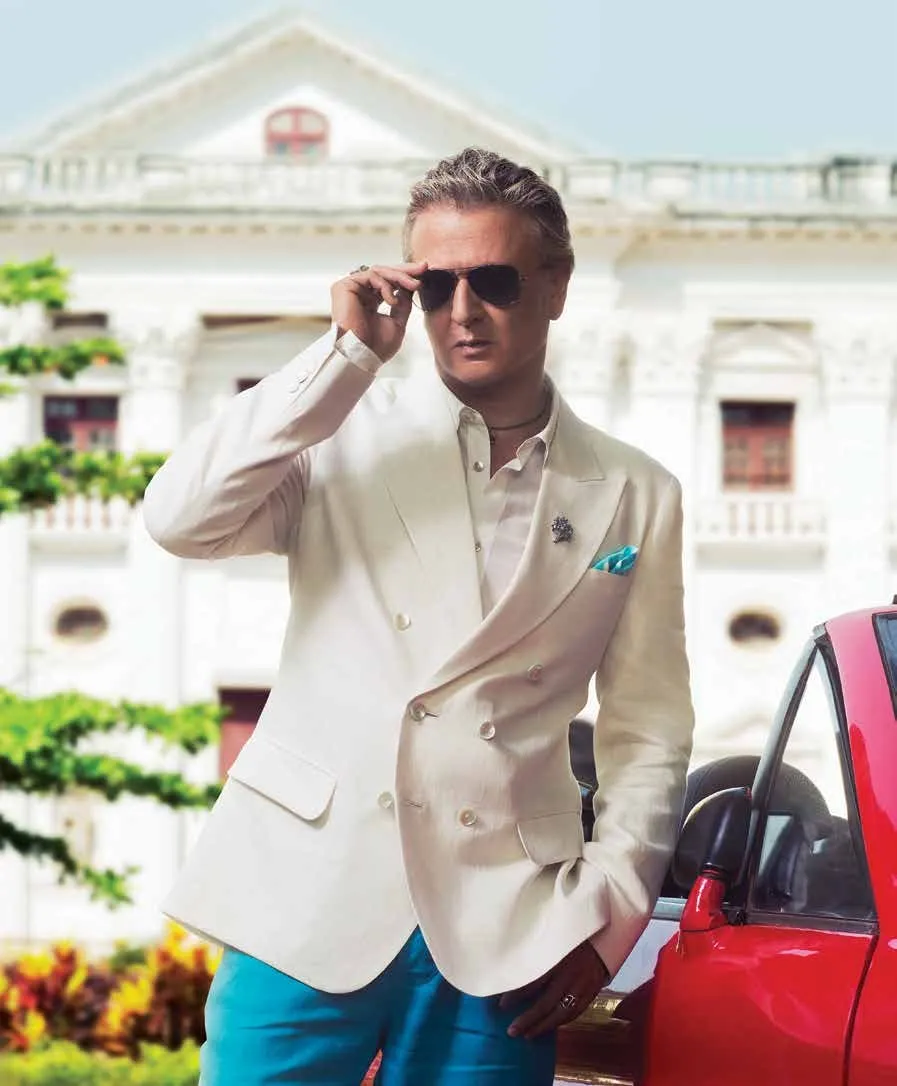
He candidly admits he is emotional, gets hurt often, is inspired by artists like Da Vinci’s pure beauty and Dali’s madness, but nobody understands the nuances of fashion, like the original and undisputed Prince of Darkness, Rohit Bal




What has been the biggest challenge as you complete 25 years in fashion?
The challenge has been to just keep competing with myself, to keep doing better than I did the last time, constant search for excellence, rediscovering and redefining what I do and who I am and also be able to reinvent everything I do, since I do classic clothing. As a designer I believe in timeless appeal. The challenge is to keep those classics and create clothes, which are actually eternal so that people can wear them over and over again.
Would you also say that being classic is somewhere putting a pause in the loop of time?
Not really, the idea is that one must keep moving forward, but you should be constantly relevant, and stay on top of your game. Being on top, for 25 years is not an easy job.
 L’Officiel India DigitalRead L’Officiel India in the digital libraryEvery issue and every cover story, on TCG Media.Read now
Authors, poems and paintings which have inspired you over the years...
There have been so many. Irene Hannon for sure, Vikram Seth also in a way, and of course, Thomas Hardy has been an inspiration for me. When I was younger I got inspired by Emily Brontë and also Gabriel Garcia Marquez to a certain extent. Now I admire Indian authors like Chetan Bhagat and Amitav Ghosh. Visually, Michelangelo without a doubt has been completely inspirational for me.
Any particular painting that struck a chord with you?
I am bowled over by the magnificence of Michelangelo’s David or the beauty of the sculpture of Pieta which are the most incredible pieces of art. I have admired Italian master Gian Lorenzo Bernini, and Michelangelo Merisi da Caravaggio as well as Rembrandt. I am a classicist, I like classic. Salvador Dali is crazy and a wonderful surrealist, I have followed the Renaissance period closely and to be honest, I am a fan of Da Vinci because of his eccentricity. Indian artists like SH Raza’s work is also inspirational much like Ram Kumar.
What do you think is your biggest weakness?
My biggest weakness is that I am disorganised, though I don’t let it become my weakness.
I think you are saying that you are unorganised because you do a lot of things?
No, that’s not the thing, I do too many things because I am unorganised.
Or is it the other way around?
No, I do too many things because I am unorganised, if I would have been organised I would not be doing too many things. So perhaps one of my weakness is also that I’m not ambitious and also my greatest weakness is beauty. I think, for me that is true weakness because I become weak in the presence of beauty. I am over emotional so I get too attached to things and people quickly and that can be hurtful many times.
What is your comment on plagiarism in the fashion industry?
I am appalled by it, I think it’s disgusting. If I had my way I would do awful things to people who plagiarise. I feel that it is something which is repugnant, it is done by people who are despicable, they are parasites, I wish I could be like a pesticide and get rid of them.
Have you ever tried to do something about plagiarism?
I have sued people, sent legal notices but they are thick-skinned rhinos who have no morals, they don’t give a damn, they were born that way and will die that way. They are shameless.
Kashmir has been a recurring motive in your repertoire despite the trouble in this valley what is it about this place that remains a motivation?
It’s a timeless beauty, an exaggerated beauty. Beauty in its natural form is never exaggerated but Kashmir is so beautiful that you feel like you are walking into an exaggerated postcard. It is ingrained in my genetic system, it is my mind, body and soul, there is nothing about Kashmir that you can extract from me and you can never extract me out of Kashmir. Everything about Kashmir is going to be a part of my life, it’s in my veins, it’s in my brain and in my heart. It’s in everything that I do. It’s deep-rooted, intense and it also gives me a lot of pain, but still for me it’s indispensable, it’s a part of my life, really!
What do designers do to provide a safe and healthy working environment to karigars?
We try to do as much as we can. Unfortunately, we are not given the proper resources by the government and to be able to do what we want to do. We don’t have the power, otherwise, we would love to air-condition our factories. There are many power cuts so our karigars have to work in oppressive conditions, we try to put coolers and provide them basic facilities which don’t exist in industrial areas like Gurgaon and Noida. Electricity is a major issue and there are so many limitations, but we try to provide as much as we can like clean drinking water, provident fund and overtime. But, the government should understand that we should have more power at a subsidised rate so that we can give karigars better working conditions.
One thing that you would change in the industry?
I would like the fashion industry to have corporate backing. Corporate backing does exist in India, but it is only for the designer’s personal growth and benefit. I would like to have equal growth for both designers and the corporate world.
One dying craft you would like to resuscitate and why?
There are many. The art of fine tie and dye is what remains a favourite. It is now not being done the way it used to be earlier in its original forms like the leheriya. I would also like to revive old Indian Mughal textiles, which are almost dying out and bring in real zari back into brocades. I would like to do a revival of handlooms like, Pochampally saris, and would like to revive textiles more than anything else along with a lot of hand-crafting techniques, hand embroideries which are facing a crisis. Beautiful zardozi has been killed by glittering crystal, block printing and tie and dye has been replaced by digital printing, exquisite Indian brocades have been killed by cheap Chinese polyester brocades. So I feel hand techniques have nose dived, I want to bring back handcrafts and preserve the labour of love.
How do you define success?
True success comes only when you feel you have done what you wanted to do and when you really feel that now I can do it for myself and not for the world. For me, success would be when you stop pandering, and do what you want and only do it for yourself. According to me, that can only happen if you have made a lot of money or you are at that stage of life when you don’t cater to the demand, but you create the demand. Making money or building empires is not success for me, I need to be able to sleep well at night and be healthy, which is success for me.
One silhouette that is loved and nurtured by Indian woman which you introduced?
There is no such silhouette. But, we introduced Jallabiyas which are long, made of crushed mulmul, with 100 metres used for an outfit. These outfits are basically layers and layers of silk which we started making in 1990 and we still make them, every season. So that is one silhouette, which is by far the most distinctly preferred one. It is something that which I invented, it didn’t exist before.
Are you keen on e-commerce and do you think it is the future of fashion?
Yes, it is already there, it is not the future. I think, it’s absolutely brilliant. We are doing a lot of e-commerce business and have tied up with a lot of companies like Jabong, Biba and Amazon. So I feel that it is the present and it is only going to become bigger and better.
What need to be done to take Indian fashion global?
Indian fashion can become global because it’s so distinct. International fashion is simple fashion, but, it is also elaborate, so it is not easy for Westerners to wear. It needs to be toned down and simplified only then it can work globally. But, it is still very limited, Indian sensibilities are different from Western ones. We like luxury, bling, gold, drama, difficult clothing and impracticality, it is everything that the West finds cumbersome and difficult. If we translate it for them then our style will get lost in transitions, and it won’t be Indian fashion anymore. If any Indian designer makes a frock or a pant-shirt then it’s not Indian fashion for me. Indian fashion is pre-dominantly for India. Never will people in the whole world start wearing kimonos, it is only for Japan. So traditional fashion only stay to your own country. In countries like America over time, their fashion sense has evolved in a very different way than ours. Our sensibilities are based on luxury whereas they are focussed on practicality. If our designers go to Paris Fashion Week or Milan Fashion Week, they won’t become Chanel, Dior or Valentino. For me, my Chanel and Dior exist in our Indian market.
With 70 pc Indians denied basic amenities should couture exist in India?
Yes, it should exist for the rest 30pc people who can afford it. Couture is anyways not meant for the rest 70pc who can’t afford it. It should exist just like all the beautiful things should. If people like the Tatas and Birlas in India, American industrialists or the elite were not spending then there would be no growth of art or architecture. I think, people who can’t afford it should be inspired by it and want to own it one day.
Spotted a mistake, or your photo used without permission? Report a correction