Simran KS Lamba: Shape-Shifter
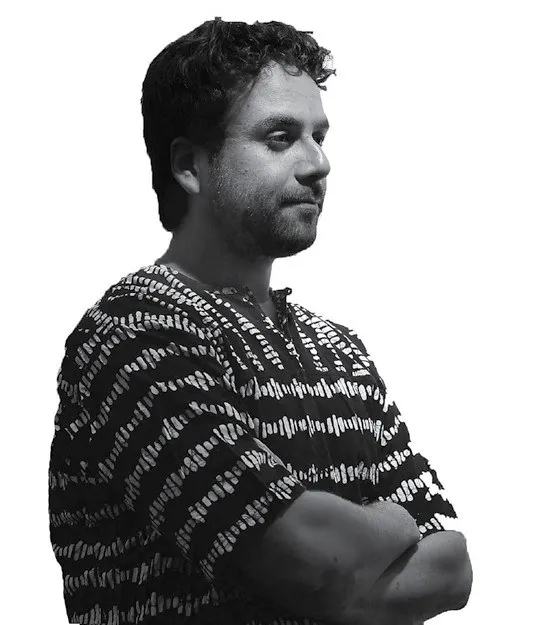


It was a pot of hot tar that sent his imagination soaring! Simran KS Lamba’s inventiveness does not just stem from the fact that he is a self-taught artist. Rather his background in film-making, theatre and his inclination towards sustainability have all contributed to the genesis of his art collection, ‘Nouveau’.
You are a self-taught artist. How do you think your work is different from your contemporaries who have a formal education in the field?
 L’Officiel India DigitalRead L’Officiel India in the digital libraryEvery issue and every cover story, on TCG Media.Read now
I would like to think that my work is constructed in a suspension of conformity, in terms of content, style, treatments and media explored. I try to express my thoughts and opinions using coal tar as a medium, which is notoriously difficult to manipulate. It involves multiple complex treatments, like temperature control, for instance.
To demonstrate the same, let me cite an example of my works-the series on divergent windows is a specimen of a unique manner of projection for exploring content, wherein I have used broad wooden frames to represent the iconic four corners of a camera’s viewfinder, and then usurped what I would conventionally see out of a windowpane with abstract and almost imaginative fluid branches (depicted through solid metal sheets) entering the frame and acting as its mainstay.
What led you to make art your profession?
Art happened by chance when I first came across this pot of boiling hot tar, which was constantly changing shape and out of curiosity, I thought that I must start exploring the medium.
How have your formative years contributed to the kind of work you are doing right now?
My background in theatre has allowed me to experiment without fear of censure. Even film-making has contributed immensely, as several pieces derive their compositional frames from this genre, so as to give the viewer the context in which varied themes are explored. ‘Moon in a Well’ depicts this thought process well.
Memories also play a significant part as I often juxtapose specific images that I recollect, with treatments and colour schemes that lend body to that transplanted image within the confines of a four-cornered canvas; this disjunction of form is apparent in the art pieces titled ‘Fragments in Genesis’ and ‘My Friends’ in Nouveau.
Are there any artists you look up to for inspiration?
Although not for inspiration but Rabindranath Tagore, Ram Kumar and Amrita Sher-Gil provide me a quiet alcove within my consciousness, wherein I take a small reprieve away from my chosen media of coal tar and discarded industrial hardware.
How do your diverse inspirations come together in entirety under ‘Nouveau’?
Nouveau is a new way of looking at tar as it represents a fresh lens through which an ordinary industrial material forces the viewer to reconsider his or her take on the intrinsic use of this medium as just an industrial agent.
What are your thoughts on art merging with fashion, globally and in the Indian context?
There are several modes through which expression in either genre can be merged cohesively within a contemporary Indian context. Looking at international fashion and art history, numerous designers like Paul Poiret and Elsa Schiaparelli to modern-day brands like Louis Vuitton and Prada amongst others, have already successfully tried to fuse art into fashion. Even The Metropolitan Museum of Art, New York, decisively placed fashion designer, Late Alexander McQueen amongst artists like Monet. In my local context, however, designers Mona and Pali (of Monapali) have already explored facets of this union through a fashion-art show hosted at Harrington Art Gallery, Kolkata, along with ArtsForward, wherein they had constructed a line of paintings on fabric and scrolls.
How do you plan to tread forward in art films?
Currently, I am scripting and developing a video art film that revolves around an octogenarian partition-ravaged freedom fighter and writer, and his immediate surroundings, which are explored through artworks being simultaneously created.
Is sustainability something you feel strongly about?
Yes, I do feel strongly about sustainability. It’s a question of collective consciousness, and we are very far away from a universal collective mode of action, owing to individual economic constraints, but I’d like to believe that we are heading towards a social consciousness that doesn’t just feed to survive but rather survives to feed albeit at a very slow pace.
From the September 2015 issue of L’Officiel India.
Spotted a mistake, or your photo used without permission? Report a correction