Shantanu & Nikhil: Backstage Entry
Sitting in the front row is passé. Taking a walk through a designer’s atelier is where the real magic lies.





I looked at my watch, for the nth time, wishing the driver would hurry up. I did not want to be late for my experience, Journey of Couture, booked through Airbnb. I was not leaving town for scenic mountains up north to stay with some monks, nor was I on my way to be hosted by a Portuguese family at their Goan beach house. I was headed to designers Shantanu & Nikhil’s atelier in Noida.
Shifting impatiently at the back seat, I did the math. Every year, for more than half a dozen times, we, fashion journalists, find ourselves keenly observing silhouettes, the flow of a gown and surface texturing at fashion shows. The rush ends much before we can spell adrenaline. The review is duly filed and printed, before we move on to another show, another venue, another season. While we have an inkling of what’s behind the scene — thanks to numerous heart-to-heart conversations with designers — it is rare for us to make it to the sketching table. Journey of Couture intrigued us as it promised to take us to the other side of the catwalk.
 L’Officiel India DigitalRead L’Officiel India in the digital libraryEvery issue and every cover story, on TCG Media.Read now
And guess what, it is not the only experience that Airbnb, the online marketplace for people to list and book unique accommodations, has on offer for India. Under its Experiences programme, there is Coffee Culture hosted by Krittivas, jazz songwriting and music production, a tour of Museo Camera, and sari draping with Rta Kapur Chishti to choose from. At the launch of Experiences in March 2017, Shantanu & Nikhil dressed Airbnb co-founder and CEO Brian Chesky who walked the ramp too. Airbnb’s first customer happened to be an Indian. A decade later, it seems to have come full circle for the company.
My 10-minute delay was politely brushed aside as designers Shantanu and Nikhil Mehra exchanged pleasantries. As they briefly told us about the experience — the number of hours, more importantly the number of floors involved — we asked if it was an unnerving thought to let people walk in here and see their designs, something that would be otherwise guarded with life. “It’s time people witness what it takes to create a garment, and be a part of its journey from thread to a finished piece,” Nikhil answered. Experience over secrecy is what it is for them.
Our first stop was designers’ sketching corner, where young apprentices scuttled about. A level above, the workroom buzzed with activity. On one side, two young men sat quietly tracing designs onto fabrics, even as Shantanu told us about their insatiable hunger to learn. We were ushered into atelier tailleur, where rows of tailors stitched different patterns over fabrics with foot-controlled sewing machines. It was time for us to try a hand at it. At the end of a brief brush with stitching, we were declared fit for the job. Now whether that was said because our hosts were being hospitable or not, we will never know for sure!
In the next hour, we were to see garments taking their final form. Rows of specialists were busy marking and pinning mannequins with an almost heron-like focus. No one took notice of us, as we lurked about observing them. “We do a lot of customisation, hence the mannequins and pins,” Nikhil said. Mostly, a garment undergoes trials using inexpensive calico to imagine the fall, cut and volume. This gives them some room for experimentation before cutting into the final fabric.
Speaking of which, we too, were made to cut the fabric. Contrary to what we had thought, it was one of the most precision-demanding stages of dressmaking. “There is a way how the scissor should move, slicing the fabric in a precise way, leaving no room for error,” Nikhil explained. We failed miserably at it.
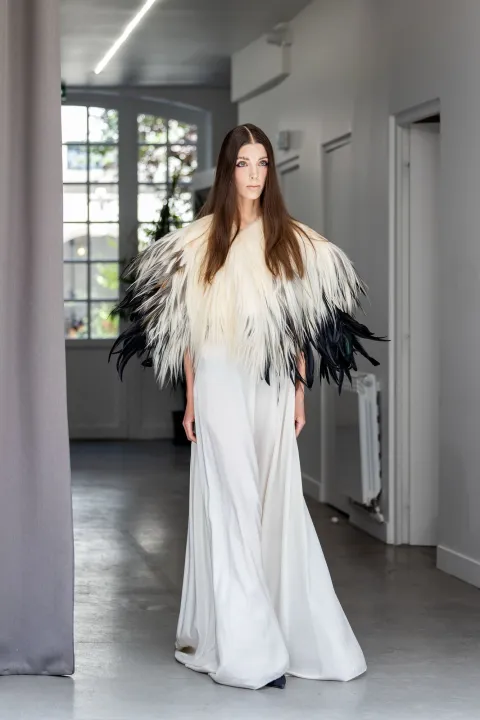
Over the last 17 years, the brothers have transmogrified silhouettes. Masculine staples such as military uniform inspired jackets have been turned into splendid womenswear, and men’s kurta have received an update with elaborate drapes, earlier restricted to womenswear. “We do not put people into boxes based on their gender or sexual preferences. Design needs to be fluid, transformational,” Nikhil said as he took us to the quietest section of the atelier.
Master embroiderers clad in navy shirts with kaarigar printed at the back sat cross-legged on the floor. “It is almost a meditative state for them,” Nikhil whispered. Embroiderers created patterns and designs over fabrics, (sometimes leather, the designers’ favourite), stretched over a wooden frame using gold and silver threads, silk yarns and beads.
The atmosphere in the next room, which was to be our final stop before everyone was to break for lunch, was a stark contrast. Women kaarigars were huddled together, giggling as we entered. They were also better at the drill than their male counterparts. They quickly passed the pieces of fabric to us, explaining how the tip of a scissor was to be used to snip off extra leather to make intricate patterns visible.
The tour ended with a quick peek into their shoemaking space on the top floor. “We use silk to make our insoles. Men need a slice of luxury at their feet,” Nikhil said, as we tried our hands at shoemaking too.
At the end of three hours, we stood next to an inspiration cart that works like a moodboard for them, as Shantanu spoke to us about the business of fashion, and how this exercise would not only help them educate people, but also get into the heads of consumers. For us, it was surreal to see almost 300 people come together to create one dress.
Journey of Couture can be booked on airbnb.co.in/experiences.
From the January 2018 issue of L’Officiel India.
Spotted a mistake, or your photo used without permission? Report a correction