Pietro Beccari: Fountain of Hope
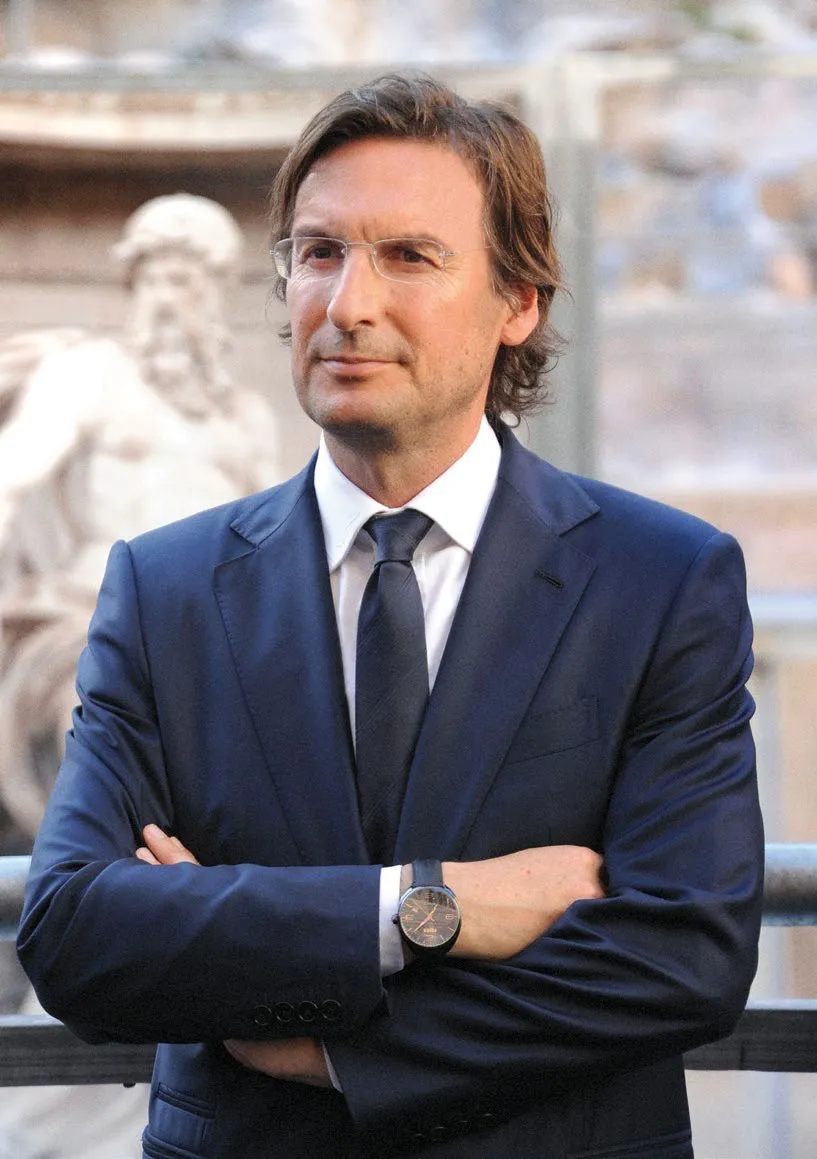




Pietro Beccari, Chairman and CEO of Fendi talks about the brand’s new headquarters Palazzo della Civiltà Italiana, decorated with 28 statues on its four facades, each representing the arts and crafts of the Italian population. He also reveals the sparkling new suites which embody the spirit of Rome, as Fendi continues to work towards preserving its robust heritage.
How has Fendi been a frontrunner in preserving the heritage of the country?
 L’Officiel India DigitalRead L’Officiel India in the digital libraryEvery issue and every cover story, on TCG Media.Read now
Fendi has a deep historical bond with Rome, the city where the brand was founded, 90 years ago and that has always inspired and culturally stimulated the maison. The funding of the restoration of the Trevi Fountain in Rome was a very important moment in Fendi’s history. It gave way to a vast project of the preservation of Roman heritage as this act of philanthropy not only concerned the Trevi Fountain, but also the complex of Quattro Fontane and the consequent Glory of Water project. We are very proud to have brought this complex to its original splendour and magnificence.
What are the future projects that you are looking to support?
The Fendi For Fountains project will continue in 2016, in support of four other fountains of Rome—Gianicolo, Mosè, Peschiera and Ninfeo del Pincio.
Prada has also launched the Fondazione Prada. Would Fendi ever think of doing something like this, in the future?
Fendi has continuously supported the preservation and transmission of savoirfaire, education and young talents and preservation of cultural heritage. On the occasion of the inauguration of Palazzo della Civiltà Italiana as Fendi’s new headquarters, we hosted the exhibition titled ‘‘Una Nuova Roma’’. L’Eur e il Palazzo della Civiltà Italiana, a first in public-private cooperation, on the first floor of the Palazzo della Civiltà Italiana, the area which, since the beginning, Fendi decided to devote to exhibitions. After more than 70 years from its creation, Palazzo della Civiltà Italiana’s first floor finally became open to the public through an exhibition that told its story, since its architectural project, to today.
What do you think Fendi has contributed in terms of design, which pays homage to Italian history and art?
Fendi and the world of design share common values: excellence, boundless creativity, mastery of materials, savoir-faire and a real passion for craftsmanship. We have been partnering with Design Miami since 2008, and last December, Fendi paid homage to Guglielmo Ulrich and his innovative work, by re-editing unique design pieces conceived by the Italian designer in the 30s for the EUR (Esposizione Universale Roma) buildings in Rome, of which two will be re-edited by Fendi Casa. He was among the countless designers, artists and intellectuals called upon in the 1930s to give shape to this new area and he designed furniture in perfect harmony with the suspended monumentality of the architecture. The Second World War prevented the fair from ever taking place and ensured that his designs and most of the construction works would stay on paper for a long time.
Can you tell us about the new Fendi apartment designed by Emiliano Salci and Britt Moran (Palazzo Fendi)?
DimoreStudio transformed the second floor of Palazzo Fendi into a refined environment, a luxurious private and exclusive space to welcome and host Fendi’s top clients, celebrities and friends of the House. The Palazzo Privé features a curated mix of hi-design vintage furniture, collectible contemporary design and art pieces, as well as a selection of new designs that Emiliano Salci and Britt Moran conceived for the Roman Lounge, a project commissioned by Fendi for Design Miami, in 2014.
Rome’s iconic Palazzo della Civiltà Italianà is the new home of fashion superbrand Fendi. It was the centre for Mussolini’s empire which you were also criticised for.
The Palazzo della Civiltà Italiana, also called the Palazzo della Civiltà del Lavoro (Building to the Civilization of Work), is a monumental building located in the EUR area in Rome. It was built at the end of the ’30s from a project by the architects Giovanni Guerrini, Ernesto Bruno La Padula and Mario Romano. This building is decorated with 28 statues on its four facades, each representing the arts and crafts of the Italian population. It is the sharing of such values that brought Fendi to choose the Palazzo della Civiltà Italiana as its future headquarters, to give life back to a monument through the creation of a public space; a homage to creativity.
How did you come up with the idea of Fendi suites?
The hotel embodies the spirit of Rome; it is a Roman stay à la Fendi. You will find various elements in the hotel that recall our codes— geometry, dualism, colour blocking and, of course, the use of materials and craftsmanship, especially with fur, as in the fur tablets displayed in each room.
You have said that you keep tradition alive, yet are contemporary. How do you effectively mix the two?
One of Fendi’s values is dualism. It’s having an eye on the past but always projected towards the future. Heritage is of course, fundamental for us. It represents where we come from, our DNA, yet we are constantly innovating and building on our roots.
From the June 2016 issue of L’Officiel India.
Spotted a mistake, or your photo used without permission? Report a correction