(Photos)
1. Magnificence of the Royal Isfahan Mosque.




Iran opens its doors to quench the thirst of Western curiosity with its multi-faceted culture.
Text and photographs by: Jean-François Guggenheim
 L’Officiel India DigitalRead L’Officiel India in the digital libraryEvery issue and every cover story, on TCG Media.Read now
Between a sandy desert, irrigated gardens, multi-coloured palaces and rose flavoured ice cream, journey into original Persia, the cradle of Godianism, land of mystical poetry and ancient architecture.
Isfahan.
Do you like Iran?
How many times have they asked me that question since this morning, imprinting as much curiosity as sincerity?
- Yes, Iran is fascinating.
- And the Iranians?
- Just as much! Warm and… so welcoming.
- We wanted to invite you to come have some ice cream with us. Would that be okay?
They are four, five even, now that I can see the youngest, who jumps in the middle of the group, to have so kindly invited me. Young girls, students without a doubt, all smiles, under their headscarves printed with flowers, birds or horsemen.
- Come! It’s this way, right next door.
And to find myself prettily surrounded, the air filled with laughter, a myriad of questions: Who are you? Where do you come from? What is your name? Are you married? What do you do for a living? Its rose flavoured ice cream. Do you think of love? All of them with an odd bit of sticking plaster on the tips of their noses. In Tehran, a few days before, I had noticed, when the border forces were passing through, the faces of a few customs officers done up the same way. They have their noses redone, is what I was told. To resemble the leading ladies of television. On exiting the airport one finds giant posters of religious heads, they aren’t as gentile. Beards of sorcerers, crooked profiles and dark eyes. Perfect for children’s fairy tales. Of a theocracy, unconcerned with detours. Tehran, despite its greyness, traffic and pollution, represents accurately, the Iran of today: with one eye looking towards the West and the other firmly rooted in a religious and conservative past. Quite an ocular gap.
Now to Tehran, where prohibitions are cleverly circumvented all day long. This new Iran was of concern to the one that we kept talking about, since the advent of ‘the moderate’ Hassan Rohani, when the country started to open up. The sky cleared and I find myself headed to La Maison des Artiste. A young woman is seated in the shade of a tree decorated with little pieces of fabric, those tied for a prayer, reading a book. The house has just opened and I stroll through the photo exhibit: images covering the Islamic revolution, the Iraq-Iran war, in colour and black and white, the terror, the death and the blood. I discover these Iranian photographers, their reckless, audacious photographs. I leave overwhelmed. The young woman in the shade notices me.
- Do you like Iran?
I admit to her that I had only just arrived in search of the artistic currents of Tehran.
- My name is Shéhérazade. I am a guide, a storyteller and a writer in my free time. Come. There are so many things to be seen.
She was dark haired and beautiful, a whiff of a fruity fragrance. By her side, I discover the most recent painters at the Saless Gallery, the name of the oldest publishing house of the country, contemporary creations at the W01 Gallery then at the Aum Gallery. These new born places seem to have grown with the coming of spring.
- There are several discreet galleries here. The many art students need spaces where they can express themselves. And then there are the expats, artists who live in Paris, London or New York, whose work and expression we would like to show. We brew a tea at the Gramophone, a hip bar where students mingle and flirt with one other, with the improbability of any boyfriends being declared. Time flies by. The sun sets over Tehran, Shéhérazade sips an orangeade. I thank her for this day. She does as well. I insist, I feel indebted. No, she says she is indebted. Then Shéhérazade explains the meaning of Taarof to me, this Persian etiquette, the foundation of the rules of Iranian hospitality, social behaviours in general, when the host is to offer, to his guest, all that is in his possession. Which the guest has every right to refuse and the other… well, to insist. A tireless discussion where everyone expresses their generosity as much as their devotion. So, we get on with it and exchange emails, I take a picture of her. The next day I returned to Kashan, 250 kilometres from where I was, in the south, south west. The desert road took me to a scene from a movie from the ’50s, a snippet of Taxi to Tobruk, a thriller on the Wages of Fear. The lorries around me transport all sorts of food products, petrol, chairs, carbon and sheep. We brush past the city of Qom, its 7000 year old ruins, the most important theological centre of Godianism in the world today where the mullah’s train, from everywhere to Kashan, the unavoidable oasis on the silk and Isfahan route. The ancient odyssey leaves me speechless. The gigantic skylights, the kilometres long bazaar, leading to the mosques and the public baths, mysterious arcades unexpected tearooms. Finally, I was in Iran, I felt as if I was in a child’s dream.
Return to Isfahan. This rose ice cream is soft and subtly flavoured. The students have finally scattered, after a multitude of questions: life in Paris, sorbets at Berthillon’s, not without them telling me that in Iran they have the sigheh, with the possibility of being married for only a few hours. An oral contract, which, it would seem, should preferably be validated by a mullah. I explain to them what it’s like to be engaged at my end and they swoon and ‘fly away’, half in earnest and half in jest, nonetheless happy, like a handful of canaries. I felt them dreaming of a life possible elsewhere, a visa for a foreign land.
The domes of the Royal square, a tremendous esplanade in the heart of Isfahan, shimmering in the strong and direct midday sun. Isfahan, nicknamed “the half of the world”, is a concentration of the fantasies of the Orient. Resplendent palaces and mosques of yellow gold faience and blue peacock, the yellow acacias and the blue pansies in these gardens, irrigated by streams and fountains, over this square, larger than the Place de la Concorde, just as Shah Abbas wanted it. One would want to travel across the world just to see the Sheikh Lotfollah Mosque. The gigantic domes of turquoise and enamel, arcades of lapis-lazuli. Abbas the first was a man who left nothing out.
In 1588, he demanded that his father leave him the power and doesn’t hesitate in assassinating his two brothers, constructing the foundation of modern Iran, supporting commerce and the arts, gets closer to the Europeans, establishes Isfahan as his capital. More than 16,000 monuments are built during this golden century of Persia. I climb up to the top of the Ali Qapu Palace to discover the music room, a skilfully built and graceful alcove, designed to master the echo, the lane towards the 40 Column Palace is reflected in its basin, I rejoice before these scenes unable to hide what I feel, where the wine and the dancers of the court of the 17th century intermingled in ancient bacchanal. Then I am, by mistake, lost in the souk, as if guided by the singing of nightingales, locked up in their little gilded cages in the front of shops. In search of a tea room, I enquire thus from a cloth merchant, who then offers me his own infusion, black and sweet.
- Do you like Iran? I am an Afghani, there are a few of us in this bazaar. You will find people of all nationalities in Isfahan. But if you would like to be entertained, then go to the Armenian quarter, you will enjoy it. They drink wine, but no, I must not speak of it. I make a mental note of this, I thank him, I am thanked, salam aleykoum, aleykoum salam, then I make my way to the Khadju bridge, built across the Zayadeh-Rud river. Under its arches, little groups of people, women, men, children, talking and laughing. The elders start with enchanting songs, which talk of the disillusionment of love, the changing of seasons, chanting Saadi’s poems: “If a person is nothing more than an eye, mouth, ear and nose then how is mankind different from a painting on a wall.”. A song finishes in the middle of an applause, then begins again, further away, a few arches down.
Vocal harmony, Persian polyphony, cadenced by the flow of the water. The sun drowns itself below the flow, it is beautiful without compare. “The intoxication of youth is much stronger than the intoxication of wine”, a Persian philosopher. And in truth, of that wine promised to me I find no shortage of, in this Armenian quarter. Youth, I see, sometimes brush past the tips of my fingers, the boys with hipster hair, checked jeans and shirt, wooing all the pretty girls who let themselves be courted, not without flirtatiousness, incomparable to the taste of the forbidden fruit. Rules a slight air of bohemia, the carefreeness and the gaiety. At vesper, the fifteen churches in the quarter assume their office. The trendy restaurants where they have their singing exercises accompanied by a flute and a tambourine, pay homage to the great, mystical poets of old, welcoming the tourists and residents, western businessmen accompanied by locals, future business partners if they’d like. Then, this morning, leaving Isfahan, and again a new desert, its extreme temperatures, its brutal light drying out the high plateaus on which we drive, amidst many lorries. The air oscillates, ready for all sorts of mirages. However, where we stop, there is a little cabin filled with samovars where we decide to drink a tea. The enormous speakers are chanting music, which I can only imagine, must be a war hymn. Curious contrast with the charming smile of our host. Further away is Yazd, the city of dried mud, with a mineral cover over the buildings, allowing them to be resistant to temperatures as high as 45 °C. It must have required an ancient genius engineer to bring water here, through underground canals running for tens of kilometres, from the neighbouring mountains as high as 4000 metres. The brilliance of the architects, to have constructed these wind catchers, sometimes as high as 30 metres, that catch the gentlest breeze. In Yazd and in this region the Zoroastrians live peacefully, practicing their ancient, monotheistic religion of Iran from which Nietzsche took immense inspiration. In the Cham desert are the Towers of Silence where the dead were delivered, in good faith, to the vultures, entrusted with taking the souls to heaven.
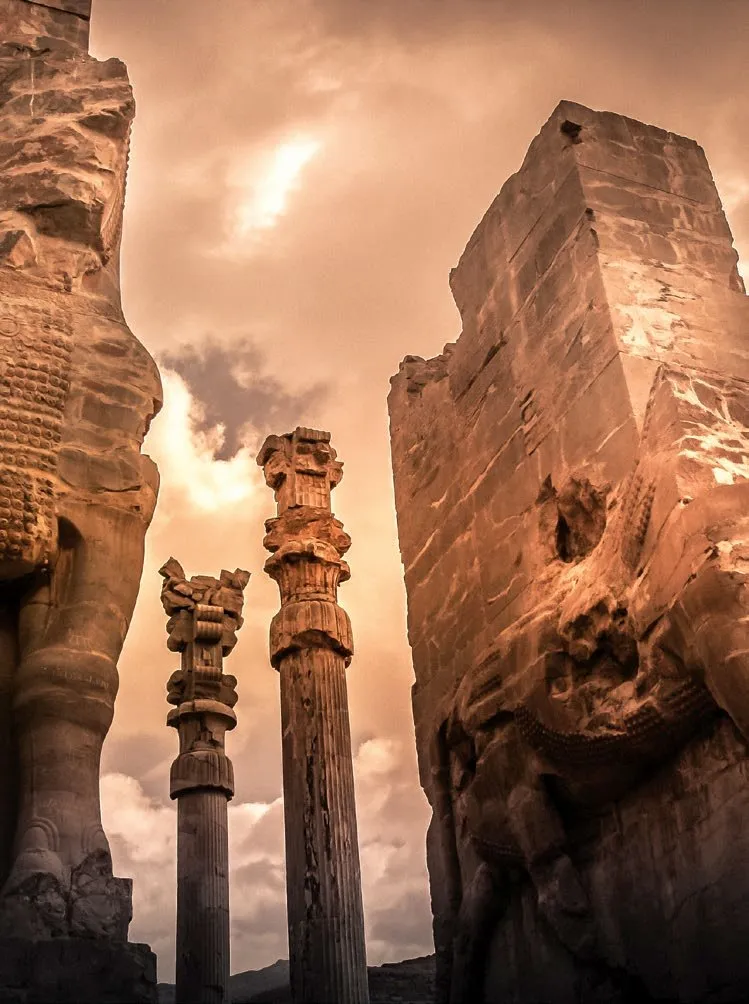
Here they cultivate saffron and pomegranates, we savour a soft local nougat named Gaz. Three hundred kilometres on the road, in the middle of the mountains and Shiraz appears. Dedicated to wine (The syrah/shiraz grape grows well in these parts and they grow it still, in spite of everything.) and to love, its curves and bends praised by its poets, the happy Shiraz was not permitted to exist following the days after the Islamic revolution. But times have changed in Iran. Everywhere one can now taste the joy of the city of the South. It’s a lot freer here it seems, for women, on customs, for happiness. Hafez and Saadi are among the poets who belong to Shiraz. Do they not praise intoxication and love as paths to a superior truth, a world of thought? Does the south of Iran then bring up people who are out of their minds? One hour from here is Persepolis, a place that everyone from the world comes to visit. An extraordinary bas-relief terrace, griffons and columns placed on the mountains itself. This is where the Shah dazzled and shocked the world with the splendour of Iran. This is where Alexander the Great came to live in excess, to consume and devour the flavours of the East, before burning down the city. It seems that in Iran, time and events weave themselves very differently from other places. The traveller perceives more of this world than he can understand.
Travel Book
To get here: Asia proposes a 12 night/14 day individual trip leaving from Paris. Driving through the historical sites of Persia: Tehran, Kashan, Yazd, Isfahan, Shiraz and Persepolis with a guide, stays in 4 and 5 star hotels and a flight back to Paris with Turkish Airlines. Starting at 4,466 € Telephone. +33 1 44 41 50 10. www.asia.fr
Flights: Turkish Airlines fly to Tehran 5 times a day via Istanbul, departures from Paris, Lyon, Nice, Marseille, Bordeaux and Toulouse. Daily connections to Isfahan and Shiraz. Flights from Paris CDG to Tehran, economy class, starting at 359 €. www.thy.com
To see: Known the world over as ‘The’ photographer of Isfahan, Isabelle Eshragi exhibits “Isfahan, the spirit of Iran” at the Espace Asia Paris from the 1st of December, 2016 to the 20th of May, 2017. A must see: Espace Asia Paris: 1, rue Dante, Paris 5e.
Spotted a mistake, or your photo used without permission? Report a correction