Muzaffar Ali: Sufi Ciphers





‘The ugly politics of Kashmir’ trapped his ambitious project Zooni, but Muzaffar Ali, of Umrao Jaan fame has seen several upheavals. Here, he reveals his journey working with Air India and studying the art of cinema with the maverick Satyajit Ray. These experiences, add poetry to his label, Kotwara, with his architect wife Meera, as he embarks on another film, Jaanisaar, with danseuse Pernia Qureshi.
You belong to Lucknow, which is known for its craft, cuisine and delicacy, how did that effect your growing up?
 L’Officiel India DigitalRead L’Officiel India in the digital libraryEvery issue and every cover story, on TCG Media.Read now
Every memory has an element of craft, cuisine and couture. The changing seasons, festivals and particularly Muharram, Holi, Diwali and Eid. Mohurrum bring a sombre commemoration had black couture. The rich embroideries were used for patkas that adorned the alams (battle standards) in the Imambaras. A horse, signifying the steed of Imam Husain, was decorated with elaborate horse gear in brass and silver. In contrast, Holi memories are not only full of colours, but music and poetry of the region, which abounds in folk songs and also the poetry of Sufi mystics. Often I used this music, with Kathak in my festivals such as Jahan-e- Khusrau and in dance ballets in the Wajid Ali Shah festival. I prefer to celebrate this festival in Kotwara, which has always had, a more laidback feel of being one with nature.
You are from the royal family of Kotwara, and your mother belonged to the royal family of Sheikhupur, who’s influence was more in your life and why?
I am very fortunate that my lineage both from my father and my mother’s side has been a confluence of cultures. Both have had a strong spiritual descent.
So much so that it is difficult to wean one from the other. The Kotwara side itself is a blend of Syeds, descended from the holy Prophet Mohammad, coming down from the Sharqi Kings, who ruled North India from Jaunpur and the Chaura Rajputs, who claim they are descendents of Lord Ram, and ruled from Gujarat (at one time stretching from Cambay to China). My maternal grandmother descended from Ibrahim Adham, who ruled Balkh, they gave up everything and turned a Sufi mystic. The family migrated to India, and they were both rulers and mystics. The two have always balanced the other, sometimes in one person. Sheikhupur was a region in Badayun given to the family, which descended from Hazrat Skeikh Salim Chishti of Fathehpur Sikri by Emperor Akbar. Her father descended from Hazrat Umar and later Baba Farid Ganjshakar, a Sufi whose poetry occupies a place of pride in the Guru Granth Sahib.
My mother’s great grandfather was the Nawab of Moradabad and a freedom fighter. He was burnt alive in 1857 by the British in a lime kiln and his melted body dragged around in the city tied to the elephant feet! All these factors have been in my psyche and somehow keep recurring in my creative and mystic being.
How do you feel Chikankari is perceived today? Did you change the fabrics, add blends and make the silhouette contemporary?
Contemporary is a strange subjective notion becomes fashionable if creatively presented.
Any creativity that happens today has to be contemporary, unless it is theatrical.
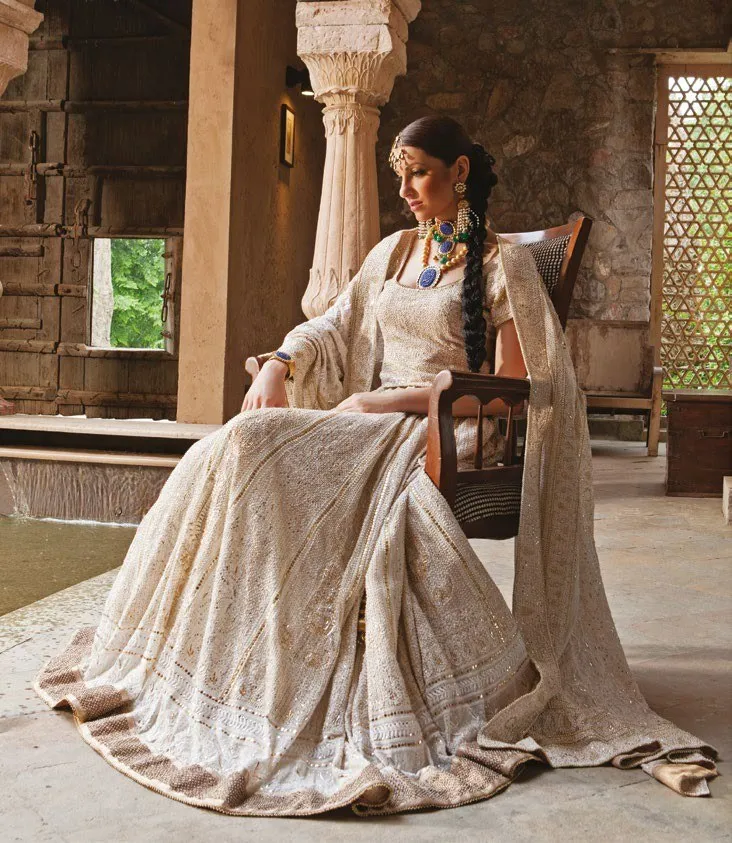
Chikan can be ugly and over-the-top or exquisite and refined. Chikankari has to be subtle and sensitive, detailed and delicate.
It is has to be poetic, a dialogue with the unseen. Therefore I see it as a continuous process of reinvention. I work in an oldworld Lucknowi ambience, like Kotwara House, Lucknow or Anhalwara Palace, Kotwara itself, I can’t see this happening in London, New York or even Delhi. I believe in the purity of the medium.And in using development. That was the beginning of chikan and we haven’t looked back.
When did Kotwara, the label, take shape? What motivated you to revive, restore and resuscitate chikankari?
Kotwara as a name is ancient. As a label it is 25 years old. Working along with world famous fashion designer Mary McFadden, while making Zooni in Kashmir I got very involved in the design and couture aspects of craftsmanship. She happened to visit Kotwara and the moment she set foot on its soil she exclaimed, ‘this could be a haven for craft’. Though Zooni was halted, my wife Meera and I embarked on Kotwara as a label, with a vision to provide employment at their doorstep, a concept which we call Dwar pe Rozi. We also run a school for skill
You have given Indian cinema, a memorable film Umrao Jaan, now there is Jaanisaar, with Pernia...what made you choose her?
I chose Pernia for her commitment, unconventional looks and dancer’s body language. Only the film will uphold my choice.
Can you tell us a bit about the film and costumes as it is a period drama? And the hero Imran Abbas Naqvi?
Imran plays the role of an Anglicised aristocrat, who gets transformed to becoming a champion of the Indian cause. Set in 1870s Awadh, the film is a visual evidence of two conflicting cultures, the Victorian and Awadhi, the latter being subjugated by the former, coming to co-exist. Certainly an exciting exercise for my design team, and myself, as also a landmark in film styling. Fortunately traces of this transition are in existence and part of my direct experience.
You shot at Kishanpur forest near Lucknow, home to tigers. How was that experience?
We shot in many game reserves near Lucknow and near Kotwara. Kishenpur happens to be 30 kms near Kotwara and is an exquisite forest and is part of the Dudhwa National Park with nearly 100 tigers. The draw of the forest is irresistible and the sense of space, peace and sound is captivating.
organic fabrics for such an intense craft. Within these parameters and such inspiration, we create the classic Kotwara kurtas and daglas for both men and women. I can confidently predict, they will forever be contemporary.
How do you divide roles? What does Meera handle and what are the challenges you have faced in these years, since the inception of the label?
Meera and I do similar things. She, however, goes beyond my contribution to understand every nitty-gritty of human resource, production and marketing. However, I too try to add value to each of these activities.
What do you think needs to be done to make Indian fashion global? With e-commerce being a big wave, will you be looking at it in the near future?
Of course, we need to go global, just to give a widespread existence to this craft. Our daughter Sama, who studied at the London College of Fashion, with her very charged young team is doing just that. Already, one can feel the difference.
The Jahan-e-Khusrau festival shows that you remain soaked in artistic pursuits...what remains the driving factor?
The Jahan-e-Khusrau festival, for me, is a miracle, and a blessing for the city where it happens. It blesses the audience in unusual ways and becomes a jewel in their memory bank. Such is the power of the mystic verse and music and melody that emerge from it. Miracles transcend rules and barriers and have their own ethics and form of poetic justice.
Beyond this, I have no words. Maybe these are too many! Anyhow, I have shot the festival over 13 years with three cameras and that is enough testimony to this jewel.
You did your BSc from Aligarh University, worked with an ad firm chaired by Satyajit Ray, and then Air India. How did these multiple experiences impact your life?
Aligarh has been the most civilising experience which went way beyond the curriculum of Geology, Botany and Chemistry. It’s deeply perceptive psyche creates thinkers and poets. Why? I can’t explain. But certainly I am beholden to the thinking, feeling poets of my time that made me what I am. A subject of study in itself. I recently went to Aligarh to deliver a memorial lecture on ‘Language of moving images in the 21st century’, which was a stimulating experience. Something that may not have happened in my time.
Working with Ray took my perception of poetry of my soil and culture to another level through its possibilities in the language of moving images. In Air India I was fortunate to have been hired by the legendary Bobby Kooka, the commercial head of the airline and the creator of the Air India Maharajah, as No. 2 in the publicity department. My mind cracked open working with a cracking mind like his! Though only on the design and advertising side. I had to think global, I had to think out-of-the-box. Another subject to be explored! And it was here that I felt the need to make my first feature film Gaman, on migration from villages to urban centres.
Would you like your daughter Sama to get into fashion?
Sama chose fashion as her calling and she will soon find herself in this extremely dynamic field.
How did you deal with Zooni not seeing the light of day?
What a question! A subject of a book again! Sometimes such simple question asked outside of yourself can create a huge stir. Only I know how I am living with this incomplete dream.
But I am a subtle fighter, and this is giving me an indescribable power to dream on. In being able to fearlessly put a camera in a vast open space is a great feeling of ease. I can only do that in U.P. Unfortunately, the ugly politics of Kashmir has ruined what is otherwise a piece of paradise.
What is the one quality that you most admire in Meera?
She is compassionate and creative, despite the difficult responsibilities she shoulders.
From the June 2015 issue of L’Officiel India.
Spotted a mistake, or your photo used without permission? Report a correction