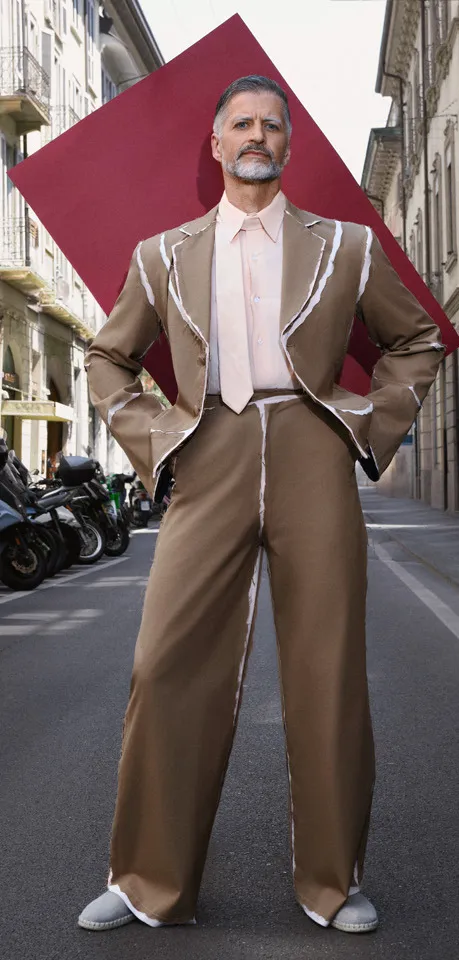
Marc Jacobs - A Rendez Vous
He has never appeared more liberated and his recent collection in New York was very well-received by critics. We spend some time with the rebellious American designer who just celebrated his 53rd birthday.




Photography TUNG WALSH
I meet Marc Jacobs in his suite at the Claridge’s in London. He gets up to greet me and extends his hand. Without looking me in the eye, he promptly asks, “We’ve met before, haven’t we?” I respond, “In fact, we’ve had lunch in Saint Barth, five years ago.” “No, I don’t think that’s it. I would surely remember,” he says. Given that he is one of the world’s most sought-after designers, it doesn’t surprise me that he would not remember me. In fact, he must meet more people in one week than I would meet in a lifetime.
 L’Officiel India DigitalRead L’Officiel India in the digital libraryEvery issue and every cover story, on TCG Media.Read now
I don’t mean to be pushy, but I wouldn’t want him to think I was making up things. So I pull out my iPhone and showed him a picture of our lunch. Both of us, seated at a table at the Taiwana restaurant, in the company of his boyfriend at the time, Lorenzo Martone, make-up artist, Pat McGrath, and accessories designer Tamara Mellon. He looks at the photo, shrugs his shoulders and sits down. When I first met him, on a European beach, many years ago, he was in a different mode altogether. I was holidaying with my husband and we found him to be mild-mannered, reserved, showing off the tattoos on his muscular body. He greeted us ever so politely. Right now, he is in professional mode, I’d even say a bit nervous.
SMOKE FILLS THE AIR
We are sitting in a triangle. He and I, side by side on a sofa and his publicist across us. The vibe is not what I would call relaxed, and the discussion is awkward at first. Cigarette smoke fills the air as Marc Jacobs, a handsome and charming fifty-year-old, has a lit cigarette in his hand, throughout our conversation. He is characterised by his simple, understated elegance — he is wearing a bomber jacket over a tee and fitted jeans. He comes across as a man who is young at heart, but also someone who has seen a lot in life. The former creative director of Louis Vuitton (Jacobs quit the French luxury house in 2013, after 16 years at its helm, to concentrate on his own brand) has never hidden the fact that he has always been attracted towards the darker side of things. The front row girls at his last show at the Park Avenue Armory in New York, was proof enough of his unconventional taste in things and people — Juliette Lewis, Sandra Bernhard, Christina Ricci, Maggie Gyllenhaal, Rachel Feinstein and Debi Mazar, actresses who are all known for being cool rebels.
MINIMALIST RAMP WITH A WHITE BACKGROUND
The collection, which was characterised by voluminous silhouettes (completely at odds with the silhouettes that most other designers have been showcasing this season), received rave reviews from the critics, who saw it as the collection of the season — original, dark, well thought-of, spectacular and uber-wearable, and, most importantly, beautifully designed, almost couture in their aesthetic. The models, half-valkyrie half ‘70s stars (with Art Deco-inspired hair) walked down the minimalist ramp with a white background, with dramatic white platform sandals on their feet. There was, of course, lots of colour and texture, but unlike the mishmash of patchwork that we saw in London and Milan, these looks seem to have been better put together, more coherent and far more subtle. The colour palette included gothic blacks and greys, light pink and beige.
When I ask him if he thinks the fashion industry is undergoing a major change, he says he doesn’t understand what I mean. I explain the concept of some brands selling their clothes immediately after a show. His publicist, seated across us, agrees, “Yes yes, Clothes are showcased and then sold at the same time.” Is this something that he could do in the future? He takes some time and responds, “It is not in my immediate plans. I have heard that Christopher Bailey is doing this at Burberry. But I don’t think this will significantly increase their sales. Maybe I will think about it in a year. My boyfriend always says, ‘it’s not our problem, it’s theirs.’ (laughs). Every time I talk to my boyfriend about a work-related problem he responds, ‘Darling, it’s not my problem, it’s yours.’”
I think he may just be right. You can’t judge your work on the basis of what others are doing. This brings me to his private life. Since how long has he been with his boyfriend? He replies, “Since Christmas. As we speak, he is fast asleep in the room upstairs. He loves to sleep.” This means that his life has a bit of stability now, which has not always been the case, since he has often battled with addiction.
Marc Jacobs was born in New York in 1963 to a father who was a film agent, who passed away when Marc was seven. His mother was mentally unstable and remarried three times. It was his grandmother who looked after his education. Both of them lived in an apartment in New York’s Upper West Side and she encouraged his artistic talent by sending him to the High School of Art and Design and then to Parsons The New School for Design. As soon as he graduated from Parsons, the young man bagged the prestigious, Perry Ellis prize. In fact, in 1988, when Perry Ellis died, he was appointed as the creative director of the brand, but remained in this post for no more than four years, when his grunge-inspired collection, albeit revolutionary, was met with a disastrous response.
WONDER KID
He soon became the fashion industry’s blue-eyed-boy, with a tendency to self-destruct. He owes a lot to his partnership with Robert Duffy (the two men met in the late ‘80s and are still professional partners), who is to him, what Pierre Bergé was to Yves Saint Laurent. It is thanks to Duffy that, in 1984, Jacobs was able to present his first collection and also thanks to him that he was able to take on the role as the creative head of Louis Vuitton in 1997, a post that he occupied for 16 years. During this time, he brought about immense financial success for the brand. Today, having returned to the city of his birth, he seems to be perfectly comfortable in his skin. What is his life looking like these days? “I wake up at 7 every morning. I take my dog Neville out for a walk. Then I prepare breakfast, go to the gym and then I head to office.” Do you still work out a lot? “Yes, but only four or five days a week, unlike six or seven days, like earlier. I used to over do it sometimes,” he says, laughing.
Now that he is no longer in charge of a massive French brand, he has the time to concentrate on his own brand — his younger line, Marc by Marc Jacobs finally merged with the main brand, after the two creative directors, Luella Bartley and Katie Hillier left. He is back to the streets of New York, where it all began. How, then, does this designer, who has collaborated with the likes of Stephen Sprouse and Takashi Murakami, find inspiration in this fast-paced megapolis, which he once left and then came back to? “I no longer experience things in the same manner. It’s just not possible to keep up with the pace of the city all the time. But things that you really want to do, you will somehow find a way time for them. You won’t be able to read every book under the sun, but those that were written for you, you will find the time to read those.” His response is a sign of the maturity that many around him have noticed, after his return to New York.
THIRTY YEARS OF THERAPY
Like many super gifted minds, this designer has a personality that is both creative and intellectual. Many years of therapy have shaped his thoughts and words. He knows and accepts himself and has the means to take on the ups and downs of life and is able to choose the people he wants to be with. “There are some people you meet, with whom you have an instant connection. I like being in the company of creative people like Phoebe Philo, Hedi Slimane and Raf Simons. I have no time to spend with fake people. My time is precious and I like to spend time with interesting people with integrity.” How does time impact his life? “I live for the moment. It is the safest place to be, in my opinion. I have been seeing the same psychiatrist for the past 30 years and he repeats to me. ‘ You never speak of your family.’ But I have always had other discussions, actual things. The problem with the past is that it can sometimes interfere with the present. In the past, I used to criticise my mother a lot. Then I realised that it was coming between me and my work. I was ruining my past, for this very reason. But it all ends up coming full circle.”
Countless rumours are being circulated currently about the movement of designers from one house to the other, some confirmed, others mere speculations. Before I ask him any more questions on this subject, his publicist gets up and tells me that my time is up. “I’m having lunch at Cipriani”, I tell him. “Ah! I just had lunch there. The lemon meringue tart is to die for. I ordered it this afternoon and I can feel the guilt.” But Marc Jacobs has nothing to worry about, he works out ever so regularly.
“I no longer experience things in the same manner. It’s just not possible to keep up with the pace of the city all the time. But things that you really want to do, you will somehow find a way time for them.”
“I like being in the company of creative people like Phoebe Philo, Hedi Slimane and Raf Simons. I have no time to spend with fake people.”
Spotted a mistake, or your photo used without permission? Report a correction