Manish Malhotra: Dressing Up Divas
After turning fashion in cinema on its head, Manish Malhotra has embraced the virtual world. His first love, though, remains making fantasy relatable.
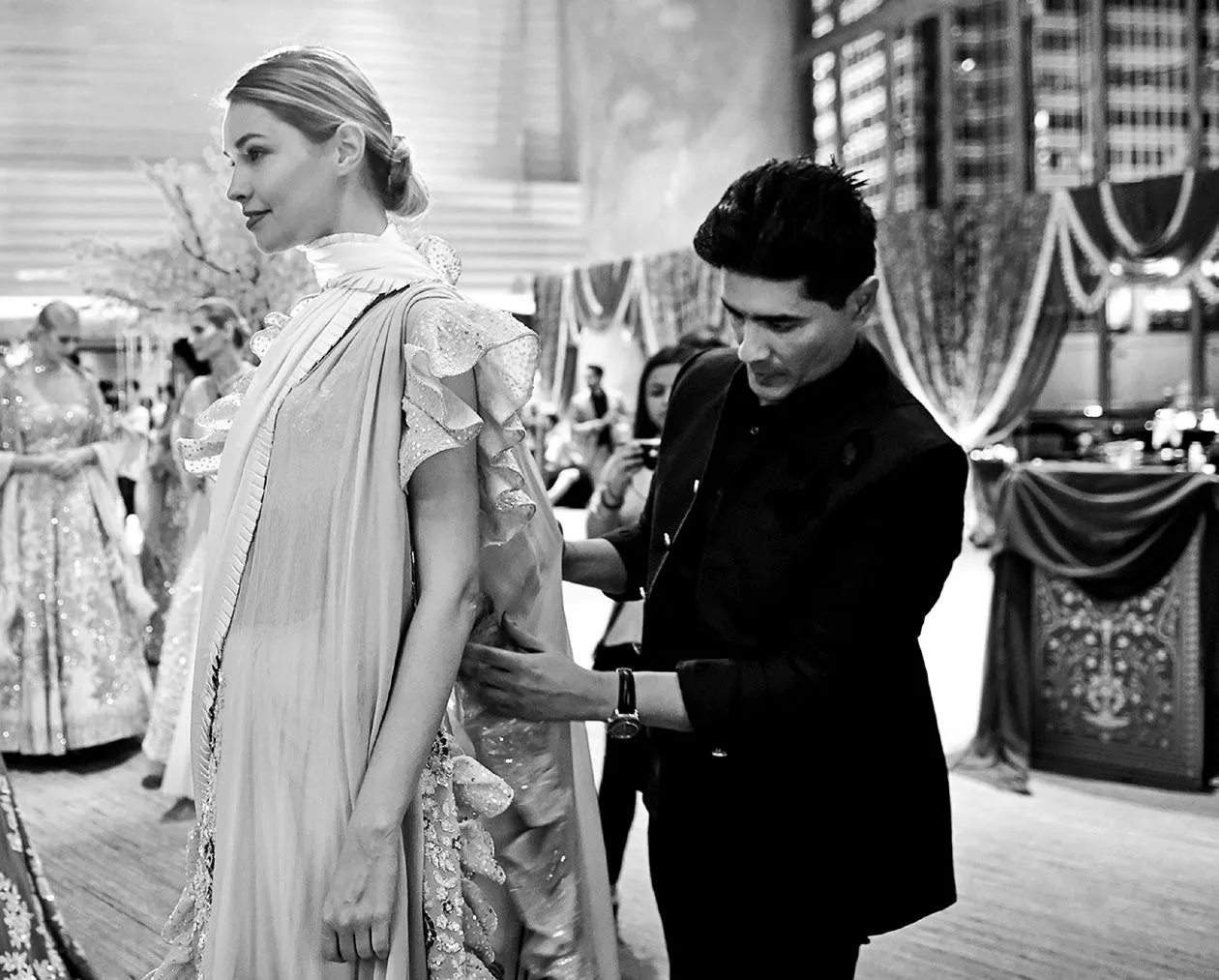




The air was thick with anticipation and reverberating music as Delhi’s newest hot spot, Aerocity saw the launch of a posh club, a couple of months ago. Everyone waited for designer and Bollywood darling Manish Malhotra to make the announcement. We, too, craned our necks to look for him and spotted him, in a discreet corner, swarmed with people trying to click a selfie with him. Clad in his preferred black colour, teamed with his signature stole in red, he stood there patiently, with a relaxed demeanour. As we exchanged pleasantries followed by a quick chat about fashion, we could not help but remember the time Manish Malhotra, the 20-something costume designer, stood grinning, clutching first of his many Filmfare awards.
The year was 1995. A young girl Mili, played by Urmila Matondkar in the film Rangeela, bursts with energy on the silver screen in her pink graphic print mini dress and leather boots. Cut to next scene, she appears in yellow t-shirt tucked in a high waist, frayed denim shorts. She looked nothing like her counterparts in the industry. As she danced away uninhibited, she stumped those around her… men dressed in white shirts and baggy pants, non-descript passers-by, even commandos. And they were not the only ones who couldn’t take their eyes off her as the audience gasped for breath. Nothing was same in cinema again. The film’s Costume Designer Manish Malhotra had single-handedly changed the way we looked at films, characters and the actors who portrayed them.
 L’Officiel India DigitalRead L’Officiel India in the digital libraryEvery issue and every cover story, on TCG Media.Read now
Manish was unstoppable. Rangeela wasn’t his first film, but was the one that propelled him into a league of his own. Instead of settling for the norm that the Indian film industry has set for itself, especially its actresses and how they looked onscreen, he chose to walk off the beaten track. Easy-breezy clothes replaced over-the-top costumes. Practical fusion wear toppled voluminous lehengas. Outlandish dresses found their way out as sensuality stepped in. But it was easier said than done. Young Manish did something unthinkable as per Bollywood standard.
“I asked for scripts before the actual filming began,” Manish says. Much to the directors’ astonishment, he was interested in knowing the characters better, refusing to scoot away to source clothes like a headless chicken. Having zero connection in the film fraternity was not helping either. The city of his birth taught him a lot and perseverance topped that list.
He demanded a script, which was often ‘fluid’ and largely inaccessible for the technicians. To Manish’s chagrin, briefings were usually only a couple of adjectives. If he wasn’t briefed well, he would be asking a lot of questions about the story, arguing with the hair and makeup artists, attending actors’ workshops, and sitting up all night with the master-ji to get the costumes right. “Actors were inaccessible and fittings were out of question!” His first couple of years were part exhilarating, part gruelling. It was not a process he was trying to change. It was the mindset.
“If an actor is playing a girl-next-door, there was no way I was going to put her in layers of rich fabric without context. I looked at characters through a different lens,” Manish says. He observed women around him and tried to bring a piece of ‘real’ to celluloid. “Would Mili from Rangeela still be remembered had it not been the clothes that accentuated the character’s personality?” he asks, and we couldn’t agree more. It took the industry a while to understand what costumes can do to a film’s look and feel. Filmfare even instituted an award category for Costume Design for the first time. No points for guessing who won it. 28 years on, Manish continues to break away from everything that would otherwise tie a designer down.
The boy, who loved films and sketching in equal measures, found himself at the theatres everyday. “I would watch at least one film every day at Gaiety, Galaxy or Gemini, come back home and sketch what I saw on screen. It’s a miracle that I passed school,” Manish recalls. “I was fascinated with colours, fabrics and their movement. It started with films, but I wanted to take my creativity beyond the silver screen,” Manish says. Looking back, he thinks he couldn’t have had a better training ground to feed his passion for fashion.
Even as he daydreamt about being in the film industry, he took a different route to realise his dreams. He began modelling as a teenager instead of hopping studios for film auditions. “My mother was slightly upset in the beginning. Like a true blue Punjabi mother, she thought her son to be too handsome who should rather be an actor,” Manish says, adding that his family supported him when they realised that his heart was set in fashion.
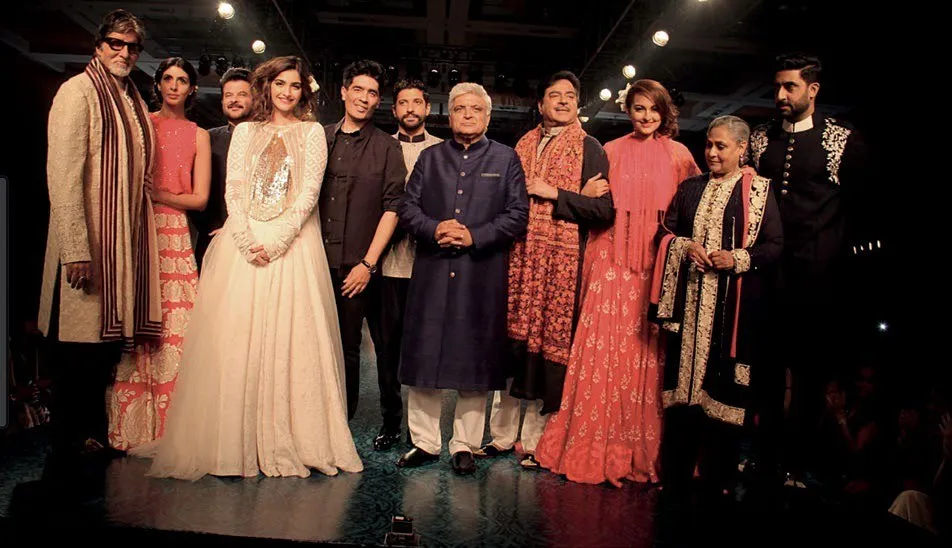
After creating mass hysteria with Rangeela and subsequent films, over 50 of them, Manish started his eponymous label 13 years ago, when Indian fashion was still fledgling. “As far as I know, I wasn’t creating fashion. I was finding ways to accentuate a fashion lover’s personality,” he says. Today, his muses are actresses of every age... Juhi Chawla, Kareena Kapoor Khan, Karisma Kapoor, Kajol, and Alia Bhatt, to name a few. “I was 21 when I was first introduced to Sridevi (who passed away on February 24) by a photographer friend, who told her that I sketched well and work in a boutique.” Ever since, he worked with Sridevi on her films, photo shoots and appearances. He has also styled Sridevi’s daughter, Janhvi Kapoor for her acting debut in Dhadak. Over the years, he has also dressed global stars such as Naomi Campbell, Kylie Minogue and Kate Moss.
Much before Yash and Avanti Birla nudged him to open a store of his own, Manish received a barrage of requests for his clothes, especially from the NRIs who were, at the time, very confused about traditional clothes. While his collections are synonymous with extravagance, fluidity and intricate embellishments, fabric for him, is the king. “It may sound poetic, but the fabric is where it all begins and ends. What a blank canvas is to a painter, fabric is to a fashion designer,” Manish says. He likes to work with silk, organza, chiffon, velvet, tulle and net, as they can adapt to both Indian and western silhouettes, and accentuates them with classic Kashmiri embroidery, a Gatsby-esque expanse of feathers, sequins and surface texturing.
His eponymous label witnessed a 300 per cent growth last year, even as his social media clout keeps increasing. A self-confessed selfie lover, Manish is one of the few designers to have embraced technology with open arms. In 2016, he became the first designer in India to shoot a show for Virtual Reality, much like Oscar de la Renta. The word ‘digital’ for him, encompasses the future of both fashion and cinema, and how they will be consumed. In this day and age, where brand loyalty depends on what meets the eye on social media, designer labels cannot work solo.
So, collaborating with brands from different genres (read limited edition bottles for Chandon and a phone for Vivo for this Valentine’s Day) is to express himself in different ways or reinvent his label, we ask. “It is more important than ever to work on new ideas and find ways to build communities that involve and impact the market,” Manish says. Being in these industries for decades, both film and fashion, where things change everyday, he must believe in the power of evolution. “Yes, definitely. And I love the turn both industries have taken. They are better organised and have taken the form of serious industries that contribute to the economy.”
For someone like him, who’s always on the move, loving his job is most important. His creative energy comes from the cities that he travels to and the people he meets along the way. “When what you do is not a ‘job’, you will not burn out. I take few vacations and find pockets of time to spend with friends and family. It helps me reboot. But, I am never without my sketchbook. You will never see me sitting behind a desk,” Manish says.
An early riser, he loves music, and turns on his television as soon he wakes up to set his mood for the day. “I don’t allow myself the luxury of resting on laurels or getting dejected by criticism. The best way to move ahead is to keep learning,” Manish says.
Before getting busy with the expansion of his store in Delhi — from 9,000 square feet to 15,000 square feet — he tells us about his film projects, the next to hit the theatres, Fanne Khan, in which he has styled Aishwarya Rai Bachchan. Her look in the film has already stirred curiosity.
As he begins this year with a dream of his label taking Indian fashion a step forward on the global platform, we couldn’t help but ask him why there are not many Indian stylists in the West. “The West has always had great regard for Indian art and culture. However, we are not the first place that comes to their mind when we say ‘fashion’. Styling is still at a nascent stage in India,” Manish says. He, however, believes that the status quo will change as Indian fashion grows as an industry and stylists are working bearing global sensibilities in mind. Amen!
From the March 2018 issue of L’Officiel India.
Spotted a mistake, or your photo used without permission? Report a correction