
Kohinoor Jewellers: Talking Gems
Kohinoor Jewellers may be 150-year-old, but they never ceased to evolve.




All my grown up life, I have been telling others (and mostly myself) that I am not a jewellery person. I have been perpetually dissing anyone who, laden with or without jewellery, tries to explain their love for diamonds to me, accusing them of being a slave of the sparkle. Not that I do not possess any form of fine jewellery (I am big on statement pieces though). I do cherish my stacked platinum ring (a birthday gift to myself) that disengages to become two pieces: a single solitaire ring and a double, diamond-paved one. And yet, I have been offering fine jewellery a not-a-care-in-the-world attitude. Until recently.
Thanks to my pre-pubescent years spent in Uttar Pradesh, I was not hot on visiting Agra. But, the plan was different this time or shall I say Agra had different plans for me, a jewelled plan. In a couple of hours of driving from Delhi and braving Agra traffic, I found myself inside Kohinoor Jewellers showroom in Tajganj area. But, Agra wasn’t where the story of Kohinoor Jewellers began. It began in Chandni Chowk, Old Delhi.
 L’Officiel India DigitalRead L’Officiel India in the digital libraryEvery issue and every cover story, on TCG Media.Read now
After experiencing a golden period in Dilli, thanks to their Mughal patrons, the founders of Kohinoor Jewellers moved to the walled city of Agra in 1857 with Emperor Bahadur Shah Zafar. After his fall, the jewellers were bestowed with a property at Old Drummond Road in Agra (now known as Mahatma Gandhi Road) by the British. The business took off on a new tangent from there.
Milind Mathur, a gemologist (trained at the Gemological Institute of America) and creative director of the 150-year-old jewellery house introduced me to his father, Ghanshyam Gopal Mathur, a fifth-generation jeweller. As they showed me around, I realised how charming (fluently speaking in seven languages) and mysterious the patriarch was. “My father would take me to a fruit market and gave me insight on coloured stones. You know the perfect colour of a ruby matches that of a pomegranate,” senior Mathur said. Punctuated with anecdotes — from the beginning of the brand in 1862 till today — he showed me some of the oldest jewellery he possessed. “May I take a picture?” I asked. “No!” pat came his reply. Milind nudged him gently as he reluctantly shrugged and agreed. It was a pendant with an enormous emerald studded to a gorgeous gold necklace. They showed me an edition of the National Geographic magazine from the ’80s with an article on Kohinoor Jewellers and how it stunned the royalties from across the world. Without divulging any details about his clientele (that includes royalty, celebrities and business magnets), Ghanshyam Gopal Mathur asked Milind to take over, whispering to him incomprehensibly.
The next I know, I was whisked away in an intriguing secrecy and planted behind a sliding door (or was it a wall, I wonder). “Not everyone who visits our showroom has the privilege of entering this den,” Milind informed me. He took me through different collections of jewellery that were studded with precious gemstones in every colour that years of working with magazines has taught me. There were saath lada haar, haath phool with peacock motifs, elaborate earrings and rings.
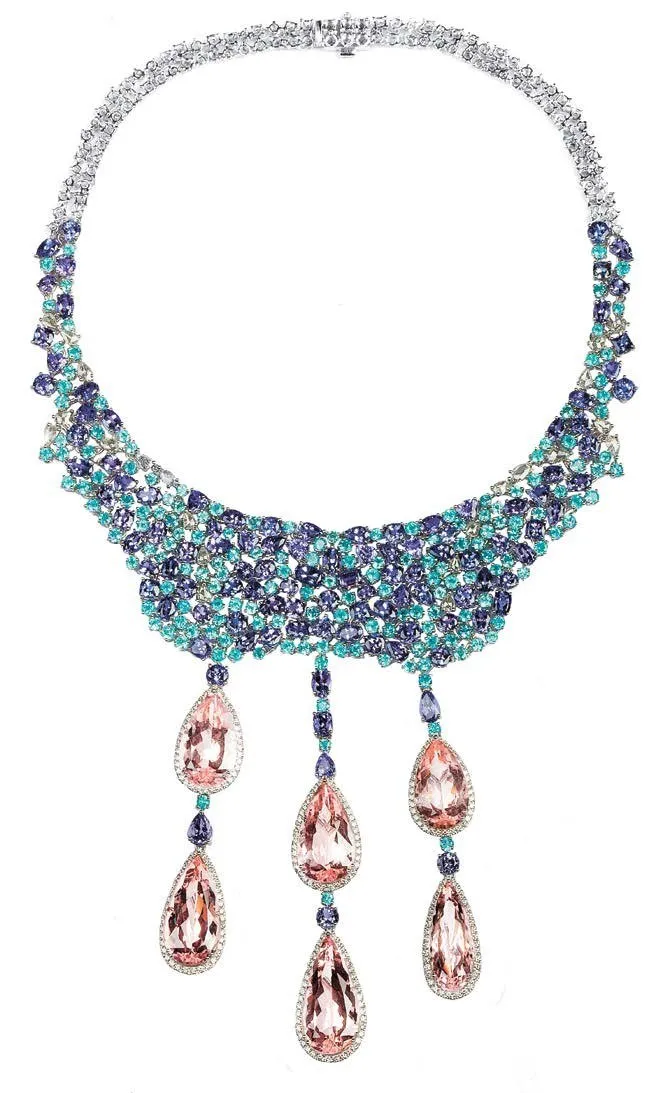
What interested me the most were the jewellery pieces inspired by famous artists (read French painters Claude Monet and Édouard Manet) and their masterpieces. These jewellery pieces are one-of-a-kind, which means if you own them, you are the only one with the bragging rights. The brand has evolved over the years, becoming younger and more experimental, but one thing that remains unchanged is how coloured stones are the highlight of almost every Kohinoor design. “Most stones that we source are unique. It would be foolhardy of us to try and find another exact piece. This is why we design the jewellery around that piece, instead of trying to fit it into a sketch. It’s difficult, time-consuming, frustrating at times. But, the result is breathtaking,” Milind said. As he nudged me to try a few pieces, I blurted out my non-jewellery personality. And then, I tried the necklace studded with morganite, pariaba and tanzanite (in picture).
I am a convert now. Period.
From the June–July 2018 issue of L’Officiel India.
Spotted a mistake, or your photo used without permission? Report a correction