‘I Do Bare Figures, Not Nudes’
Sarah Ishtiyaque




Photography by:
Shivamm Paathak
 L’Officiel India DigitalRead L’Officiel India in the digital libraryEvery issue and every cover story, on TCG Media.Read now
WALK THE LINE
“A lot of people buy my paintings online. I pity them. Because when you look at a painting actually, and on the computer it appears this size (he gestures emphatically to a postcard-sized image), how could you know the brush strokes?!” Such are the musings of an artistic genius, painter extraordinaire and Padma Bhushan recipient who goes by the name of Jatin Das. “My reactions are more intuitive. I meet a person, to get to know them…” The geniality with which I was allowed to witness a maverick at work was humbling. One can only hope for so much patience and kindness while in the company of an artist with an oeuvre akin to his.

“Websites are not God’s gospel truth, you know?” he says looking up at me intermittently through sips of his black coffee, voicing his vehement disregard for the Digital Era that we so clearly inhabit.
“What I do when I paint or draw, is I don’t repeat myself consciously. That is one. I have no time to look back at what kind of work I’m doing and bunch them. A lot of artists do it in different disciplines.” he says of his working aesthetic. Speaking of his interest in poetry, he muses, “I write poems when I feel like. In my paintings, in my poems, in my life…I introspect. But I don’t look at myself…” he trails off in contemplation only to frame existential questions for his own answering, “…what are my mannerisms, what is my style, what are the themes I work on? Creative people don’t work on a theme. A theme is born. There is a difference between a musician, a poet, a painter and a scientist. There are applied scientists, and then there is one scientist who decides that if I do this…this is the application for it. But a pure scientist works in a direction. And then sometimes an accident takes place. Then he learns something out of it. Then he takes that path. It’s like if I am going to Rajasthan, on the way I see Haryana, then I go and see a fantastic sculpture in Haryana. You think Haryana is all rubbish! But in Haryana there are fantastic ancient sculptures. So instead of going to Rajasthan, I go to Haryana, then eventually I may go to Jammu & Kashmir, and then I may go to Rajasthan. What I’m trying to say is, (that) any creative person has a journey. They find their own path, sometimes by accident and sometimes by will.”
“There was a cyclone in Odisha and Andhra Pradesh some twelve years ago. And a lot of people do paintings on a lot of events. (But) I don’t. When you’ve been working for a long time, there is a journey that is devoid of social, political and other events. So when I get down to work, wherever I have left, the previous work, there is a thread of connection. There can suddenly be a new journey. And that’s the beauty of life. Everybody can have that journey.” he reveals.
“Let me give you an example of Sudhir Kakar. He is a dear friend of mine, who is a very famous writer now. He did engineering in Germany, then he did sociology, which is not connected. He then became a psychotherapist, then a writer and (currently) lives in Goa. So life is like a river. It meanders. That is how any committed, creative person journeys. But each one’s journey differs according to (their) family background and (their) situations. I am from Odisha. I went to Mumbai to study art and I (currently) live in Delhi. So (I’ve spent) fifty-five years away from Odisha, but I visit Odisha, I am doing an Art Centre there.” this he says of establishing J D Centre of Art in the city of Bhubaneswar in Odisha. “I travel all over the world. All these experiences come into play. Then there is an inner journey, (besides) a personal journey. This inner journey evokes ideas and thoughts.”
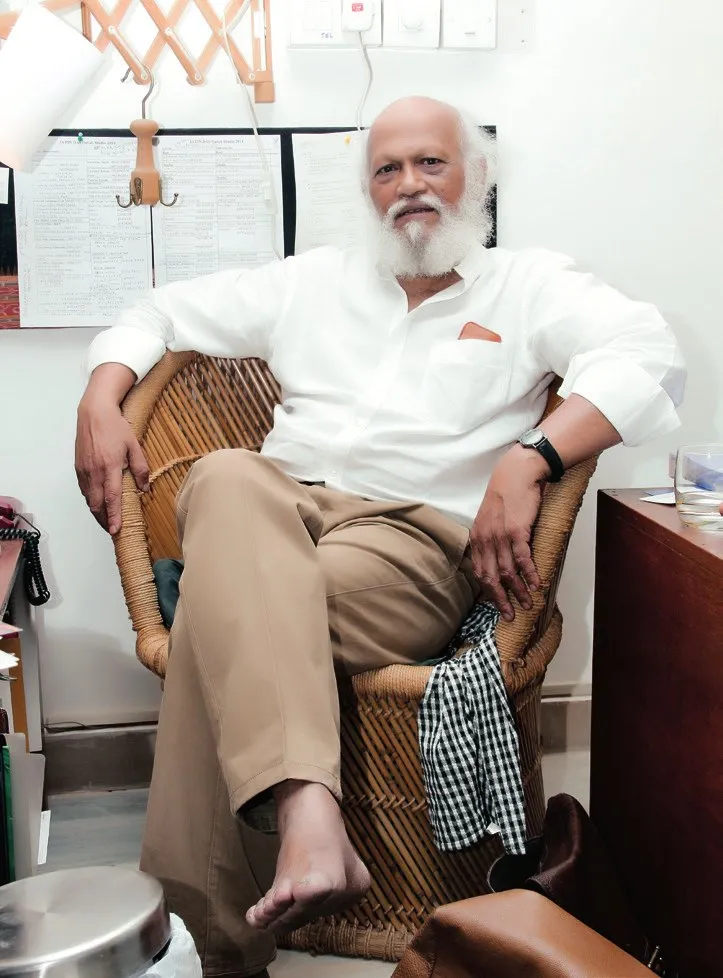
Amongst the many things that he has a distaste for, lies the question of favouritism amongst his own body of work, “I like all colours for instance. A lot of people ask me which is your favourite colour? But when I paint, certain colours dominate unintentionally. But that’s my personal journey.”
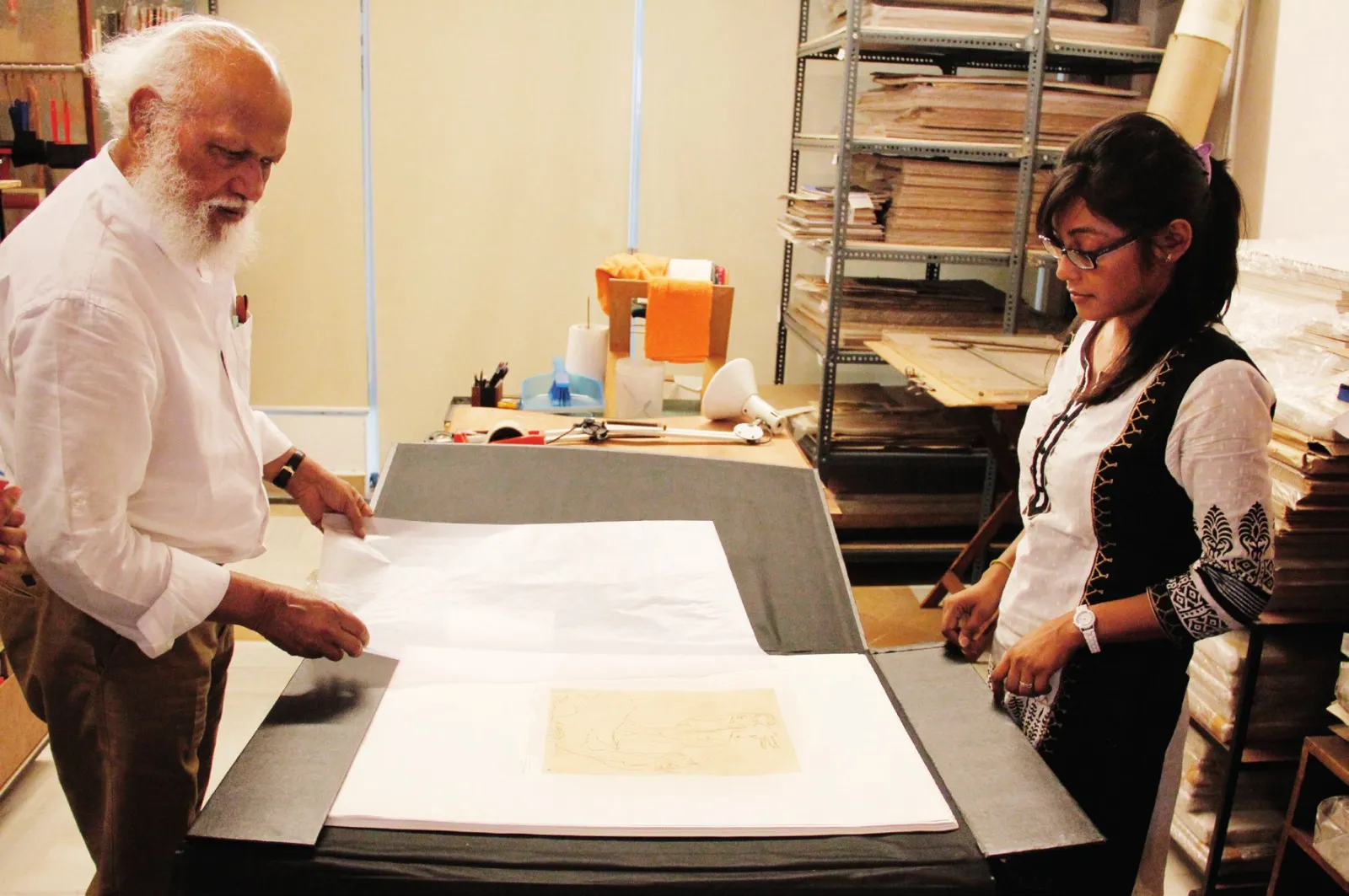
“I am working on many things of late. I am doing graphics.” he says of his recent projects. “Do you know what a graphic is? Etching, lithograph, dry point? I’ll show you.” he trails off suggestively “Anybody who is doing any form of art, should have a proper foundation in art. That is, line, form, shape, colour, tone, etc…”
Jatin Das’s figurative paintings epitomise human forms. After an unyielding albeit relentless quest to uncover the underlying symbolism behind his body of work, he reaches out for a hardbound crimson catalogue and rebuts, “This is a catalogue which is 20 years old. When you paint and draw human forms, there are male and female (forms). Female has lalitya or grace. I do bare figures. Quite often people call them nudes. They’re not nudes.” he quips. “Do you know what a nude is?” he asks while I sit enamoured beyond my ability to reply. He goes on immediately, “If somebody is clothed and you unclothe the person for a photograph or a painting, that’s a nude.”
“There are some artists who paint abstract or landscapes, non-figurative as they would call it in simple terms. I paint human figures. Although I also do landscapes which I don’t exhibit. In life whatever you get to see of a person, you form your opinion of that. Whereas, if you want to make a comment on Kumar Gandharva, the musician, then you must go to a hundred or two hundred concerts of his. Then you should go and sit in his rehearsal, then you can say, I have heard Kumar Gandharva for two years and this is how Kumar ji sings. I do male and female forms separately. Sometimes together and when there are two forms there is an interaction.”

He went on to patiently take me through his catalogue, from an exhibit in Germany to a painting depicting Ashoka in Kalinga. “There are different kinds of concepts. This is guru and the shishya – the initiator and the initiated. I did a series called Man Woman. In every man-woman relationship, there is an interaction, a fire, affection, tension, sensuality, spirituality and many things.” he trails off.
“My paintings are metaphoric, poetic and symbolic. These are not narrative paintings. If you look at these figures, there is a different kind of passion, anguish and tension which is what I am working with. When you do not have architecture or clothing (in the paintings), you see male and female interaction. (On) all Indian structures, there are a lot of female forms. The use of drapery is just a suggestion. They (clothes) cover up the rhythm of the figure. I work on working people a lot. Their body language is different. When you look at these (paintings) you don’t think whether they are nude or male or female, you think, this is a painting!” he exclaims.
“There was a theatre director called Safdar Hashmi. He was killed. He was a friend of mine. Normally I don’t do a painting on an event. But I did this painting because my daughter used to act in his plays. He was beaten up with a lathi.” he says, still browsing through the catalogue. “You can’t become an artist in one life. You need two, three lives. It’s a continual process. It’s a never-ending journey. And I’m not satisfied with anything that I’ve done. If you are satisfied then that is the end of a journey!”
“I speak my heart to each work. I do not compare my work with anyone. Nothing is ever complete in life. Nothing is absolute. Whatever we are doing, it is our passion and anguish and frustration and angst that is coming out in the work (we do) but the best work is done by nature. I’m not empowering men or women. My paintings have a thought, an idea, which I’m not illustrating but painting.” he voices quite literally what his paintings don’t represent, but leaves what they do, to the symbolic deciphering of its viewers, like the rustle of withered leaves in the heart of silence.
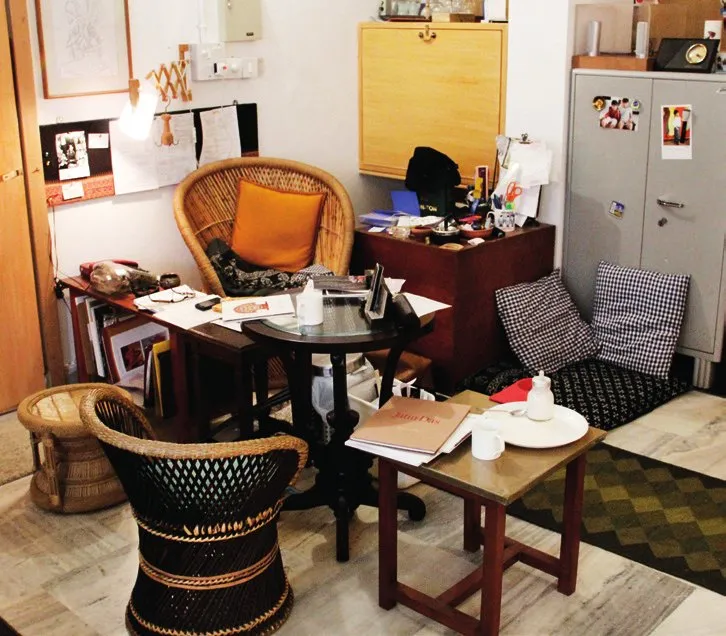
“Everything is an inspiration for me. But I get more inspired by nature than man-made things. I get inspired by, you know, by a sudden storm, by the skies, by human beings, by animals, by birds. I also get inspired by man-made things or beautiful miniatures, beautiful architecture, body language, beautiful poetry and so on. I’m very happy about my children. My eldest son Siddhartha is a designer. Nandita is an actress and at the same time, she writes, she’s done plays, she has worked for women and children. And I am proud of them for this reason that they are honest, committed and uncompromising.” he says resolutely of drawing inspiration from his daughter Nandita and son Siddhartha’s endeavours.
“There are thousands of works that I have not shown. Because, you see, it’s not necessary to show everything to the public. Secondly, it is the tip of the iceberg. I’ve got some graphics which have just arrived, which I haven’t seen. I’ve got thousands of poems which are not typed out yet. So there will be editing, there will be cleaning up…there are a lot of works of mine which I have not signed because when I look at them again, I may say, ‘Oh it needs a little more work!’ And when I feel it is finished, then I sign it and date it. It is not a hard and fast rule to exhibit. You see, unlike cinema and theatre where they are forced to think of an audience, I don’t think of an audience. I live on the sale of my paintings but I don’t paint for selling.”
The mindless cacophony of social media and the internet doesn’t interest him. “There is so much of unnecessary information that people are collecting. I don’t have to know how much steel and concrete has been used in (the making of) this building, although that information is available. (Our) lifetimes are very short. Some people are friendly with 2000 people, but then you are dissipating energy with 2000 people. When will you get the time to work? If you meet one friend in the evening, you get to know that person. If you meet 1000 people a day, there will be no time (for yourself) in 24 hours! So you have to channelise your energy and your interests.”
“There was no website before. There was no publication before. The catalogue that I am showing you, at that time in New Delhi hardly anybody had a catalogue. This was one of the best catalogues of the period. Would you believe something, if I tell you? I haven’t seen my own website in three years. Would you believe another thing? I have not seen anybody’s website, I am so busy. Every innovation is good. You need a computer in a hospital, an airport etc. I as an artist, need it too, as it stores my research and documentation. But that’s as far as it goes.” he continues.
In a finishing stroke of conversational wizardry he says, “I’ve got many hats like yours. Yeh dekhiye.” he says looking at our photographer’s fedora, then nodding towards his own hanging on a stand at the entrance to his studio. “This is nothing. I have about fifty in my home.” he continues. He gets up briskly to stand alongside his painting for a quick photograph and finishes, “At 20, you are so confident. I am still quite fragile…”
My lemon grass tea from Bangladesh, faded in comparison to the exoticism of this singular genius.
Spotted a mistake, or your photo used without permission? Report a correction