Damir Doma: Eternal Sunshine of the Spotless Mind



Time is a luxury in such forlorn times. While designers are building commerce and banking on marketing, Damir Doma describes how slowing down doesn’t mean stagnation.
“They say I’m old-fashioned, and live in the past, but sometimes, I think progress progresses too fast!” were the words by American writer and illustrator Theodor Seuss Geisel, or as the world knows him, Dr. Seuss. Such are the times we are living in. At a click-bait away, you can find not just material things like shoes and bags, but also love, friendship and vivid emotions of arresting depth, lasting only as long as Kim Kardashian’s next Instagram post. The era of physical presence is over. Yet the fight against time is real. We saw it last year with Raf Simons and Alber Elbaz leaving their magnum opuses at fashion houses like Dior and Lanvin, and we see it across discussions taking place on a wide spectrum across various disciplines, giving way to a counter culture that is pleading us to slow down.
 L’Officiel India DigitalRead L’Officiel India in the digital libraryEvery issue and every cover story, on TCG Media.Read now
MEANINGFUL GLANCE
Damir Doma is a Croatian designer, who wants to slow down. “High fashion is following the domains of fast fashion,” he says, as he adjusts his computer. He does not want to participate in the whirlwind that fashion is caught up in. “A year ago, I used to have women’s pre-collection, men’s pre-collection, silent men’s and women’s line. We decided that we would cut down from 10 to four collections in a year. So, we stopped silent. We also put together the pre-collection and the main line. Just because I believe I am an avant-garde designer, I need to be creative. Creativity takes time. You need a certain time to process thoughts and ideas,” he says, in a voice with a heavy accent and wearing a warm smile.
He puts great thought into what he does, which we forget to do at times, blindly following the herd. To fit in is easy. But Doma refuses to do so. He elaborates on how it has paid back. “When I had too many collections, there were a lot of decisions that were very rushed. It would result in things that were not well thought through. It also ended in things that I regretted later. You think to yourself, why did I do that. And that was because I did not have the time to think about it. At the same time, my work is about volume and construction. And such things take time. I think new things mostly happen due to mistakes. If I would sketch on paper, it would be something that I have in my mind and would be something I have seen somewhere else. I could be inspired by art or something else, but it definitely exists,” he adds.
He establishes how his mistakes have only elevated his creativity by saying, “The moment I take a fabric and start draping it, mistakes are bound to happen which I did not plan on making. But the things that happen without being planned, sometimes turn out to be really beautiful. These things take time. So, we decided not to rush anymore. We decided to do it our own way and as a result the creativity, the details and construction started becoming better.”
GENDER BINARIES
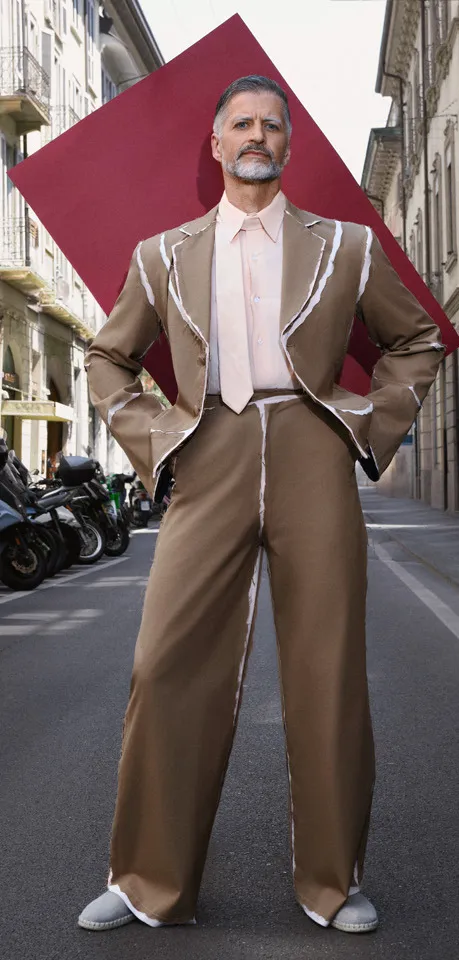
He has been the one to take the road less travelled, which is maybe the reason why his top clients include Jared Leto, Robert Pattinson and Kirsten Dunst. His ideas in 2006 were synonymous with certain progressive ideas we attach with fashion today. “When I started menswear eight years ago, my mother ran my atelier for six years. She is a womenswear designer and pattern maker. My inspiration in the beginning, came from women’s wear and not menswear. The latter in the beginning had soft tailoring and there was a lot of draping in it, which was very new at the time. This is also the reason why my menswear was really appreciated at the time and I’m here today because I did something that others did not do. Otherwise, there is no reason why the market would accept you if you just do something that already exists,” he says.
Doma adds, “Except, if you have a lot of money and you make something that is already there and you put more money into marketing and advertising. In my case, it’s different.” His collections exude the quality of being intellectual as he says, “I think that the idea of feminine and masculine plays an important role in my collection without being something that I do want to communicate. For me, my vision of the man was always this soft and sensitive intellectual. At the same time my woman was somebody, who was structured, strong and independent. And there was always inspiration going from my womenswear to my menswear and vice-versa. I was trying to be very transparent in the sense that things go from one side to the other.’’
HUMBLE BEGINNINGS
He has previously participated in the Italian tradeshow Pitti W and joined the prestigious league of designers like Proenza Schouler, Rodarte, Giambattista Valli, Peter Pilotto and Haider Ackermann, who were also invited to showcase their collections in preceding seasons.
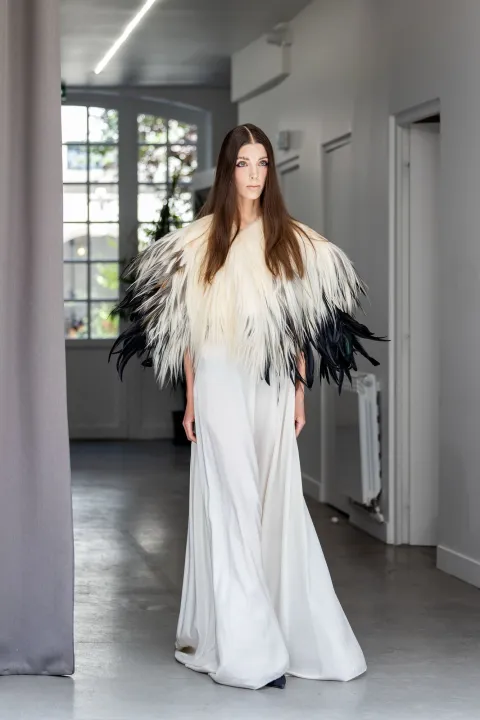
His white office resonates with his design aesthetic, and his inspiration comes from diverse avenues. Even though musicians like Rihanna, Usher, Kanye West, Nelly Furtado and ASAP Rocky follow the brand closely, he says how his vision of music is different from what the patrons of the brand might be into.
He adds, “Last season, I think my choice in music was close to my creation. So the sound had a lot of artisanal feeling. Even if it’s electronic, it needs to feel hand-made. There must be a certain grain in the sound. But it’s definitely not pop or rap music, even if my close friends are inspired by these collections, or are drawn to the clothes. I think, in reality my sound is a different sound.”
He talks about his beginnings and says, “Before I started my own brand, I worked for more than two years in Antwerp not only for Raf but also for Dirk Schönberger who is the Creative Director for Adidas and Ann Demeulemeester. For me, the most rewarding thing was to see there is not one way to do it. You have to find your own way.” He talks about Raf Simons and describes his way of working as very conceptual, which he believes comes from his training in architecture and interiors. “You can see a brand like Ann Demeulemeester, which is sensitive and poetic and that reflects in the work too. What I’m trying to say is your process will define your work. It is not that people underestimate that. People think that you sketch something on paper and this is what you do. The process you created around yourself, your team, your pattern makers, your fabrics, the way you do things, this will really define your work,” he says.
He credits his design ideology to his early years of training.
“I wouldn’t have seen different ways of working, I would have done it by probably seeing my mother and I would have never had the guts to do it my way, or maybe even questioned it.
And I think it is important for people working in any field to do it. And a lot of people do not have a point of view. They just do things in a nice way. The most important part is to have a philosophy about the way you work and have a point of view on things.”
PENNY-LESS LUXURY
He describes time as a luxury. He wishes to “…have the time to be creative; have the time to sew the garment properly and develop the garment properly, have the time to do quality control, have the time to go on a vacation with your family.” He further says, “I think we’re living in a period where time is getting limited. And I think we’re so overwhelmed by so many things going on and also the social media. I think time is the thing that is running off. We can’t buy it. It is very rare.”
From the February 2016 issue of L’Officiel India.
Spotted a mistake, or your photo used without permission? Report a correction