
Come Into My Parlour





It’snot on the route of those hop-onhop-off tourist buses. And it’s not your regular museum either. In fact, till some time ago, Hillwood Estate was a private museum and you had to call and request an appointment to visit. When we drove past the springtime-flower-speckled neighbourhood and entered the gates of Hillwood Estate, Museum and Gardens, it didn’t quite feel like I was in a museum. And for good reason, too.
Tucked away in a lush residential area in northwestern Washington, D.C., far from the madding crowd and usual tourist traps, Hillwood was one of the many homes of Marjorie Merriweather Post, heiress of the Postum cereal empire. Overlooking the beautiful Rock Creek Park, the 36-room Georgian mansion was modified into a home that would fit Post’s lifestyle and also function as a museum for her extraordinary art collection. Post possessed a rare love Top: A view of the exteriors of the mansion at Hillwood estate, museum and gardens.
 L’Officiel India DigitalRead L’Officiel India in the digital libraryEvery issue and every cover story, on TCG Media.Read now

Right: The French Parterre Gardens far right: the french breakfast room bottom right: midnight blue Twelve Monograms Easter Egg and pink Catherine the Great Easter Egg, both presented by Nicholas II to his mother. The Nuptial Crown that Empress Alexandra wore at her wedding to Nicholas II in 1894.
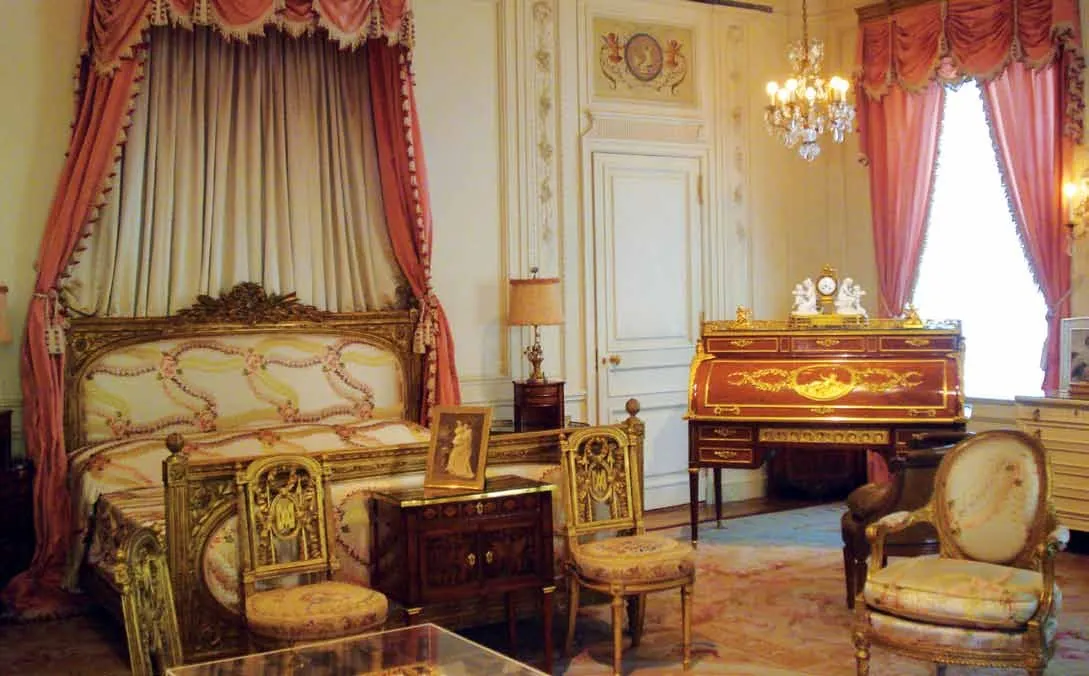
facing page: mrs post’s bedroom The Good Life for the arts and began collecting French decorative art in 1919. While she lived in Russia with her third husband in 1937 and 1938, she discovered Russian imperial art— which was to become her lifelong passion. Today, Post’s collection at Hillwood is regarded as the largest collection of Russian imperial art outside of Russia. If gardens could ta l k The businesswoman, philanthropist and socialite lived here from the 1950s till her death in 1973. If the gardens had a speaking tree or two, they might regale you with tales of the parties where she hosted presidents, royalty and diplomats. The garden party in the first week of May every year,was a sought after annual event in her day, when the 13-acre landscaped lawns would be flush with flowers. It is still considered the best time to visit the estate when it is in full bloom—even though there are no more garden parties. Incidentally, that is exactly the time when I happened to be visiting. Lucky me! After a series of selfies with the gorgeous tulips and sundry other blooms at the entrance garden (I am a flower enthusiast), I made my way to the mansion. You can choose to wander at leisure or take the free audio-guided tour. But before that, step into the AV room to watch a video presentation about the life and times of Marjorie Merriweather Post and how Hillwood came to be. Standing at the reception as I looked up at the winding staircase, I couldn’t have fathomed what awaited me.
Of Louise sand Napo leans Don’t let the modest staircase fool you. For upstairs, you will find riches from the palaces of French rulers Louis XIV, Louis XV, Louis XVI, Napolean and Napolean III. There is even a French Porcelain Room. And I must warn you, the bar for picking out your china will be raised higher than anticipated. The formal Louis XVI drawing room, with wall tapestries, tapestry-covered sofas, and portraits of the Duchess of Parma and the Empress Eugenie, is reminiscent of the French dynasty’s display at the Louvre in Paris. The breakfast room, which is an extension of the expansive dining room, with goodies from France’s Sèvres factory, is a vision in pink and overlooks the French Parterre Garden. The only thing missing is a platter of croissants and cheese. A ta leoftwoeggs Mrs Post devoted her life to the Russian imperial arts and that is why, of the 42 Imperial Easter Eggs that survived the downfall of the Romanovs, she managed to procure two. They sit proudly in the Icon Room of the mansion’s first floor where I found several visitors swooning over them as I struggled to click a picture. Fabergé, the artist-goldsmith, made 50 jewelled eggs for the Imperial family from the reign of Tsar Alexander III in 1885 through 1916. As a yearly tradition, the Tsar would present his Tsarina and, sometimes, his mother with the work-of-art egg on Easter—the most important occasion in the Russian Orthodox Church. While whipping up artistic eggs was Fabergé’s specialty, he also made other spectacular artefacts for the family. The Iusupov Music Box and Empress Alexandra’s notebook also have Fabergé’s touch and find space in the Icon Room, along with Empress Alexandra’s nuptial crown.
The second floor offers a peek into Post’s lifestyle in her opulent bedroom suite and the dainty dressing room. Also on display here are her drool-worthy Cartier jewels. After two hours of soaking in the luxurious mansion, I wanted to soak in the spring sun and sip on some ginger ale. Hillwood’s café, with indoor and outdoor seating, is usually full and has a remarkable luncheon menu with fresh salads, sandwiches and delectable desserts. If you have to wait for a table, I suggest you wander through the many gardens— the Greenhouse and Cutting Garden are close to the café. But my favourite was the Rose Garden (no surprises there) and I didn’t mind getting lost in the oh-so-Zen Japanese Style Garden on the other end. After scouring the city over three days, I can say that Hillwood is, quite literally, the hidden treasure of Washington, D.C. and deserves a place in your itinerary— especially when you are with your girls. We certainly made a day of it!
As a yearly tradition, the Tsar would present his Tsarina and, sometimes, his mother with the work-of-art egg on Easter. photographs: Hillwood Estate, Museum & Garden; Hansa Makhijani.
Spotted a mistake, or your photo used without permission? Report a correction