Canvas, Artists, and Sunburned Brushes
Throughout history, artists turned their attention to capture the essence of long summer days. Sun, sand, sky, water, and women dominate as subject matter, conveying the light, languid heat, and soft sensuality of the season, look ahead how!




The Swimming Hole by Thomas Eakins
Thomas Eakins’ masterpiece, ‘The Swimming Hole,’ is an oil on canvas painting created around 1883. It falls under the Realism art movement and exemplifies genre painting with its lifelike portrayal of a candid moment. The artwork, measuring approximately 92.71 by 69.85 cm, currently resides in the museum.
Depicting this serene and intimate scene, a group of young men enjoy a leisurely swim. Eakins skilfully captures the males in nude form in a naturalistic setting, free from societal constraints. The composition features two men reclining on a rocky outcrop—one resting on his side, the other with a hand gently on the first man’s knee. A third man stands at the water’s edge, poised for a dive. Figures in the midground swim and dive, their splashes frozen in time. The background fades into a distant landscape of lush trees and grass-covered fields.
 L’Officiel India DigitalRead L’Officiel India in the digital libraryEvery issue and every cover story, on TCG Media.Read now
Eakins’ meticulous attention to anatomical accuracy and the interplay of light on flesh and water showcases his mastery. The scene balances peacefulness with the dynamic energy of figures in motion. Notably, Eakins portrays the nude male form within a contemporary context, departing from classical or mythological themes—a bold choice that underscores his commitment to realistic and truthful human representation.
Bain à la Grenouillère by Claude Monet
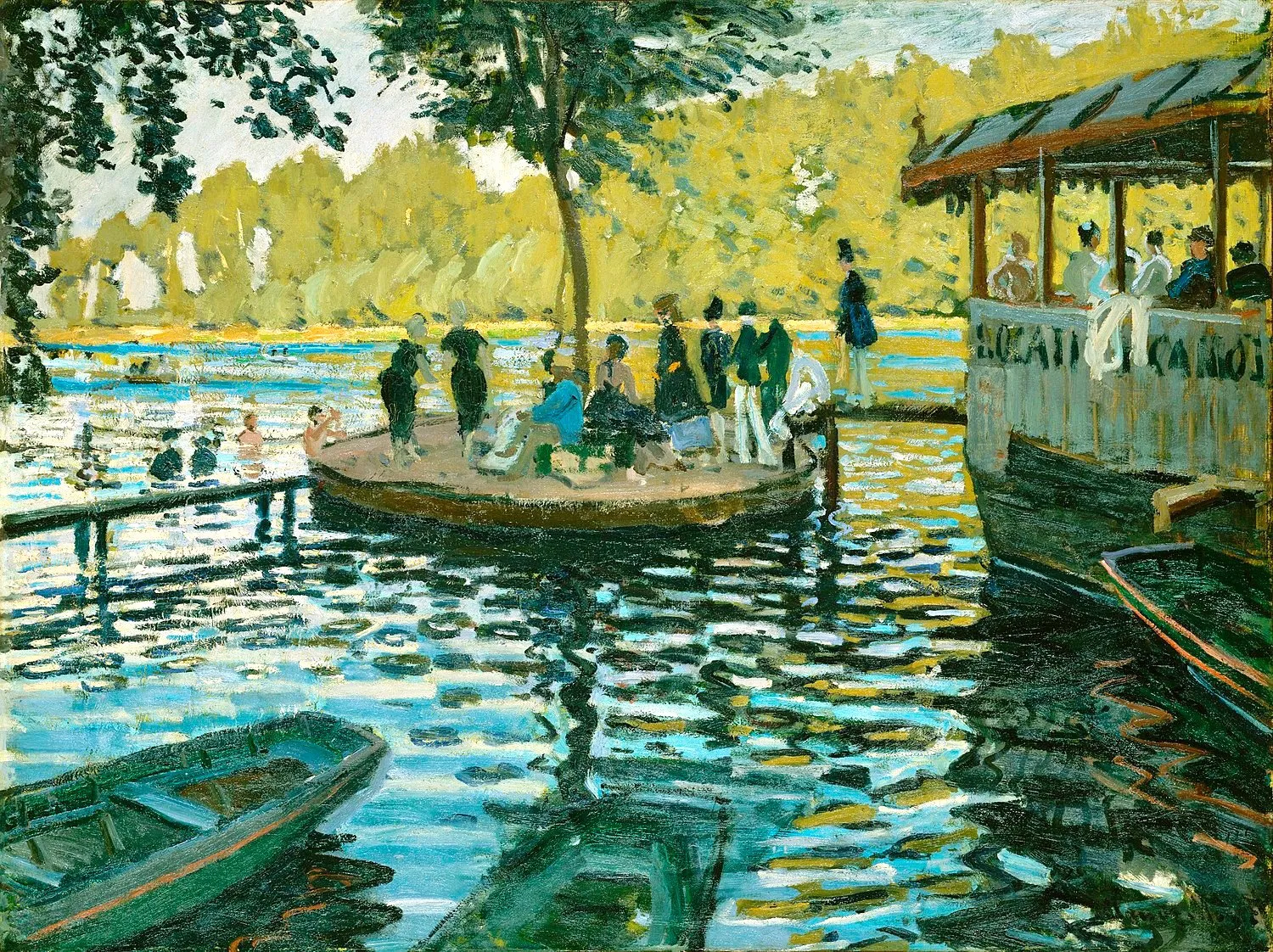
In the summer of 1869, artists Claude Monet and Pierre-Auguste Renoir positioned their easels at La Grenouillère, a boating and bathing resort along the Seine River near Paris. Monet expressed his dream of painting the baths of La Grenouillère, although he had only created some rough sketches. Among their various depictions of the subject, this composition closely resembles one by Renoir in the museum.
La Grenouillère, optimistically promoted as "Trouville-sur-Seine," catered to the middle class and included a spa, a boating establishment, and a floating café. It had recently received a visit from Emperor Napoleon III, along with his wife and son. Monet and Renoir recognized it as an ideal subject for capturing leisurely scenes. He focused on repetitive elements—the water ripples, foliage, boats, and human figures—to create a textured fabric of brushstrokes. Despite the emphasis on brushwork, the paintings retained a strong descriptive quality.
Both artists faced financial struggles, and their choice of subject likely aimed to appeal to bourgeois patrons. While the surface theme depicted middle-class leisure, the true essence of Monet's painting lay in capturing the play of light on the water. The figures in the scene lost their individual identities, merging into the overall interplay of light and colour.
Le Déjeuner sur l'herbe by Édouard Manet
Le Déjeuner sur l'herbe, an oil painting by French artist Édouard Manet, was completed in 1863. Initially rejected by the Paris Salon, it was later exhibited in the 1863 Salon des Refusés. Manet knew that "Le Déjeuner sur l'herbe" would provoke reactions. The painting became the principal attraction, eliciting both laughter and scandal.
However, in “Le déjeuner sur l’herbe,” Manet paid homage to Europe’s artistic heritage. He borrowed his subject from the Concert champêtre—a painting attributed to Giorgione (Louvre) but previously thought to be by Titian. The composition of the central group drew inspiration from Marcantonio Raimondi’s engraving after Raphael’s “Judgement of Paris.” Despite these classical references, Manet’s boldness stood out.
The presence of a nude woman among clothed men lacked mythological or allegorical justification. This, combined with contemporary dress, rendered the scene almost unreal and obscene in the eyes of the public. Manet playfully nicknamed his painting “la partie carrée.”
During that time, Manet’s style and treatment were as shocking as the subject itself. He eschewed subtle gradations, opting for abrupt contrasts between light and dark. The characters appeared uncomfortable against the sketchy background of woods, deliberately devoid of depth and perspective.
A Sunday Afternoon on the Island of La Grande Jatte by Georges Seurat
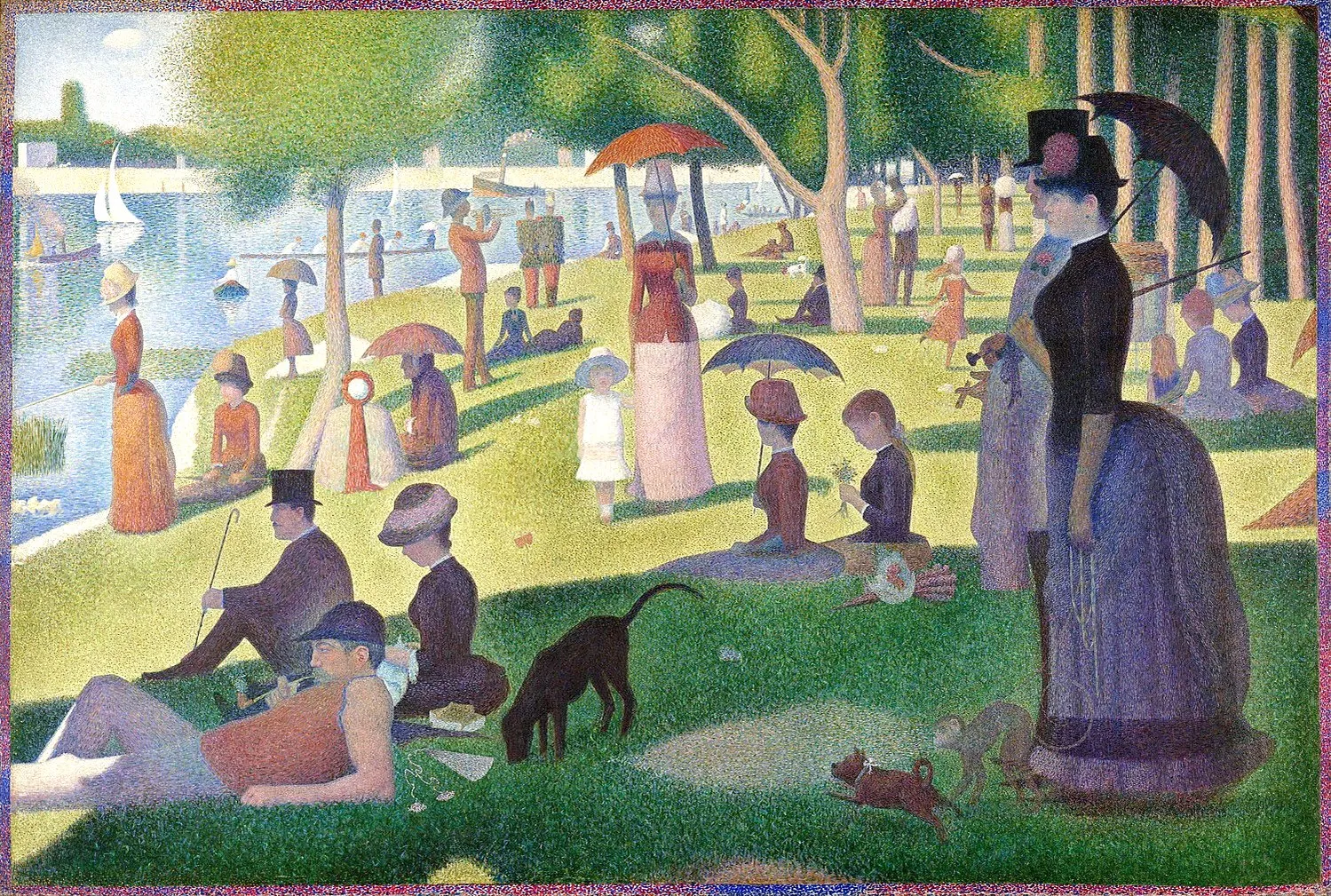
During the 1880s, the lower-middle classes frequented La Grande Jatte, an island in the Seine River’s northwestern suburbs near Paris. They gathered there for riverside strolls and Sunday afternoon picnics. This subject matter aligned with the fashionable themes, but Georges diverged from their pursuit of fleeting spontaneity. He meticulously prepared for this formalized image, creating over 70 preliminary oil sketches and drawings.
The canvas features around 40 figures, mostly in profile or full face. Initially static and seemingly uncommunicative, these figures include recognizable Parisian stereotypes. For instance, the woman in the right foreground, accompanied by a pet monkey—a symbol of lasciviousness—represents loose morals. On the left, a seated man with a top hat embodies the flaneur, a fashionable boulevard stroller. The transition from a shaded foreground to a bright background creates depth, although some shifts in scale can be disorienting. Seurat aimed to depict modern life in the style of a classical Greek frieze.
Seurat’s use of this highly systematic and “scientific” technique, subsequently dubbed Pointillism, set his art apart from the more intuitive approach favoured by the Impressionists. In 1889, Seurat made final adjustments to “La Grande Jatte.” He restretched the canvas, creating a visual transition between the painting’s interior and his specially designed white frame.
Spotted a mistake, or your photo used without permission? Report a correction