Battle Hymn
A stalwart in her own right, a messiah of the unheard and an unapologetic soul; Kara Walker pushes her artwork into the present while reflecting the pains inflicted from the past.
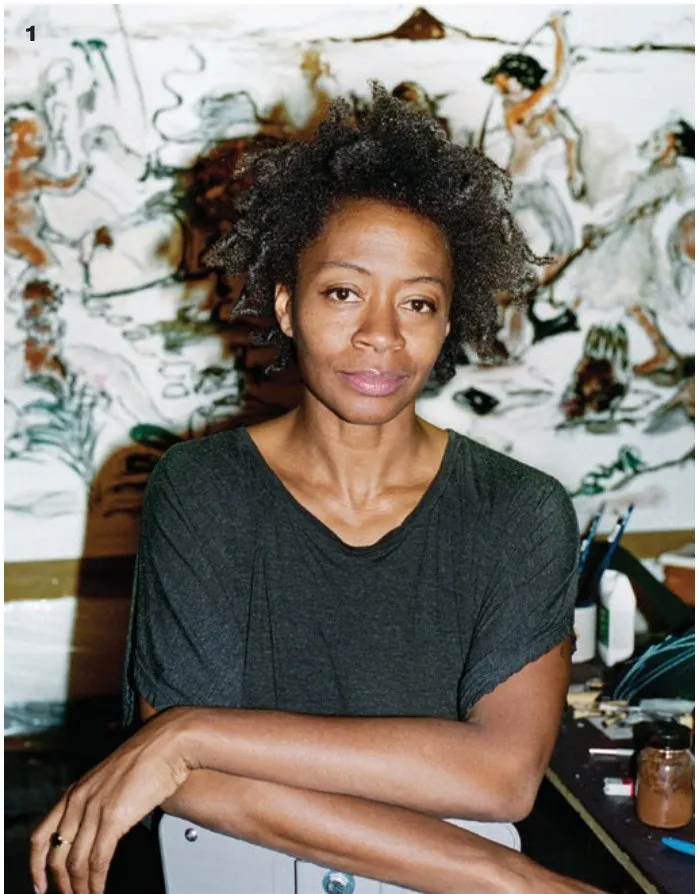




Born in 1969 in Stockton, California, Kara plunged into notoriety in the 1990s after studying at Rhode Island School of Design. Viewed as a whipsmart upstart, she made controversial cut-paper silhouettes of black figures that arguably played into racist caricatures – and won herself the MacArthur Foundation’s “genius” award in 1997.
But her craft, almost always monochrome, extends to etching, sketching and even sugarwork. She is now perhaps best known for ‘A Subtlety’, the completely unsubtle, giant, curvaceous sugar she constructed in 2014 at a disused sugar factory in Brooklyn, which drew such visitors as Beyoncé and Jay Z. The most consistent aspect of her work is its ability to latch on to you and unsettle you. The pouted lips of a black woman may be slightly engorged, the head of a baby rolling its eyes back might be slipping out of a vagina, a slave may be poised to chop off an arm. They’re like the unwanted, distressing thoughts that burrow into your head at night-time.
 L’Officiel India DigitalRead L’Officiel India in the digital libraryEvery issue and every cover story, on TCG Media.Read now
For Kara, who came to the art world's attention in 1994 with her mural Gone, An Historical Romance of a Civil War as It Occurred Between the Dusky Thighs of One Young Negress and Her Heart. This cut-paper silhouette mural, presenting an Antebellum south filled with sex and slavery was an instant hit.
Her latest adventure was the Hyundai Commission for the Turbine Hall at Tate Modern in London, which will run from 2 October 2019 to 5 April 2020. The commission is a coveted nod previously awarded to heavyweight artists from Louise Bourgeois to Carsten Höller, who famously turned the gigantic space in the Gilbert Scott-designed Bankside Power Station into a series of giant slides, and Tania Bruguera, whose offering last year included a heat-sensitive floor that used the audience’s collective warmth to reveal a hidden portrait of a young man who had immigrated from Syria.
Being known for her ambitious work across mediums interrogating race, sexuality, slavery and identity; her recent feat - Fons Americanus is Kara's fourth site-specific work, and it references classical British artists such as J.M.W. Turner and William Blake, as well as African- American historical figures including Emmett Till and Marcus Garvey. The artist was inspired in part by London’s Victoria Memorial, a towering, majestic monument to the Queen who commandeered the British Empire. “I just got this jazzy feeling. I’m interested in ways allegorical figures are misrepresentative of the thing they’re meant to symbolise,” says Kara. Tributes to empire in the U.K., like Confederate statues in the U.S., have come under scrutiny in recent years, as observers reconsider how frequently immortalized figures also played key roles in the oppression of others. “Public space creates the opportunity for misinterpretation. In some ways, I think my work is a misreading of empire," shares Kara.
“Kara’s aesthetics may often be black and white, as in her large-scale silhouettes or virtuoso charcoal drawings, but her thinking is anything but limited," says Achim Borchardt- Hume, Director of Exhibitions & Programmes at Tate Modern.
Details of the installation are closely guarded, but Achim reveals that the 3 million visitors who are expected to visit the Turbine Hall in this period – and the many more who will do so virtually – will be asked to consider as a single shared history that which is often separated as “British history”, “American history” and “black history”. “If this sounds heavy,” he adds, “I can promise you that it will bring a lot of smiles.”
Looking at Kara’s work, we began to see how all of it – the falling bodies of those felled or chopped-up black figures, all those dead and dying young men and women ignored by their government, local health
care systems, not to mention their families – were part of a system: America as an affliction. And, in
that America, there was a split between community and the individual. Kara showed, as my dead
showed, how power was consolidated, and how it fed the few while making a horrible mess of the
many.
Kara’s work was a new reality, a turning point in the history of art, because her art was about
society without being social realism. Looked at a certain way, it is abstract without turning away
from the world in order to represent internal abstraction – the flow of mind and heart, the language
of the self; rather, it depicts the concrete abstraction of humans relating to themselves, to history,
to the world. I felt and identified with what she made of a world and what it made of her as we sat
at the feet of the dead or the dying.
Spotted a mistake, or your photo used without permission? Report a correction