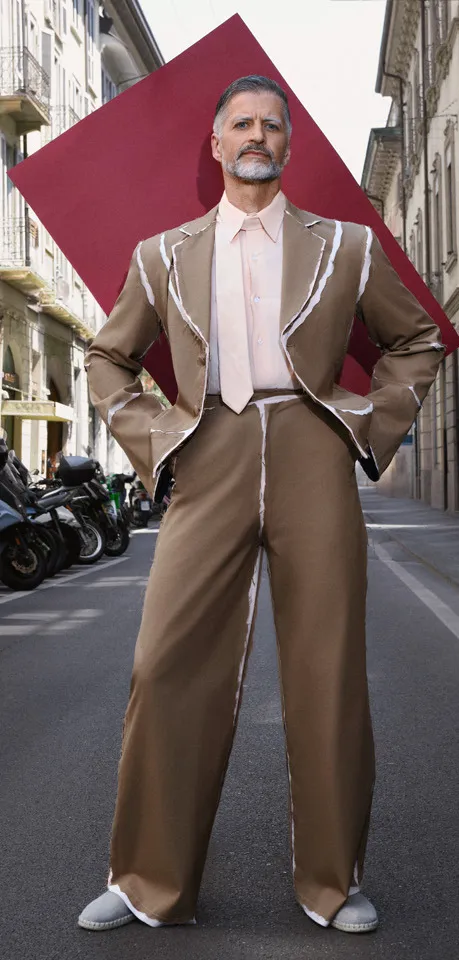
Ancestral Connoisseur
History isn't always written in vernaculars and tales, rather it is deciphered by art. India's magnanimous tradition in craft keeps it at the paramount of preservation for generations to come.





ROGAN

Exquisite and meticulously crafted, Rogan painting is a conventional art form which alludes to Persian influence. While the art continues to linger in a state of unawareness, it is in the quaint, dusty village of Nirona where exists only one family that has devotedly kept this beautiful Rogan art alive and thriving. Abdul Gafur Khatri’s family has a rich legacy of creating wonders on fabrics.
"Rogan is an outcome of imagination, and experimentation of various kinds of form. Earlier it was perceived as ‘Folk” and later it evolved as fine work. I have worked with various kinds of color combination and different textile bases (earlier cotton and sometimes silk). The inspiration from nature actually brought Rogan the finesse it has today, and it is my immediate family that started this trend," says Abdul.
 L’Officiel India DigitalRead L’Officiel India in the digital libraryEvery issue and every cover story, on TCG Media.Read now
Enraptured by the beauty of Rogan, Abdul promised his father that he would take it to the international level. Needless to say, he fulfilled his promise when Prime Minister Narendra Modi chose Rogan art to gift to the then U.S. President Barack Obama during his U.S. visit in 2014.
"Rogan is on the verge of extinction, and it almost diminished in 2008. It was then I decided to ignore the community norms of training only men workforce, and started to encourage women to take up this art for its growth and survival. I do not know how long Rogan art would survive, but our community is trying its best to revive and sustain the art form," shares Abdul.
CHAMBA RUMAL
Recognised as a Master Craftsperson for excellence in Chamba Rumal embroidery, Lalita Vakil has devoted her entire life for the upkeep of the traditional art form. Known for exhibiting her exquisite work and lending her expertise and training to further the craft, she says that her biggest satisfaction comes from the knowledge that many young and aspiring girls have benefitted from her passion.
"Since 1971 and it was my mother and grandmother who inspired me to take up this passion. While following my mother’s work closely, I learnt that it was customary to gift embroidered rumals in a girl's marriage. She would often playfully tell me that one day I would also get married, and for that I would need to prepare my own ‘Rumal’, which generated my interest in the art. After that, there was no looking back," says Lalita.
What essentially distinguishes her work from the rest is Lalita's eye for detail and her vast knowledge about both embroidery and painting. Traditionally done only on muslin, she has developed new designs on fabrics such as silk, tussar and voile. Infusing traditional methods with the vibrancy of contemporary themes, she finds joy in experimenting and launching new designs that in turn add a new life to this fading art.
"I don’t design. I am a storyteller and proud craftswoman. The relationship of a craftsperson with their material is synonymous with that of a devotee to their God. My craft is unique because it a strong expression of my personal and social belief. My major inspiration comes from original traditional work such as “Raas”, “Radha Krishna”, “Hunting”, “Pahadi Miniature”, ‘Dashavtaar’, ‘Raas Mandal’, Chota Shikaar’, ‘Parijata Haran’, ‘Gaudhuli’, ‘Raas Manjari’, ‘Das Maha Vidya’ and variation of these in more innovative ways without losing the essence of the craft," shares Lalita.
LEATHER PUPPETRY

Dalavayi Kullayappa's intricately carved and vividly coloured leather puppets are known for unravelling stories like no other. It is not every day that you get to witness stories from Indian epics through larger-than-life puppets, and striving hard to make sure that leather puppetry does not fall by the wayside is Dalavayi. For him, puppetry is an age-old family legacy, unique to Andhra Pradesh’s traditional folk culture.
"As a 5 year old boy, I was very fascinated by the vividly colored leather puppets. It was also very entertaining to see puppet show which is an interplay of narrative, music, drama and songs. All that attracted me to become a showman, where I am the director and all the puppets are my characters and I direct them based on stories and scripts. I don’t support animal cruelty anymore, so we now buy leather which is available in the market," says Dalavayi.
Brainchild of Iti Tyagi, India Craft week (ICW) an offspring of Craft Village is an initiative to bridge our nation's iconic heritage, and skilled craft-people, such as Dalavayi by allowing them to narrate their untold stories. Having spent over 20 years practising and promoting leather craft, Dalavayi is a recipient of National Award and is a UNESCO awardee. He was also conferred an honorary PhD from the University of Vietnam as a chief contributor to the revival of leather puppetry. As part of conservation efforts, he has organized a series of master creation programmes across the country.
"As the world is moving towards a cruelty-free future, the art form doesn’t have many takers today. Our future generation seems reluctant of taking it up further, ethically and morally. We had no choice so we did what was locally available as a resource material, or an outcome of hunting. And in order to preserve what our forefathers started, we are doing our best to save this dying art," shares Dalavayi.
TANEIRA - KHADI SARI
Celebrating the spirit of Khadi, ‘Parichay’ – an experiential walk-through of 150 hand-spun and hand-woven Khadi sarees by Taneira were presented as a symbol of India’s Textile Heritage. The brand worked closely with the weavers and the artisans from all across the country to bring alive this “fabric of diversity”. The exhibition boasts of 35 different crafts from 28 regions of India showcasing the versatility of khadi as a fabric. Resonating with the spirit of Khadi, Taneira’s products are simple, natural and indigenous in every aspect.
"For long Khadi, has been a symbol of Indian persistence; a fabric which has given Indian resurgence new meaning. This year, as we celebrate 150th birth anniversary of Mahatma Gandhi, it gives us an opportune moment to re-contextualise the meaning of the “humble charkha” for modern India. We re-imagined Khadi as the fabric of diversity. Further, we tried to demystify khadi and challenge its stereotype of being the modest coarse cotton, says Rajeshwari Srinivasan, COO, Taneira.
Each saree in this collection has been handcrafted keeping in mind that it carries the legacy of the cluster they represent while blending with the comfortable, breathable fabric that is khadi. From intricate Kanjeevarams to laborious Bengal Jamdanis, ethereal chikankaris to royal zardosi, playful madhubani to meticulously crafted double-sided ajrakh, this collection presents a new vocabulary of Khadi.
Rajeshwari further adds, "India boast of a rich heritage of crafts and textiles that have been passed on from one generation to the other and these skill based art and crafts can only flourish if the community is well supported in future as well."
MINIATURE PAINTING

Master Craftsman Syed Shakir Ali of Jaipur is a renowned miniature painter who specialises in the Mughal style of painting. He has been painting since the age of fifteen after completing graduation in 1978. He took up the guidance of renowned painters, Ram Gopal Vijayvargiya and Ved Pal Sharma and (Bannu) to learn Mughal and company styles of painting as well as traditional art.
"The intricacy of this field is what fascinates me the most, which means when you look at a painting with a ‘Magnifying Glass’ or ‘Microscope’ then you could really see what has gone into making it the most finest piece of art on earth and it makes it hard to believe that such fine work is possible. It gives me a sense of high, as that is the crux of finest paintings ever made. The style that fascinated me always is ‘Mughal School’ and the paintings of the British period possessed by my grandfather," says Shakir.
Shakir Ali is the recipient of numerous awards and honors including SAARC, Pakistan National Award, Nexzen Excellence Award and the Padma Shri Award. He has also restored old paintings in City Palace, Jaipur and Prince of Wales Museum, Mumbai and they also have a collection of his paintings. Since the last few years he has been experimenting with new creativity and has started working in modern miniature and contemporary art where he is continuing with the miniature technique. His work is infused with delicacy and fineness of strokes that reveal his mastery over the technique of miniature painting.
"Good art is like great education, and preserving art would mean preserving education, as it brings emotions, self-expression, appreciation and many such human aspects, and contributes to holistic development of a social sensitive human being. Imagine a world without art, how is it going to look like? One cannot imagine! Therefore, global community should comprise of compassionate human beings with an outlook towards, people, society, animals, birds, nature, environment or sustainability," shares Shakir.
KANTHA
For eons, women have been telling stories through various forms of art and music. Indigenous to Bengal is the beautiful Kantha stitch, one of the oldest forms of embroidery, and using it as a medium for self-expression is Presidential Award winning artisan, Mahamaya Sikdar, who has taken the Kantha art to levels of unimagined prowess.
"I refer to my work as the “Song of Life” where I have been trying to capture inner reflections in the embroidered form as daily stories or ‘Katha’. So when I started working with various women, I loved the diversity of ideas, as everyone was different and so was their work, and that showed the potential of this form bringing so much on table from daily lives, influences, emotions and inspirations," says Mahamaya.
She now has a cluster of about 300 women from the suburbs of Kolkata working under her, subsequently creating additional income source for them. Her girls are taught personally by her; most of them want to take up quilting practice as a profession.
There are various methods in Kantha, however, the popular one involves running stitch. Other methods include Lohori Kantha, Anarasi Orr Lik, Cross Stitch and Sujni Kantha. My grandmother used to practise a variety of stitches such as kashidakari, button stitch, and satin stitch.
"The key element that distinguishes my work from countless other artists is my ability to experiment with traditional processes. In many cases I use color harmony by using the threads that are extracted from the same saree or fabric using variations in tints and shades, making it more classical in its approach. Just as a musician forms nodes to create the perfect rhythm, we are the composers of our own art and our work has the same rhythm and harmony between threads, colors, motifs and overall composition," shares Mahamaya.
Spotted a mistake, or your photo used without permission? Report a correction