Source
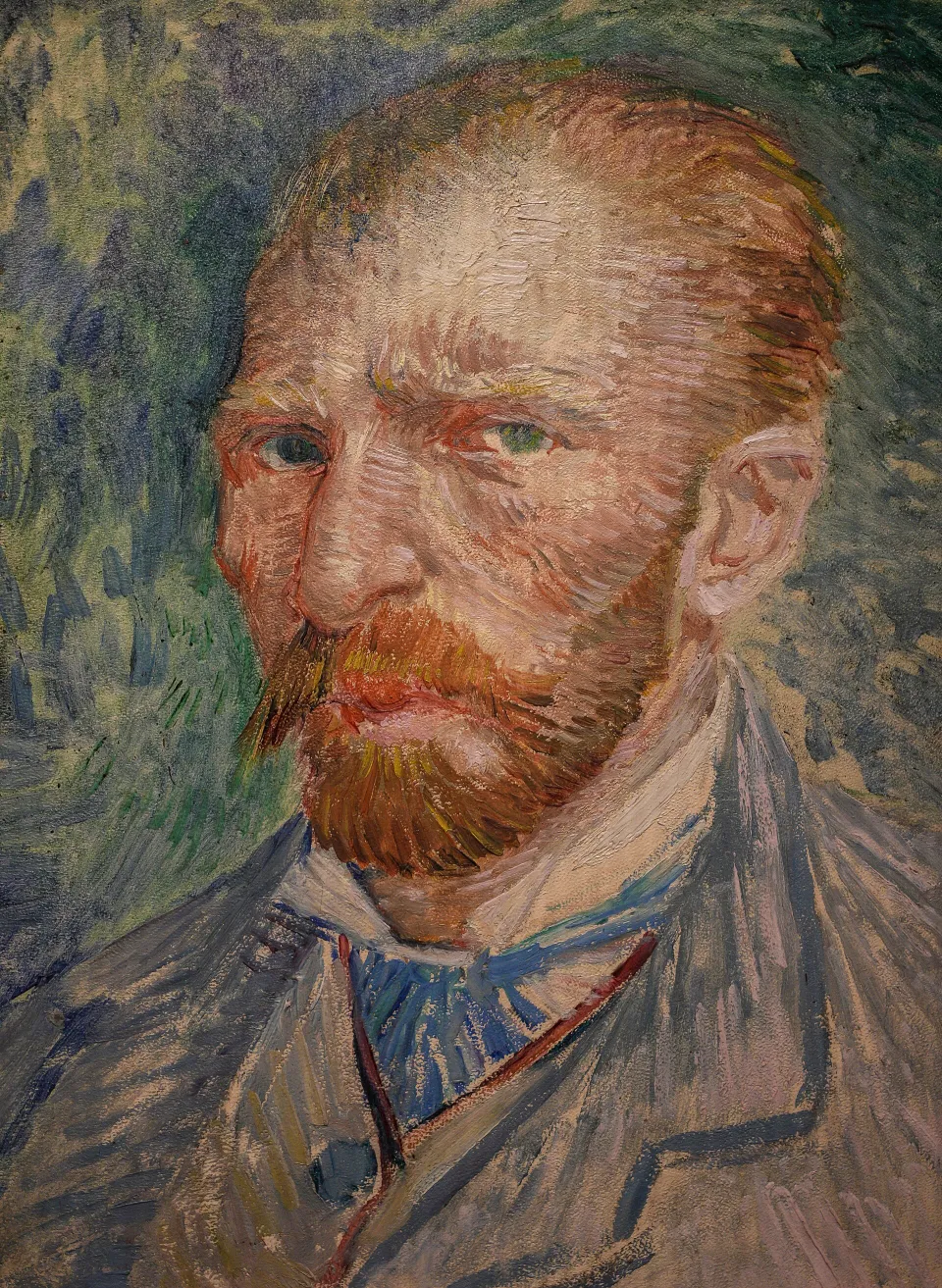
Photo: Vincent van Gogh / Wikimedia Commons, CC BY-SA 4.0https://commons.wikimedia.org/wiki/File:Self-portrait_-_Vincent_van_Gogh.jpg
Vincent van Gogh
The Dutch painter Vincent van Gogh (1853–1890) worked as an art dealer and a preacher before taking up art at 27. In ten years he painted the Sunflowers series and The Starry Night, and since 1973 Amsterdam has had a museum devoted to his work.
Early life
Vincent van Gogh was born on 30 March 1853 in Zundert, a village in the Dutch province of North Brabant, the eldest son of a Dutch Reformed minister. Of his siblings, the one who mattered most to his work was his younger brother Theo, with whom he kept up a correspondence that would last the rest of his life.
In 1869 he joined the art dealers Goupil & Cie in The Hague as a clerk, handling prints and reproductions years before he painted anything himself.
Dealer, teacher, preacher
Goupil sent him to its London branch in 1873, at the age of 20. He worked at the firm's Covent Garden gallery and lodged across the river in south London, on Hackford Road. Dickens and George Eliot were among his reading. The firm moved him to Paris in 1875, and after about seven years in the art business he left it.
In 1876 he taught at schools in Ramsgate and Isleworth. After a spell in a Dordrecht bookshop and study for the ministry in Amsterdam, he went to the Borinage, a coal-mining district of Belgium, as a lay preacher. The church did not keep him. By 1880, at 27, he had decided to become an artist.




Teaching himself to paint
Van Gogh was largely self-taught. He copied prints and worked through drawing manuals. Theo, by then a dealer himself, sent money and encouragement, and that support never stopped. Rural life was his first great subject: in 1883 he went to live with his parents in Nuenen, where he painted dozens of studies of peasants' heads. They led to The Potato Eaters of 1885, a dark, earth-coloured picture of a family at supper and his first large composition with several figures.
Late in 1885 he left for Antwerp to study at the academy, and soon moved on.
Paris and a new palette
In February 1886 Van Gogh arrived in Paris and moved in with Theo in Montmartre. In Paris he met Émile Bernard, Henri de Toulouse-Lautrec and Paul Gauguin. Seeing the Impressionists and the dotted brushwork of Georges Seurat and Paul Signac, he lightened his palette, and with his brother he collected Japanese woodblock prints. The browns of Nuenen gave way to clear colour and quick, broken strokes. Pictures such as Self-Portrait with a Straw Hat of 1887 show the change, as do the dozens of flower still lifes he painted in the city.
Arles and the Sunflowers
In February 1888 he left Paris for Arles in the south of France, hoping to found a community of artists, a "Studio of the South". He rented the Yellow House in May, and only Gauguin answered the invitation, arriving on 23 October 1888. To decorate the house, and the guest room in particular, Van Gogh painted sunflowers in a vase. The first four versions were made in a single week in August 1888, and he went on to make seven in all between 1888 and 1889.
Five of those canvases now hang in public collections, among them the National Gallery in London and the Van Gogh Museum in Amsterdam. One is privately owned, and one was destroyed in Japan in 1945. Gauguin's stay ended in late December 1888.
Saint-Rémy and Auvers
From May 1889 Van Gogh spent about a year at Saint-Rémy-de-Provence. The cypresses and wheat fields around him became the subject of some of his best-known pictures, among them Wheat Field with Cypresses. The Starry Night was painted there in June 1889; it entered the collection of the Museum of Modern Art in New York in 1941.
In May 1890 he moved north to Auvers-sur-Oise, near Paris and near Theo, where he worked at great speed and painted his Portrait of Doctor Gachet. He died in Auvers on 29 July 1890, aged 37.
Legacy
Van Gogh made nearly 900 paintings and more than 1,100 works on paper in a single decade, yet sold almost nothing while he lived. In 1890 the Belgian painter Anna Boch bought one of the canvases he had shown at the Les XX exhibition in Brussels. His reputation was built after his death, largely by Theo's widow, Johanna van Gogh-Bonger, who exhibited the work and published the brothers' letters, still the most detailed record of how he worked.
In 1962 Theo and Jo's son, Vincent Willem van Gogh, set up the Vincent van Gogh Foundation to keep the family collection together. The Van Gogh Museum, in a building designed by Gerrit Rietveld on Amsterdam's Museumplein, opened in 1973 and holds the largest collection of his work. The Fauves and the German Expressionists took his colour and brushwork as their starting point.
Van Gogh and couture
For his spring-summer 1988 haute couture collection, shown in Paris in January 1988, Yves Saint Laurent paid tribute to Van Gogh with evening jackets that recreated Irises and Sunflowers. Each jacket took the embroidery house Lesage more than 600 hours, and the iris version carries about 250,000 sequins in 22 colours. Naomi Campbell wore the sunflower jacket on the runway with an emerald-green pencil skirt, and in 2019 one of the sunflower jackets sold at auction for 382,000 euros, a record for a Saint Laurent garment.
Paintings
- The Potato Eaters
- Self-Portrait with a Straw Hat
- The Sower
- Sunflowers (series of seven)Painted in Arles; versions in London, Munich, Amsterdam, Philadelphia and Tokyo
- Wheat Field with Cypresses
- The Starry NightMuseum of Modern Art, New York
- Portrait of Doctor Gachet
Sources
- Van Gogh Museum: Young Vincent
- National Gallery of Victoria: Vincent van Gogh timeline
- The Metropolitan Museum of Art: Vincent van Gogh (1853–1890)
- Rijksmuseum: Vincent van Gogh
- The National Gallery, London: Vincent van Gogh, Sunflowers, 1888
- National Gallery of Australia: The seven Sunflowers
- English Heritage: Vincent van Gogh blue plaque
- Tate: Seven things to know about Van Gogh's time in Britain
- The Art Newspaper: The story of Van Gogh in Brixton, 150 years on
- National Gallery of Art, Washington: Vincent van Gogh
- The National: Van Gogh Museum at 50
- Museum of Modern Art: Van Gogh, The Starry Night (course notes)
- Musée Yves Saint Laurent Paris: A collection paying tribute to artists
- The Metropolitan Museum of Art: Yves Saint Laurent
- Van Gogh Museum: The woman who made Vincent famous
- Van Gogh Museum: From dark to light
- FashionNetwork: Yves Saint Laurent jacket fetches record sum
Put together from published reports in trusted Indian and international media; every statement is checked against at least three of them. Details can change. Profile updated 22 Nov 2026.
For the person, their manager or PR, or the owner of a photo. We act within 7 working days.
Vincent van Gogh on L’Officiel India
All stories

 in your inbox
The best of fashion, beauty and culture, picked by our editors. You choose how often.