
Reinforcing Royalty
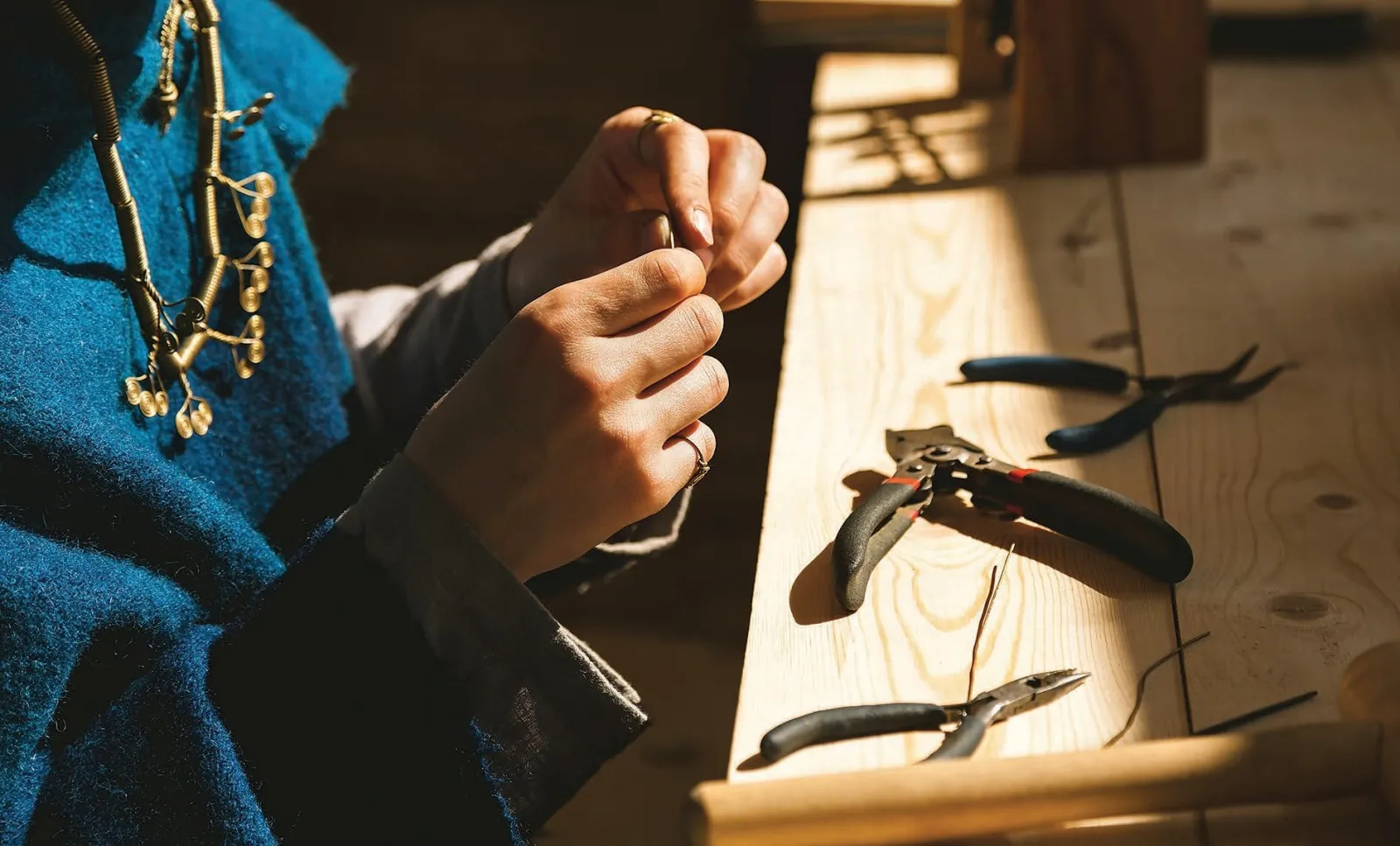




With the constant pressure of reinventing, it can be quite a feat to straddle tradition. Contemporary jewellery designers of India are stepping up in support of the rich and diverse history.
Let’s confess how every time a magnum opus by Sanjay Leela Bhansali or Ashutosh Gowariker left us enchanted and completely immersed in the grandeur of our past. From larger than life sets, props to fascinating costumes and heavily embellished and elaborately crafted pieces of jewelleries—it’s a mere glimpse of the rich traditional legacy of Indian art and craft summarised in 180 minutes. The history of Indian jewellery spans more than 5000 years with mentions and illustrations from epics, legends and mythology. Archaeological surveys traced the use of jewelleries back in the Indus Valley civilisation. Adornments made from flowers, stones gave way to precious metals and gems owing to the socio-economic transitions in India. The advent of Mughals in the 16th century has proved to be one of the glorious periods for Indian jewellery. Their reign introduced precious gemstones and most importantly, the art of jewellery engineering blossomed in this era. India was the first country to mine diamonds. The first mines were discovered in Hyderabad, and art of jewellery designing flourished under the patronage of the Nizams. The sentiment behind jewellery possession extended from royal gifts to establishing social status, sign of immortality and investment or fall back options at times of crises.
 L’Officiel India DigitalRead L’Officiel India in the digital libraryEvery issue and every cover story, on TCG Media.Read now
With trading and exporting businesses blooming in the 19th century, Indian jewellery experienced global influence from Russia and Europe. The mingling of ideas inspired Indian craftsmen to experiment with the designs and techniques. Modernisation wasn’t just limited to Indian artisans. Even the legendary jewellery brand, Cartier, is known to have designed jewellery for Indian Maharajas. Innovation and adaptability are the driving factors in the realm of art, jewellery design being no exception. But, how important is it to hold on to or merge one’s roots to preserve the glorious past? In our quest for answers, we speak to two new age jewellery designers Abhishek Raniwala, Co-founder of Raniwala 1881 and Latika Khanna, Founder and Designer, Latique who tell us what it takes to give a fresh perspective to heirloom designs without compromising on the old-world charm.

Need of the hour
With global influences at its peak, it’s high time credible measures are taken to revive our traditional art forms, and inculcate the cultural values in the youth. Explains Latika, “Over 1650 dialects are spoken by the people of India and the harmony is worth mentioning. While traditional way of art and crafts received royal and aristocratic patronage during pre-Independence days, and played a central role in Gandhi’s independence struggle, they have slowly lost relevance with the advent of industrialisation. While it’s still preferred to adorn traditional jewellery on various important occasions like marriages and pujas, there still is a need to constantly revive and improvise the design aesthetics. A cross-functional and multidisciplinary innovation activity, capable of making sense of social challenges while devising strategic and holistic solutions to support competitiveness, is definitely the need of the hour.” She further adds, “At Latique, we understand this and are constantly seeking out and applying ways to keep the traditional way alive. Our design process involves steps where we consider factors like modern and appealing aesthetics, but also has an exigent touch of tradition. Apart from that, we have various programs to help our artisans who are the real heroes in keeping the traditional way of art and craft alive.”
Design ethos

The jewellery from the house of Raniwala 1881 echoes the imperial history of not just Rajasthan, but also the country in a very modern way by extracting the motifs and inspirations from the legacy. Although the concept is old, the techniques and settings used are contemporary. “As the global trend is getting retro, the idea is to innovate production techniques in terms of cutting and setting of stones to give a more contemporary look. By keeping the latest trends in mind, we experiment mostly with pastel colour palette for navratnas,” shares Abhishek.
“Our design process begins with research and observation. The uniqueness of our creation lies in the interpretation of design sources. Sources of inspiration exist everywhere; anything visual, tactile, indeed sensual, can lead to inspiration in design,” explains Latika. She stresses the fact that both the craft and design departments of her brand share a symbiotic relationship. Through craft the designers connect with the natural world and the collective past.
Best of both the worlds

Traditional jewellery skills are mostly adapted to contemporary design. Latika believes that it’s the duty of the designers to bridge the gap between the market and the artisan, as today the artisan is geographically apart from his/her client, to be able to understand his/her aesthetic and socio-cultural needs. Designers are thus a bridge, between the past and the present, matching the traditional techniques to the needs of modern times and demands. She adds, “Empathy and focus on the little details along the process of making each design come to life is what we aim for at the house of Latique. We make sure that our admiration and passion for the traditional way is evident in our design–from inspiration to the final product till it reaches our customers.”
“A lot of motifs in our jewellery like paisley, lotus have been inspired by the traditional motifs. We combine these traditional motifs with modern techniques and colour palettes. Our vision is not just taking the rich legacy ahead, but to bridge the gap between two eras, and to communicate the rich heritage through our jewellery to the new generation,” explains Abhishek.
Inspiration everywhere

Says Abhishek, “Everything about jadau craft is fascinating and inspirational from motifs like flora and fauna to the architecture of the Mughal era. The design philosophy of the brand is inspired by the beauty of these motifs.”
For Latika, inspiration can often seem elusive and out-of-reach when you need it most and to contradict that, inspiration can be found anywhere and at any time. She explains, “I do not seek inspiration as such, but keep myself ready for it to come to me and by god’s grace it always does. Sometimes in quite an eerie time for which I have to jump out of my bed in the middle of the night. I also meditate every day to keep in touch with my core being and it helps quite a lot.”
Trends to reckon
While Latika loves the romance in the aesthetics of the renaissance time, she finds the Art Deco movement and the Mughal era quite enchanting. On the other hand, Abhishek is of the opinion, “What appeals to me the most is accessorising the jewellery, the way the Indian women used to adorn the jewels like baajuband, bodla, karnphool, nose pin, is no less than art in itself.” He further adds that a timeless choker strung with pearls and emeralds with a maangteeka and chandelier earrings is something which will never go out of fashion.
From the January 2020 issue of L’Officiel India.
Spotted a mistake, or your photo used without permission? Report a correction