Source
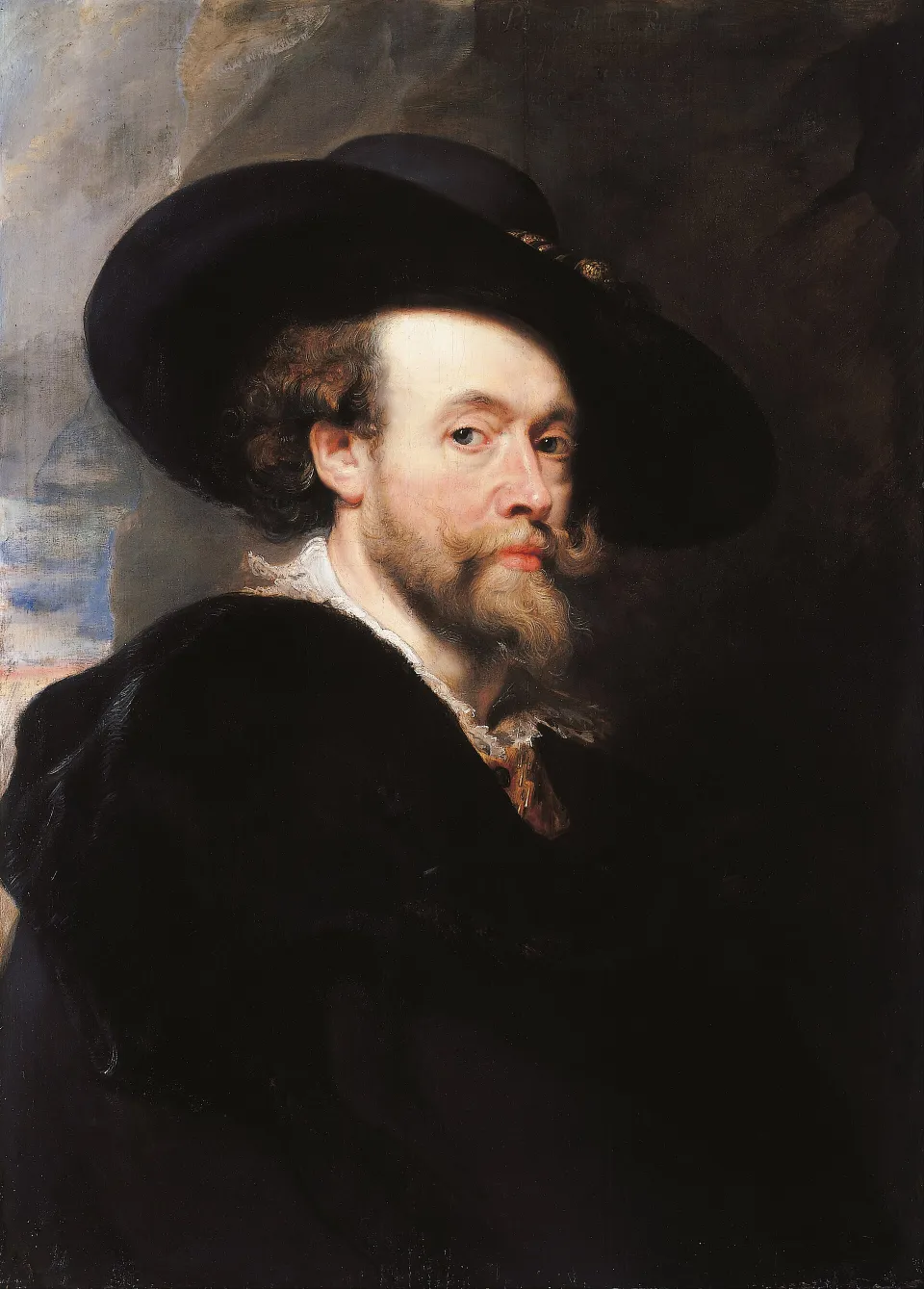
Photo: Peter Paul Rubens / Wikimedia Commons, Public domainhttps://commons.wikimedia.org/wiki/File:Sir_Peter_Paul_Rubens_-_Portrait_of_the_Artist_-_Google_Art_Project.jpg
Peter Paul Rubens
Peter Paul Rubens (1577–1640) was the leading painter of Baroque Flanders, court painter to the rulers of the Spanish Netherlands and a working diplomat, whose altarpieces for Antwerp and ceiling for Charles I's Banqueting House are among the best-known works of the European Baroque.
Early life
Peter Paul Rubens was born on 28 June 1577 in Siegen, a small town now in Germany, where his parents, Jan Rubens and Maria Pijpelinckx, had settled after leaving Antwerp. His father died when the boy was about ten, and his mother took the children back to Antwerp, the city that would shape the rest of his life.
He went to the Latin school there and then served as a page to the Countess de Ligne, a post that taught him court manners and polished his languages. He soon left the post to train as a painter, first with Tobias Verhaecht and Adam van Noort, and finally with Otto van Veen. A sketchbook survives from these years: 42 ink drawings made after prints by Hans Holbein, which the Rubens House museum dates to when he was about twelve.
In 1598 he was received as a master in the Guild of St Luke, Antwerp's painters' guild. He was twenty-one. The Rubens House dates his Adam and Eve, now in its collection, to 1598–1600.
Eight years in Italy
In 1600 Rubens left for Italy to see for himself the Renaissance and classical works he had known only from copies. He stayed eight years, mostly between Mantua and Rome, with spells in Genoa. Vincenzo Gonzaga, Duke of Mantua, employed him, partly to copy the Italian masters for the ducal collection, and Genoese noble families sat for him. A portrait probably of the Marchesa Maria Grimaldi with her dwarf dates from about 1607.
In 1603 the duke sent him to Spain as his envoy to Philip III at Valladolid, a first taste of the diplomatic life. There he painted the Equestrian Portrait of the Duke of Lerma and studied the Titians in the Spanish royal collection, a painter he would return to all his life.
In 1608 he hurried home to Antwerp to see his mother, who died before he arrived. He decided to stay.




Antwerp and the court
In 1609 Archduke Albert and the Infanta Isabella, the Habsburg rulers of the Spanish Netherlands, appointed him their court painter while allowing him to keep working from Antwerp. The same year he married Isabella Brant. The double portrait of the young couple seated in a honeysuckle bower, painted around 1609–1610, shows the newly married pair seated side by side. In 1610 he bought a house and land on the Wapper in Antwerp and rebuilt it as a home and studio; it is now the Rubens House museum.
For Antwerp's cathedral he painted The Elevation of the Cross (1610–1611) and The Descent from the Cross (1611–1614). He worked with friends as well as for patrons: Pan and Syrinx (1617) was painted with Jan Brueghel the Elder.
To meet the demand he ran a large workshop. The young Anthony van Dyck was among his assistants in the late 1610s. The National Gallery in London still catalogues several studio pictures alongside his own.
Painter and diplomat
In 1622 Rubens took on the largest commission of his career so far: a cycle of paintings on the life of Marie de' Medici, the queen mother of France, for her Luxembourg Palace in Paris. The series was painted between 1622 and 1625 and belongs today to the Louvre.
From the early 1620s the Infanta Isabella also used him as an envoy and close adviser. He carried messages and negotiated in Paris and Madrid, and later in London. His missions did not bring a lasting peace between the Spanish Netherlands and the Dutch Republic, but he helped end hostilities between Spain and England. Philip IV of Spain ennobled him in 1624, and Charles I of England later knighted him.
Isabella Brant died in Antwerp in 1626. Their daughter Clara Serena had died in 1623.
The Banqueting House ceiling
Charles I commissioned Rubens in 1629 to paint the ceiling of the Banqueting House at Whitehall, a project first discussed with his father, James I, before James died in 1625. The canvases, finished in 1634, celebrate the reign of the Stuart kings: the union of England and Scotland, the peaceful reign of James I and his apotheosis. They were installed early in 1636 and cover 225 square metres. They are still in place, and the Royal Academy has quoted the critic Waldemar Januszczak calling it a "truly remarkable piece of cultural diplomacy". In 1630 Rubens also gave Charles I the allegory Minerva protects Pax from Mars, now in the National Gallery.
Hélène Fourment and the late work
In 1630, aged 53, Rubens married Hélène Fourment, the sixteen-year-old niece of his first wife. She became the face of much of his late painting, from The Judgement of Paris (about 1632–1635) to The Three Graces. In 1635 he bought Het Steen, a country house at Elewijt near Mechelen, and the landscapes around it entered his work: The Rainbow Landscape and An Autumn Landscape with a View of Het Steen in the Early Morning, both from about 1636, and Landscape by Moonlight, painted between 1635 and 1640.
Philip IV of Spain was by then one of his most important patrons and ordered more than 80 paintings from him in the 1630s, many of them for the Torre de la Parada, the king's hunting lodge near Madrid. Saturn (1636) belongs to these commissions.
Death and legacy
Rubens died at his house on the Wapper in Antwerp on 30 May 1640, a few weeks before his 63rd birthday, and was buried in St James' Church. The city gave him a funeral with a guard of honour on 2 June. He had eight children in all, four sons and four daughters; the youngest was born eight months after his death.
Van Dyck learned from him at first hand, and Rembrandt and Delacroix after him. Later Gainsborough, Constable, Van Gogh and Picasso studied his pictures closely. In the nineteenth century Lord Byron and Ingres were among his detractors. The Royal Academy traced the line from Van Dyck to Cézanne in Rubens and His Legacy, which ran in London from January to April 2015.
Selected works
- Adam and Eve
- Equestrian Portrait of the Duke of Lerma
- Marchesa Maria Grimaldi and Her Dwarfabout 1607; sitter probably Maria Grimaldi
- Rubens and Isabella Brant in the Honeysuckle Bower
- The Elevation of the Cross, Antwerp Cathedral
- The Descent from the Cross, Antwerp Cathedral
- Pan and Syrinx (with Jan Brueghel the Elder)
- Ceiling paintings, St Charles Borromeo, Antwerp
- Coup de Lance, Récollets church, Antwerp
- Marie de' Medici cycle, Luxembourg Palace
- The Assumption of the Virgin, Antwerp Cathedral
- Banqueting House ceiling, Whitehallinstalled 1636
- Minerva protects Pax from Marsgiven to Charles I in 1630
- The Judgement of Paris
- The Rainbow Landscapeabout 1636
- Saturn
- Landscape by Moonlight
Sources
- Rubenshuis (Rubens House, City of Antwerp): Biography of Rubens
- Art UK: Peter Paul Rubens: prince of painters and painter of princes
- The National Gallery, London: Peter Paul Rubens
- Nationalmuseum, Stockholm: Peter Paul Rubens
- Städel Museum: Rubens, Peter Paul
- The Brussels Times: Nobody rocked the Baroque like Peter Paul Rubens
- Royal Academy of Arts: Rubens: a beginner's guide
- Historic Royal Palaces: The Rubens ceiling
- Deutsche Biographie (Allgemeine Deutsche Biographie, vol. 29: Rubens, Peter Paul
Put together from published reports in trusted Indian and international media; every statement is checked against at least three of them. Details can change. Profile updated 22 Nov 2026.
For the person, their manager or PR, or the owner of a photo. We act within 7 working days.
Peter Paul Rubens on L’Officiel India
All stories

 in your inbox
The best of fashion, beauty and culture, picked by our editors. You choose how often.