Fields of Gold

This season, the top Parisian jewellery houses have anchored their collections in nature. We take a closer look at this gorgeous trend and its cultural references.
At the very heart of the idea of fashion is this need to constantly change. That said, the heart of fashion also beats to the rhythm of fantasies. However, no matter how flippant it may appear, there is definitely a hardcore rationale to this fantasy world. Behind every piece of decorative or abstract art, there is an aspect of formal research. This instantly brings to mind the Années Folles of the Art Deco period and even the glorious decade of the ‘30s. Very often, gorgeous artistic results have emerged from historically difficult periods, like, say, the French Revolution, where there emerged a trend of simplicity and nature-inspired jewellery. The juxtaposition of two different styles has always been perceived as interesting—minimalism versus maximalism, classicism and modernism and even bling versus sober.
 L’Officiel India DigitalRead L’Officiel India in the digital libraryEvery issue and every cover story, on TCG Media.Read now
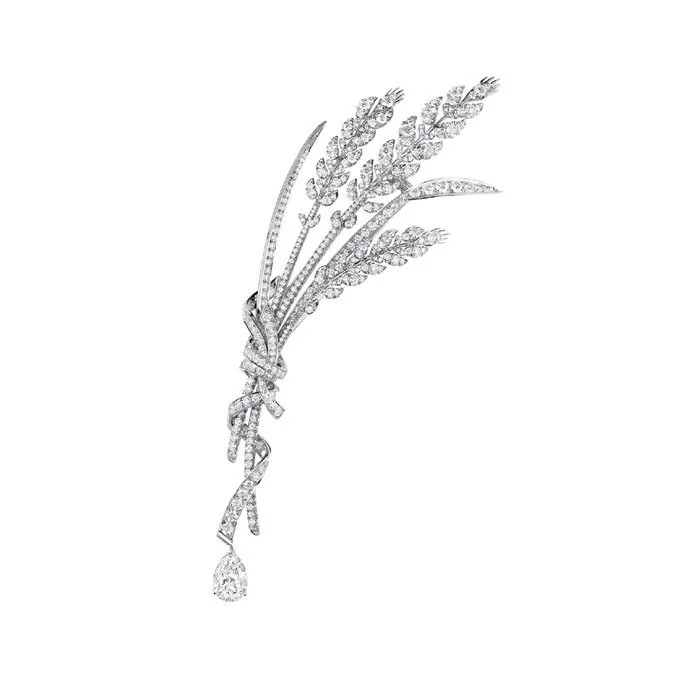
In keeping with the annual haute couture calendar, jewellers usually present their haute jewellery collections to clients and editors during the first week of July. This year, without stepping into a single Parisian jewellery house, we were able to capture the essence of jewellery trends just by looking at Place Vendôme. It was all about going back to nature. Chanel sponsored a giant natural installation in front of the Ritz, where it was presenting its nature-inspired haute joaillerie collection in Gabrielle Chanel’s suite. This 2,800 sq. m. masterpiece by artist Gad Weil featured an actual wheat field, planted in lacquer boxes. In this collection of 62 pieces, diamonds, peridots, aquamarines and sapphires were used to evoke the beginning of spring. For these nature-inspired motifs, the house of Chanel was influenced by Gabrielle Chanel’s life. The designer always used nature as a symbol of eternal rebirth, abundance and prosperity. Another coincidence, wheat was one of the central motifs of Chaumet’s haute jewellery collection by Claire Dévé-Rako. At their headquarters on 12, Place Vendôme, Chaumet set up a symbolic greenhouse, to showcase the fundamental design principles of the house. Pieces were exquisitely fashioned along the lines of wheat, lily and oak, among others. Similarly, the house of Boucheron showcased its collection “26 Vendôme” where radiant crystal lilies surrounded a 20 carat diamond, in addition to blades of wheat set with diamonds, etc. Around the same time, the house of Cartier presented a remarkable collection dedicated to cactus, at the Palais de Tokyo. The world’s most famous jeweller, known for its architectural style, has often sought inspiration in flora and fauna. If you visit its archives on Rue de la Paix, you will see to what extent Cartier has used floral motifs in its collections, dating back to the ‘30s. For the current collection, Cartier has chosen to reinterpret an ephemeral flower, and has done so with its unmistakable panache and finesse, playing with geometry, volume and texture. The pieces in question are best described as dreamy! Au naturel!
From the October 2016 issue of L’Officiel India.
Spotted a mistake, or your photo used without permission? Report a correction