‘It’ Has Arrived
Has the era of the indispensable accessory returned? It’s not that easy as the bar has been raised. Today, to be able to hold one’s attention, a bag must have an air of exclusivity.
The term it-bag became a cornerstone in the vocabulary of fashion in the 1990s. It was the time when minimalism was on the decline, letting flashy pieces become the new symbols of fashion. An exponential trajectory of growth for this trend was observed till 2008. That was when the global economic crisis hit and turned everything around, or at the least put brakes on superfluous expenses.
The rich had to, at a minimum, show that they, too, followed the movement. But, during those ‘dark’ times, a number of exceptionally designed bags saw the light of day. Baguette by Fendi, 2.55 bag’s revisited version by Chanel, Lady Dior, Murakami by Louis Vuitton, Le Dix by Balenciaga, and Paddington by Chloé. They became the must-have accessories, placed alongside the timeless Kelly and Birkin by Hermès and Bambou by Gucci.
 L’Officiel India DigitalRead L’Officiel India in the digital libraryEvery issue and every cover story, on TCG Media.Read now
These bags resulted in becoming such cash machines for their respective brands that every fashion house tried to come up with their own must-have. Often satisfied by claiming that their creation was an ‘it-bag’ with the hope that just by naming it, it would become one. Another phenomenon that fuelled the trend was the burgeoning number of aspirants for the proverbial social ladder. Somewhere, the concept of the it-bag was diluted. Making them available in different price ranges, the original idea became weaker and was on the verge of losing its relevance.
“The concept has changed. It still exists, but there are so many in the market now that the meaning has changed. When it-bags first appeared, it was about wearing a bag that actually said something about a relatively new concept that helped distinguish it from those available for mass consumption,” Fflur Roberts, head of global luxury goods at Euromonitor International, says. “It was followed by every brand coming out with their it-bags. Ever since, the market for such bags grew tremendously.
What also changed the dynamics over the last decade was how brands were trying to reach a middle ground between luxury and affordability.
Today, there are options in different price slabs within a line. The Internet also had an impact on it-bags and how it was viewed. “An it-bag is no longer something that you might have a slim chance of owning,” journalist Plum Sykes says. What he means is that with the digital revolution, it is now possible to buy a bag at a click of a button, without having to move physically.
Personalisation and rarity
“We are now exiting from a slow period in the market of it-bags,” says Gabriele Corto Moltedo, founder of a brand of independent luxury bags, Corto Moltedo. “There was a time of excess and customers got a few too many bags. Their interest shifted to shoes. This lack of attention to bags was the result of saturation in the market and also in customers’ head. We are now trying to bring back resurgence,” says Gabriele.
The number of logos back on bags seems to indicate that Gabriele knows exactly what he is talking about. Over the last few seasons, Fendi has placed its famous FF logo on as many bags as clothes, and the Louis Vuitton monogram has become more visible as well. So, Fendi has variations in its metallic logos, Louis Vuitton has the LV clasp on its Twist bags, and Dior bags have J’adior on its buckles conceptualised by Maria Grazia Chiuri.
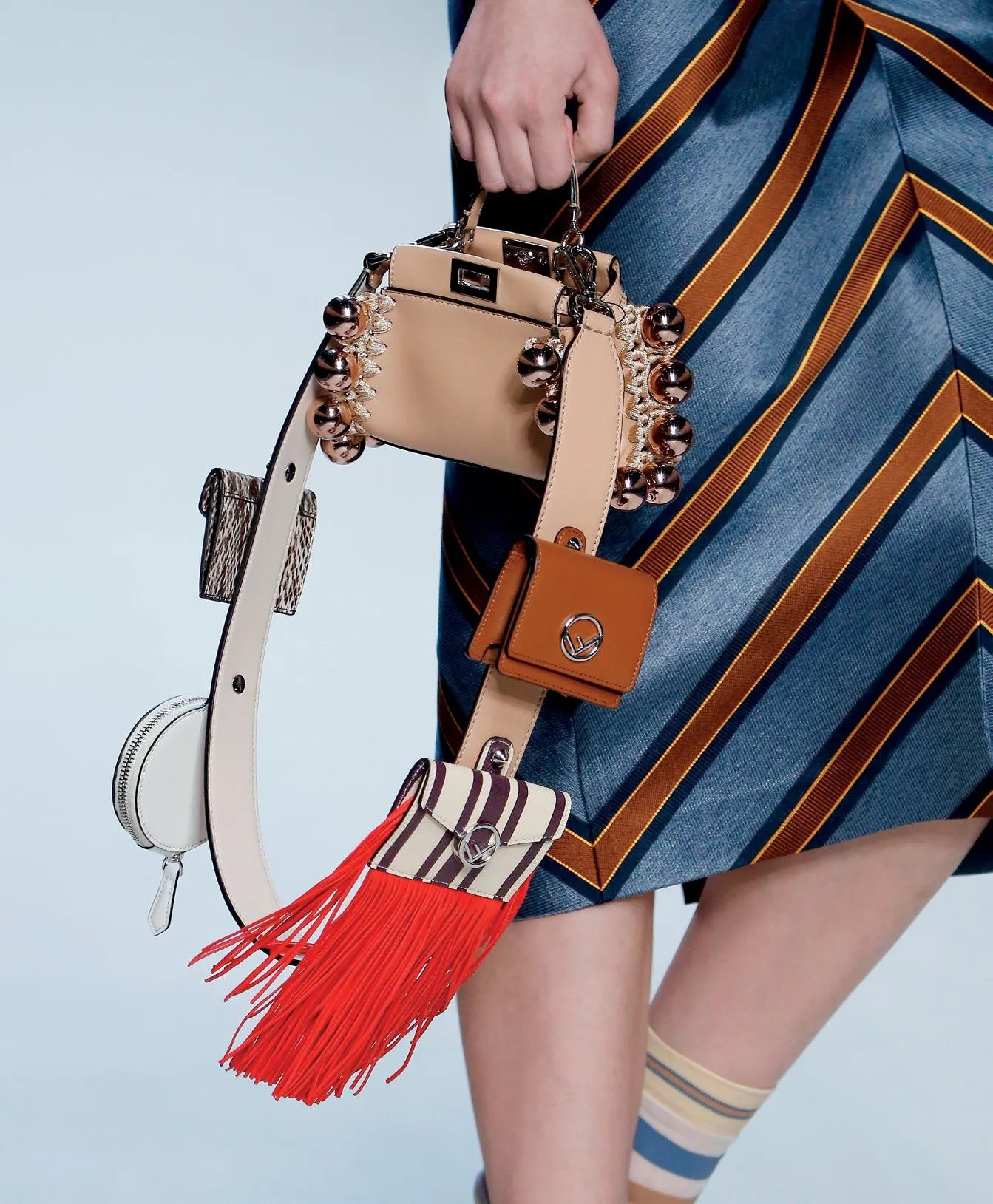
This new-found enthusiasm in branding it-bags is accompanied by a subtle increase in interchangeable straps or pendants that add youthfulness. Personalisation and rarity have become the fundamental vocabulary of the new it-bag.
The limited editions of Dionysus by Gucci are extremely sought-after, as are luxury bags available in rare colours and materials. Luggage by Céline has skilfully incorporated this concept, with a classic design that had been branded. With the Peekaboo by Fendi, we saw a discreet return of it-bags on the fashion scene. For decades, Hermès has been the master of the art of turning its bags into objects of desire by simply making them difficult to procure.
Millennials and their bags
It is interesting, as underlined by Fflur, that Millennials have a very different approach towards luxury accessories. They are a lot less interested as compared to the previous generations.
“The amount of money one would spend on an It-bag, they would rather use in booking themselves a luxury safari or a yoga retreat. It might or might not cost more than an It-bag, but spending on an experience is more important to them,” Fflur says. Or maybe because they can out it up on their social media accounts?
It is simple math. Travel photographs are sound investment as one can prolong the glamour of the trip through multiple posts, over several months. One the other hand, posts about buying an It-bag is restricted. It might actually have a limited visual pull. And yet, there has been a gentle increase in the sale of luxury accessories in the recently, with Chanel takes the lead.
It is a trend that does not seem to surprise Tina Craig, the woman behind Bag Snob, one of the first and most influential blogs on high fashion. “I believe that in real time, It-bags have (and continue to) come out at such a speed that women are literally afraid of buying one. At present, the ultimate It-bag is the classic 2.55 by Chanel and Mini Kelly by Hermès.
Tina adds that Prada has launched a bag that brings back its famous triangle logo, the same that decorated its black nylon bags in the 1980s. “For them, it became a sort of It-bag, if it does work, that would be because of its return to the classics. Customers want to invest in bags, but intelligently. So, a good choice would be something that has passed all tests, even in design.
Gabriele is in agreement as he adds, “It requires a life to transform an It-bag into one that is iconic. Or at least a generation after which it can be reinterpreted.” Gabriele launched his House in 2004, and ever since has unveiled two timeless designs, Priscilla and Susan, which he continues to remodel for his loyal customers. In that vein, he deliberately named his last collection, We Have More Than Enough, fashioned for a younger clientele. The designs are minimalist. “I think this is what the youth of today want... to make a statement with what they wear.”
The idea is as old as fashion itself, but it works every time, and stands true even now as it did when it all began. With It-bags, the message is loud and clear. It is no longer about immediate satisfaction or to prove something to others. It is about the brilliance of design.
From the April 2018 issue of L’Officiel India.
Spotted a mistake, or your photo used without permission? Report a correction