Jewel Moves
Trinkets are shining with cinematic effects as brands use daring metamorphosis to bring functionality and adventurous spirit together.




Place Vendôme, end of January. An unmissable event on the calendars of fashion journalists for many years is the week for the presentation of haute couture collections. It is the time when some of the most famous jewellery houses make the most of this exciting time in the Parisian calendar to unveil their latest collections, primarily their exceptional pieces.
The affinity between haute couture and haute joaillerie are unmistakable. One, just like the other, has the responsibility of shining light on the rarest and most fragile of techniques and methods, at times those which have even been forgotten but brought back to life for such occasions, created by the priceless hands of craftsmen who express the wonders through immaculately constructed pieces of art. “True luxury”, proclaimed Christian Dior in his memoires (1957), “drives real materials and real artisanal work. And it only makes sense if it, the work and the artistry, is deep rooted in rich and timeless tradition.” We could not possibly give a better definition for haute joaillerie than this.
 L’Officiel India DigitalRead L’Officiel India in the digital libraryEvery issue and every cover story, on TCG Media.Read now
The audacity and insolence
To respect and protect tradition does not mean that one must renounce all daring and sense of adventure. On the contrary, for great jewellers, it is a method of expression, and in so doing maintaining certain venerable canons. But, these creations are also meant to surprise and titillate. That surprise and that daring, those are hidden away in the details of the piece’s construction.
Our first stop was Chanel Joaillerie. A collection dedicated to lion, the symbol of the House. It was Gabrielle Chanel’s zodiac sign too, and also a symbol of the free and guiding star under which the designer’s destiny lay. One such creation leaves the display case for it has found its owner even as we looked at it. In high fashion, the general understanding is often to exalt the image of the House while high jewellery is a commercial reality. It is sold, and has been selling better and better in the last few years. How could it be any other way?
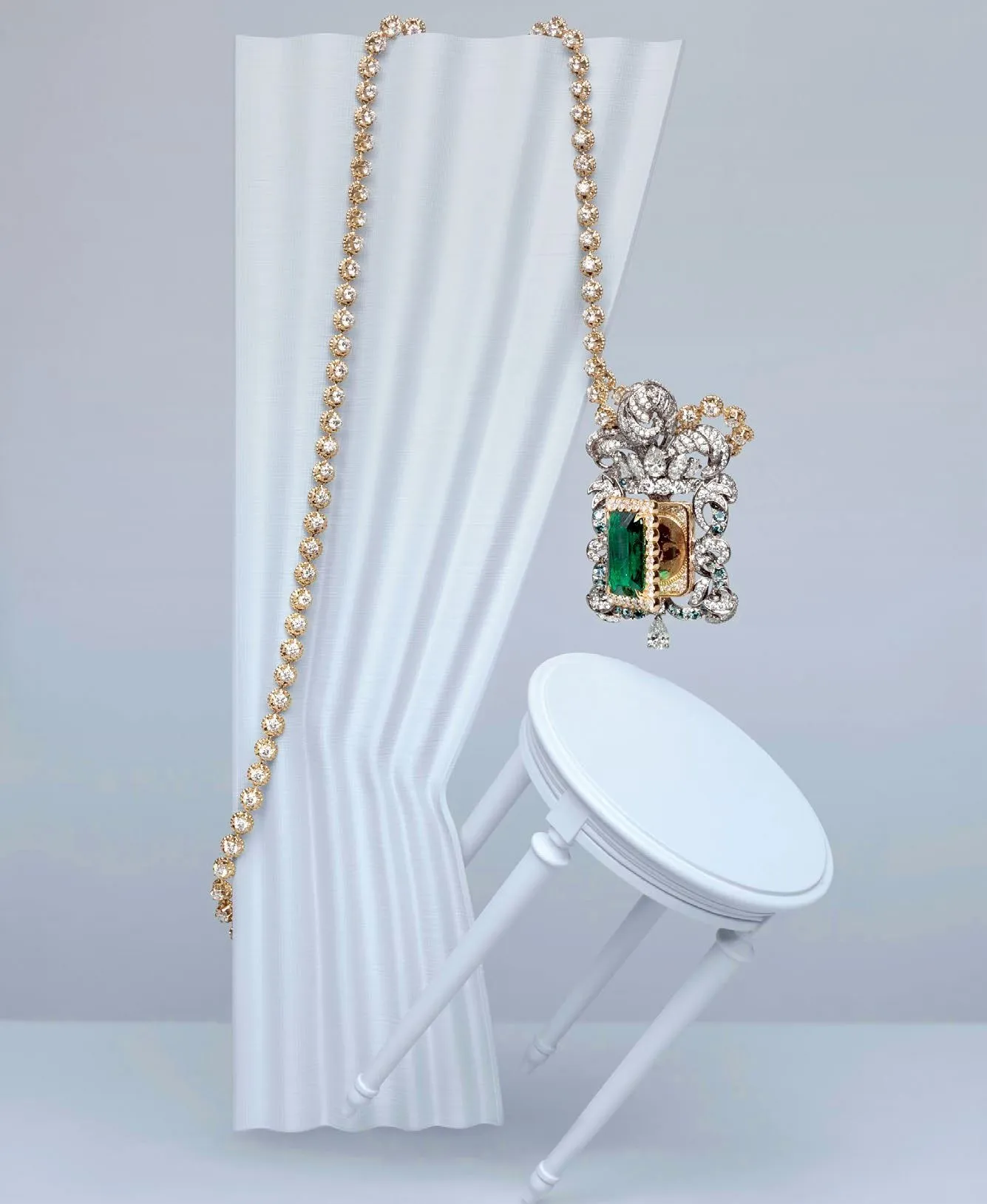
Multi-chained necklaces, open bracelets have a certain modernity that catches the eye. Instagram generates enthusiasm as posts are dedicated to grab everyone’s attention. It must be said that these pieces in yellow or white gold covered with sapphires, beryls and imperial topaz are ostensibly created for the woman of today who is the mistress of her silhouette and her life. These pieces are also intuitive. For example a necklace with long chains can also be used as a belt.

Prodigious exploits
A few steps away the venerable house of Chaumet also plays its role in the transformation with its new collection named Promenades Impériales, homage to the country of Doctor Zhivago. Under the guidance of Claire Dévé-Rakoff, the ateliers of this House founded in 1780 are mastering, without a doubt, the art of infusing in its most spectacular jewellery an additional soul and enthusiasm which has been missing from Parisian high jewellery. Here, a magistral necklace can be transformed and used in ten different ways.
The exploit is all the more prodigious that it, in no way, alters the details of the design or the finesse of execution: one really gets the impression that the number of steps gone in the creation of a piece of jewellery is like the innumerable little bits in making a singular snowflake. Among the new arrivals at the presentation of high jewellery in Paris is Goralska Joaillerie. It had viewers gasping in amazement at the inventiveness. As seen in the Pensée ring in black gold mounted on a rose gold crucible at the heart of which circulates, gaily and freely, a pearl of Tahiti.
Everyday companions
With Dior Joaillerie, one understands the meaning of the word panache. Victoire de Castellane contributed the largest number of pieces since the objective of Dior’s attendance this time around was the presentation of creations which were to serve as intimate every day companions to their wearers. In this case, ostentation was not the game. Certainly, the 36 pieces that made up the Dior à Versailles high jewellery collection were set with rare gems that together were far from ceremonious, stones that hide a multitude of exquisite romantic motifs.
Boucheron was not welcoming people at their boutique at Place Vendôme since it is under renovation and so was found at the Monnaie. Now, this was not a presentation but a true exhibit, large numbers of the public present to bask in the glory of the House’s creations. The entire affair was interactive as well: thanks to an app, the Wladimir chat, the feline companion of Gérard Boucheron, guides us through as we immerse ourselves in the beauty of the pieces.

We also learnt that the famous Point d’interrogation necklace, sketched in 1879 and having been reinterpreted several times since, was the first necklace to have been created without a clasp, symbolic of allowing women to let go of convention — at a time when nothing could have been achieved without the help of several people helping one dress — highlighting their waistline without the help of anyone. An innovation in the service of freedom, in a manner of speaking.
An ode to independent women
“The number of women heading such companies is increasing, but the percentage is still quite low. Less than five per cent of the world’s largest companies are headed by women. Being a CEO myself, this percentage affects me. Pomellato was founded in 1967, a key moment in the history of feminism,” Sabina Belli, general manager of Pomellato said.
The artistic scene in Milan was being forged and set ablaze by a new wave of jubilation which was all consuming. Pino Rabolini, the founder of Pomellato, wanted to, right after the House was created, to emancipate women through jewellery that was non-conventional. It was that essence, that homage paid to independent and free women that they want to perpetuate with the Pomellato for Women campaign. This company does not choose stereotypical beauties but accomplished personalities, such as Esther Kremer editors, the Enrico sisters, the godmother of Italian design, Rossana Orlandi, the art collector, Audrey Bossuyt, and so on.
Sabina Belli calls them “real women”. Chiara Ferragni of The Blonde Salad now joins this list. Sabina Belli defends this choice, “Chiara represents a new generation of women. At 30, this Italian entrepreneur is running a flourishing business. She succeeds every day in sending messages that touch millions of people.” It is not the influencer or Chiara’s physical beauty that Sabina applauds but the business woman who is independent and determined.
Is it necessary, therefore, to underline the fact that this change in semantics is a result of the social movement sparked by the Weinstein affair? It is a given, that for a woman, the criteria of excellence is no longer about being young and beautiful but to dream one’s destiny and accomplish it.
From the April 2018 issue of L’Officiel India.
Spotted a mistake, or your photo used without permission? Report a correction












