
Charles Zana: Collector Of Memories
Architect and designer Charles Zana takes us on a journey from India to the Americas through his spectacular personal collection of artefacts.




An 18th century façade and no signs of ostentation. The intercom is mounted on the side, facing the street. The name plates have nothing more than the initials of the occupants of the building in this bustling neighbourhood of the 6th arrondissement in Paris. A beautifully designed paved courtyard is visible beyond the boundary wall, a menagerie of branches of different trees overhead. What a precious and rare private canopy in the city, we think.
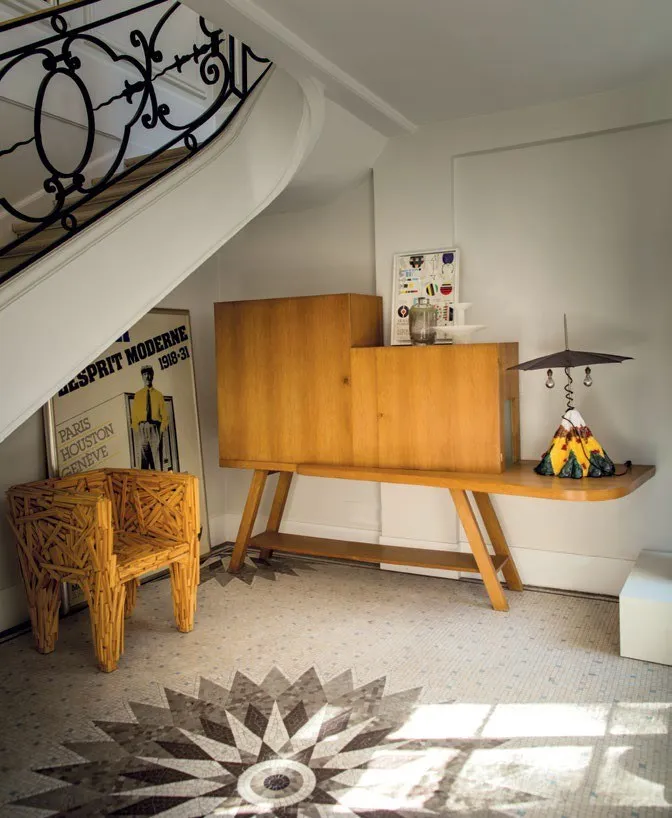
The air is soaked in the essence of dolce vita as we enter. At the threshold of the glass and wrought iron door stands Charles Zana, smiling. We were now in the anteroom through which lay the stone staircase leading to the ‘favela chair’ floor of Humberto and Fernando Campana, neighbours with a large Taryn Simon and a collection of Ettore Sottsass pieces.
 L’Officiel India DigitalRead L’Officiel India in the digital libraryEvery issue and every cover story, on TCG Media.Read now
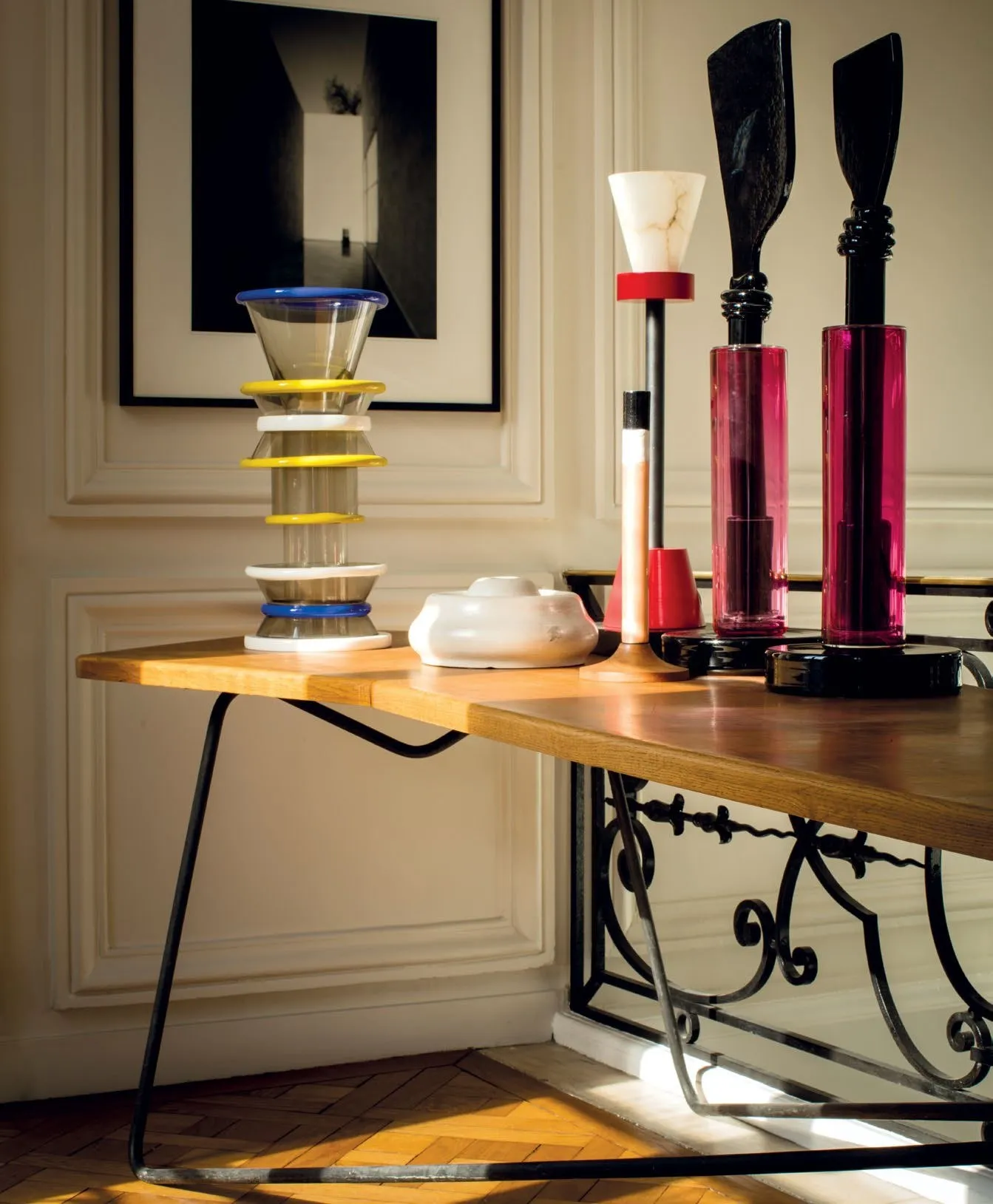
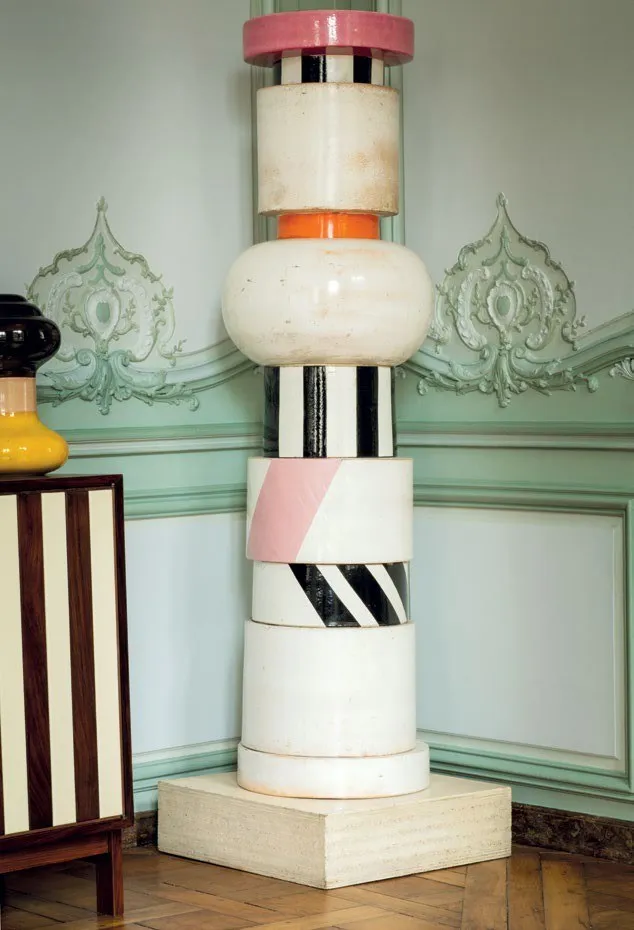
Charles is an avid collector of ceramics, especially the ones by the founder of the Memphis Group. It was the summer of 2017, on the occasion of the 10th death anniversary of this creator of art, Ettore Sottsass, that Charles brought together 70 Sottsass pieces for a legendary exhibit at the Olivetti boutique at the Saint Marc square in Venice. “Ettore was among one of the first to have anticipated the blurring boundaries between design and art,” Charles says. Ettore did, without a doubt, expand ceramic work from its function of being merely decorative to becoming representative of great moments in human existence.
With a series of works such as the 1963 Ceramiche delle Tenebre (Darkness Ceramics) and the 1964 Ceramiche di Shiva (Shiva Ceramics), he takes us on a therapeutic voyage from India to the United States. And as Ettore has once said: Design is not about giving shape or form to a more or less senseless product for a more or less luxury centric industry. For me, design is a weapon to conquer life with. It stands true in Charles’ case.
A desire is born
Born in 1917, Ettore lived through all the historical moments of the 20th century, mainly fascism in Italy, his motherland. All of which resulted in 60 years of reflection and creation, through which he explored equally the classics and the counter culture. Charles has collected about 30 rare pieces by the maestro from the ’60s and the ’70s, carrying on to those from the ’90s passing through the clarity of the hippie era.
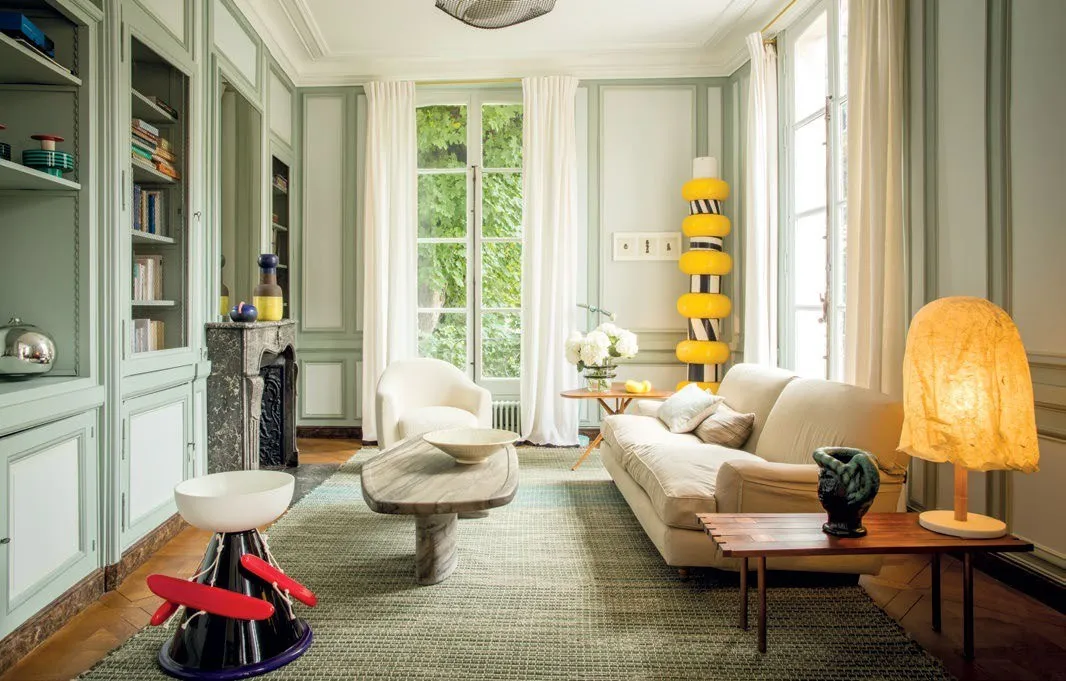
Placed and installed on tables and surfaces across the apartment are pieces signed by Christian Liaigre and Sottsass, himself. Approximately 190 square metres of surface area with a large duckboard covered terrace have been immaculately put together with these fantastic works of art. In the living room, the walls are covered with wooden panels of a light sea green, which are broken in intervals to make room for large bookcases with works on art and artists, and an interval for a fireplace. A sublime mix of classic elements with contemporary pieces, but Italian art is omnipresent.
Following the same vein of art and interior design, Andrea Branzi, another powerhouse of the Memphis Group, illuminates the staircase with one of his sculptural suspensions while chairs by legend Carlo Mollino flaunt the perfection of their lines. In this space, objects seem to breathe a life of their own, filling it up with their rare and unique intelligence and functionality that was given to them by their creators.
A passion that Charles has put down as a credo, “Ettore interests me the most because he never stopped questioning society and himself. An interesting way to keep desire and passion alive... a desire for beauty, a desire for meaning. That perspective is very close to my idea of life. I love, on a permanent basis, to be surrounded by objects created by others, works of art impregnated by my existence. Interiors are not to be done as if it’s a museum, but as something that radiates life, something with a beating heart.”
An architect’s vision
Charles has a wrestler’s physique and a steady gaze of a martial artist. But on the inside, he is a true artist. He translated his predisposition for mathematics and an acute passion for drawing into architectural training, DPLG. At the beginning of the 1990s, he set his studio up, for a while, in the United States, collaborating with different architects and interior design firms. Creating a well-defined vision for space, just like French creativity, was at the beginning of the 1930s, highlighted by figures such as Pierre Chareau, who was also an architect by training. “I don’t feel as if I have changed disciplines. I always worked with interior architecture, with the vision of an architect, with an existential analysis,” Charles says.
So, how are these two professions observed? “According to me, a decorator is one who puts things together while an architect goes through the technicality of everything, focused on logistics of construction.” If today the both of them are merging, what are their references in pure design? “I really appreciate the work of the Bouroullec brothers. This pair of designers has an architect’s reasoning, and, in some cases, on the contrary, certain architects develop a more decorative reasoning.” Adapting to one’s environment, to the various cultures and clients, to listen attentively, all of that is essential in formulating a quality project.
Today, as the head of a firm with about 20 different collaborators, Charles has, for his entire team, a fool proof modus operandi when it comes to their field of work. “At the moment, for example, we are working for Goyard. It interests me and in this case to understand what it means to be a client who is so in touch with the world of fashion, through the analytical and reflective reasoning that I have cultivated as an architect. Respect for the present sometimes requires conforming to the past,” he says.
A private client or an enterprise, the method for Charles consists of two aspects: listening and then acting. The work should tell a story, a tale of the clients which is conveyed, not through ex nihilo images but through sketches and designs he brings to life. On the same side of things, he adds another sphere of functioning linked more to his own terrain of artistic exploration which has helped him create avocation born from its privileged surroundings nourished by collectors for whom he does interiors.
“The firm has been built around a certain cultural network, we participate in events, we aim to be bring to life the famed French culture. We also work a lot around collections, and not only those of contemporary art. We have, therefore, orchestrated a space for French collectors who are more drawn to art from the 1950s to 1960s.” The problem with a collection is something that Charles is very familiar with since he also teaches at the Camondo School. The subject is how one can integrate an art collection within an architectural project.
Eyes spy
As is the case with all grand masters, who first intimately study the classics and working towards Charles is part of a generation of interiors architects who benefit tremendously from the knowledge of an inherited expertise and legacy of French culture. With Paris as a platform, all of which plays an important role, and, at the same time, these creative individuals offer their own, contemporary vision for their work, in neither conflict nor contradiction to their heritage.
“French style is, at times pure and clear and complex as well. It is simply a way to give proportions to things, to see them, the eye acts as a tool of measure. It is then naturally very important to nourish it well, aesthetically,” Charles says. A passion hinged on the expertise of those who have laboured for art, those who now labour after being mentored by their predecessors in the world of art, such masters possess the desire and the ability to bring tradition together with the contemporary.
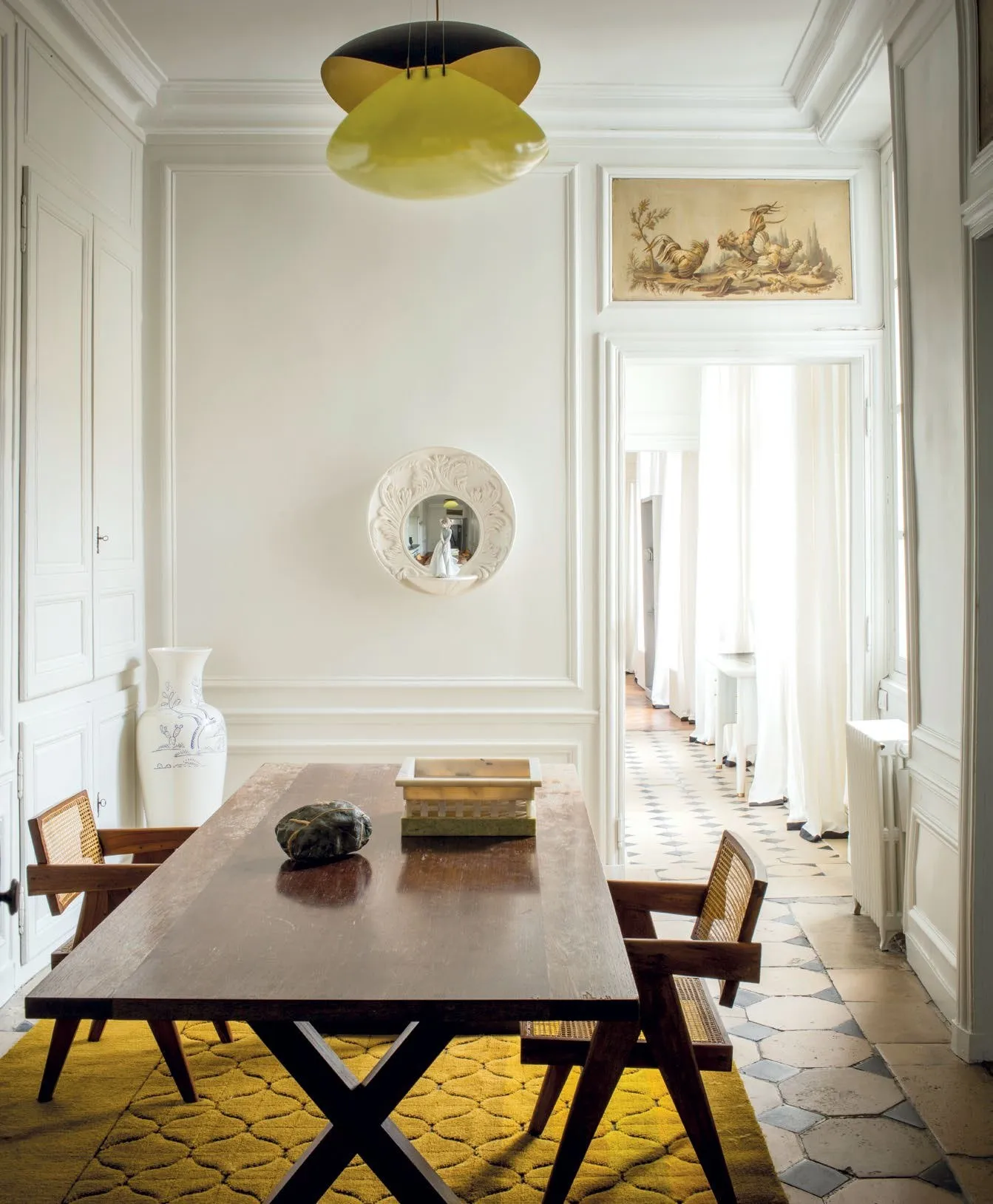
“Certain countries that have relatively young cultures do possess technical competence, but fall short when it comes to references and inspiration,” adds Charles. How does this furniture designer qualify his own work? “Today we are evolving, it seems to me, in a rather complicated world of furniture, and so I try to create pieces of a simple construction, comfortable, easy to carry, with fluid lines. This desire to simplify is accompanied with the use of excellent and beautiful materials, and the constant trouble of trying to avoid an overload of information,” he explains it us. In the alcove and the dining room are ceramics by Fernand Léger and Georges Jouve, sketches by Adel Abdessemed, a Laurent Grasso canvas and photographs by Hiroshi Sugimoto that resonate their own quiet music. And we are drenched in it.
Photography: Matthieu Salvaing.
From the February 2018 issue of L’Officiel India.
Spotted a mistake, or your photo used without permission? Report a correction












