Painting On Sewing Machines
Designers across the board reference art movements. These vibrant moodboards of inspiration usually reflect their state of mind, their vision and the direction, their aesthetic journey is taking. L’Officiel traces these movements in design houses over the years.
How Christian Dior replicated the now iconic lily of the valley flower on to his dresses is a study in perfection. Much later Raf Simons morphed artist Sterling Ruby’s artwork on to couture dresses, which made his debut Dior couture in 2012 quite multidimensional.
 L’Officiel India DigitalRead L’Officiel India in the digital libraryEvery issue and every cover story, on TCG Media.Read now
A brush of artisanal whiff makes fashion lines conceptually playful, besides of course, infusing the much-needed breath of fresh air.
Designers let their quirky flag fly high and look at street art and artists, performance arts or delve into the art history to make you think, sit up and take note. The clothes and accessories do not just remain pretty essentials but are enriched with multilayered complexities, which make this marriage of fashion and art an intoxicating cocktail.
Impressionism
When Christian Dior was 15, he’d helped his mother craft their beautiful garden in Granville. Like the designer, the artists of Impressionism were also inspired by flowers.
Both Dior and Monet loved flowers. While Monet splashed the gardens on his canvases, Dior realised them stunningly on dresses: fabrics patterned with roses, lily of the valley, embroidered bouquets; full skirts that swirl like petals.
Dior successors have referenced the house’s universe: Yves Saint Laurent, Marc Bohan, Gianfranco Ferré, John Galliano and now Raf Simons. However, they have added their own touch of modernity to the founder’s spirit.
Pop art
Street artists have time and again found resonance in fashion. Manish Arora’s Fall 2012 line flirted with eccentric graffiti. Throughout the show, street artists painted early ’90s-inspired bright letters that spelled out ‘life is beautiful’.
Moschino’s runway has been a melting pot of FMCG imagery-be it the McDonald’s iPhone case or Barbie gowns or Jeremy Scott’s Formula 1 meets baroque dandies. For his Fall 2015 line the designer had a strong ’90s hip-hop vibe.
In 2013, fashion’s chicest hooligan Marc Jacobs turned an incident of vandalism into a profit. The front of his Paris store was branded with $686 in lurid green spray paint by graffiti artist Kidult. However, instead of calling the cops, the brand tweeted, ‘Come by Paris Collection for the opening night installation of the new @therealkidult. We proudly support the arts’, along with a picture of the ‘art’.
Betsey Johnson’s spring-summer 2011 line brought out some neon spray paint and began painting the dress in fluorescent orange, then pink. The show was divided into sections, starting with bikers in Brooklyn sporting body-con leotards with guns, comic prints and gowns in perforated nylon active-wear fabrics. Next stops were The Met, Central Park, lower Manhattan, a quick detour to the Seaport followed by Times Square, with neon graffiti decorating her finale gowns. This show was a love letter saluting the diversity of New York women.
Cubism
In 2013, Andrew Gn paid tribute to his favourite artists and designers-Cubists Georges Braque and Pablo Picasso in an art-inspired collection held fittingly at Paris’ Palais des Beaux-Arts. Singaporeborn Gn also named Italian architects and designers Giò Ponti and Carlo Mollino as influences on his spring/summer 2014 collection.
At Lakme Fashion Week’s GenNext batch, Pune-based designer Salita Nanda debuted with ‘Demoiselles’ last year, a collection inspired by Picasso’s famed artwork ‘‘Les Demoiselles d’Avignon’’. Nanda, who studied art history during her stint at London College of Fashion, University of the Arts, was moved by the Cubism art movement. She was inspired by a Picasso painting and reinterpreted the women featured in the artwork, as well as given the red and blue used in the painting, a touch of pop.
Surrealism
Throughout Elsa Schiaparelli’s career, she was influenced by numerous cultural events and ideas that later reflected in her outings. She would bring surrealism into her designs by collaborating with artists such as Salvador Dali, Elizabeth Nourse, Jean Cocteau, Marcel Vertes and Kees van Dongen. Together, Schiaparelli and Dali created garments that were majorly impacted by the surrealist wave. In 1937, they created the epochal ‘Lobster Dress’. What made this design the ultimate talking point, was the Freudian implications of the lobster, echoing the predatory and castrating nature of the lobster against female sexuality.
Diane von Furstenberg played with surrealist art in her spring-summer 2012 campaign. Shot by Camilla Akrans, it featured models with mirrors where their faces should be, reflecting the Californian sky. The unexpected placement of the mirrors lent the campaign a surrealist vibe.
Rodarte’s fall 2012 line used tools meant to unlock the unconscious psyche-through techniques such as automatic drawing.
In 2012, Alber Elbaz at Lanvin was inspired by a poem of Louis Aragon and surrealistic imagery in general, thus giving birth to a capsule collection ‘Les Yeux D’Elsa’, refering to the poem’s words. He juxtaposed brooches and necklaces, in a manner reminiscent of Dali’s aesthetics, especially how the eyes, hands and mouths were presented in his work.
Expressionism
Rodarte’s expressionist qualities have always brought to mind Willem de Kooning or Edgar Degas. The design house is revered for their expressionist, deconstructive, sculptural style. They revel in burning, staining, and juxtaposing precious materials with mundane textiles.
Issey Miyake’s fall winter 2013 painted an expressionist picture of Scotland. The line stood out thanks to the visual interplay-as the models walked down the ramp, the trousers unravelled their vibrant streaks.
Performance art
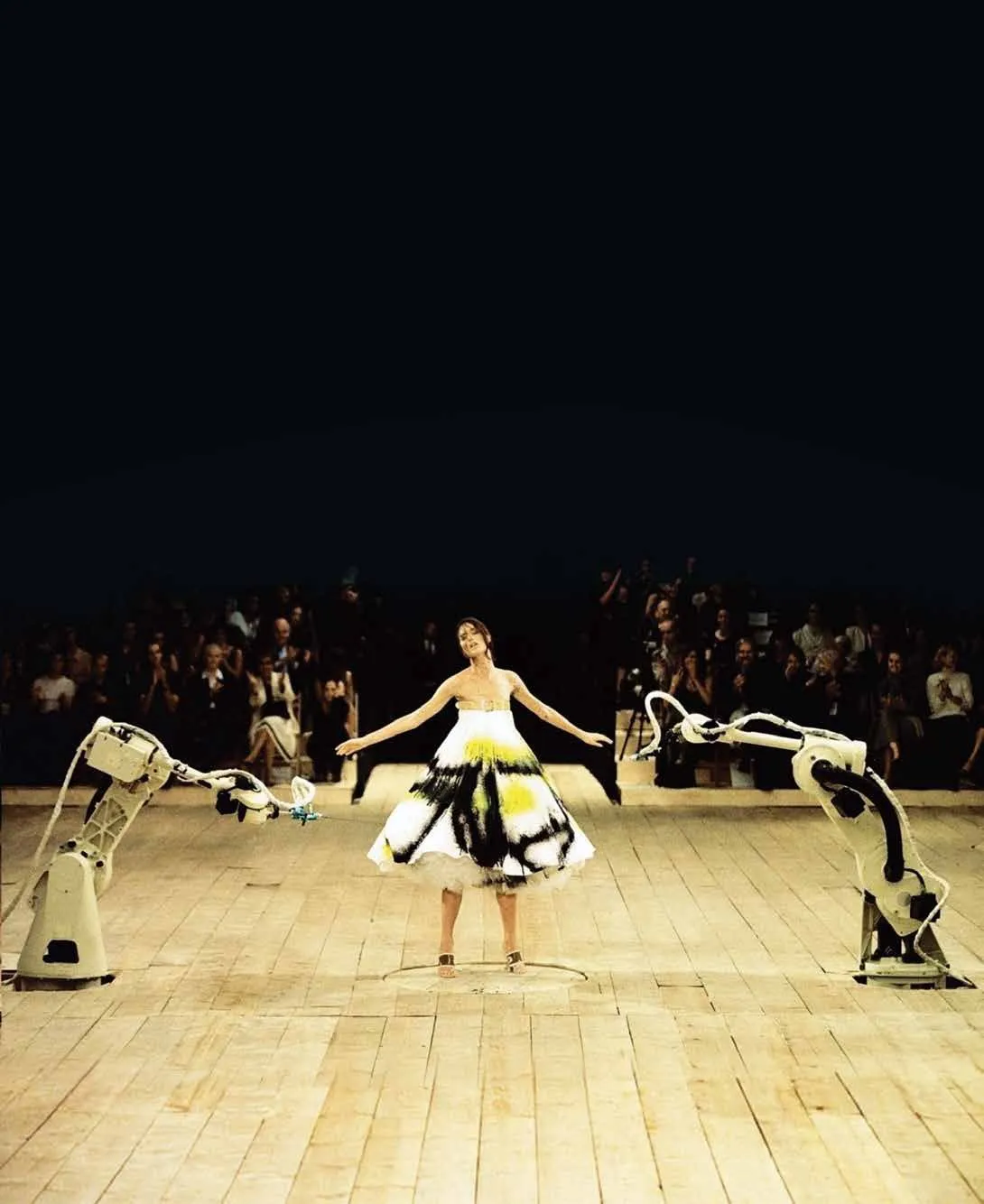
Who can forget the finale of the late Alexander McQueen seminal show which was part live art, live catwalk? Supermodel Shalom Harlow, dressed in a strapless white dress walked down the ramp and then on to a wooden plinth. As the plinth began to rotate, two mechanical robots spray painted the dress in black and green.
Designer Manish Arora got a Russian illusionist Benjamin Dukhan to perform for his show at the Paris Fashion Week. The models appeared and disappeared from a glass case as they showcased his fall-winter 2011/2012 women’s ready-to-wear fashion collection inspired by magic dolls.
From the October 2015 issue of L’Officiel India.
Spotted a mistake, or your photo used without permission? Report a correction