Art Etc.
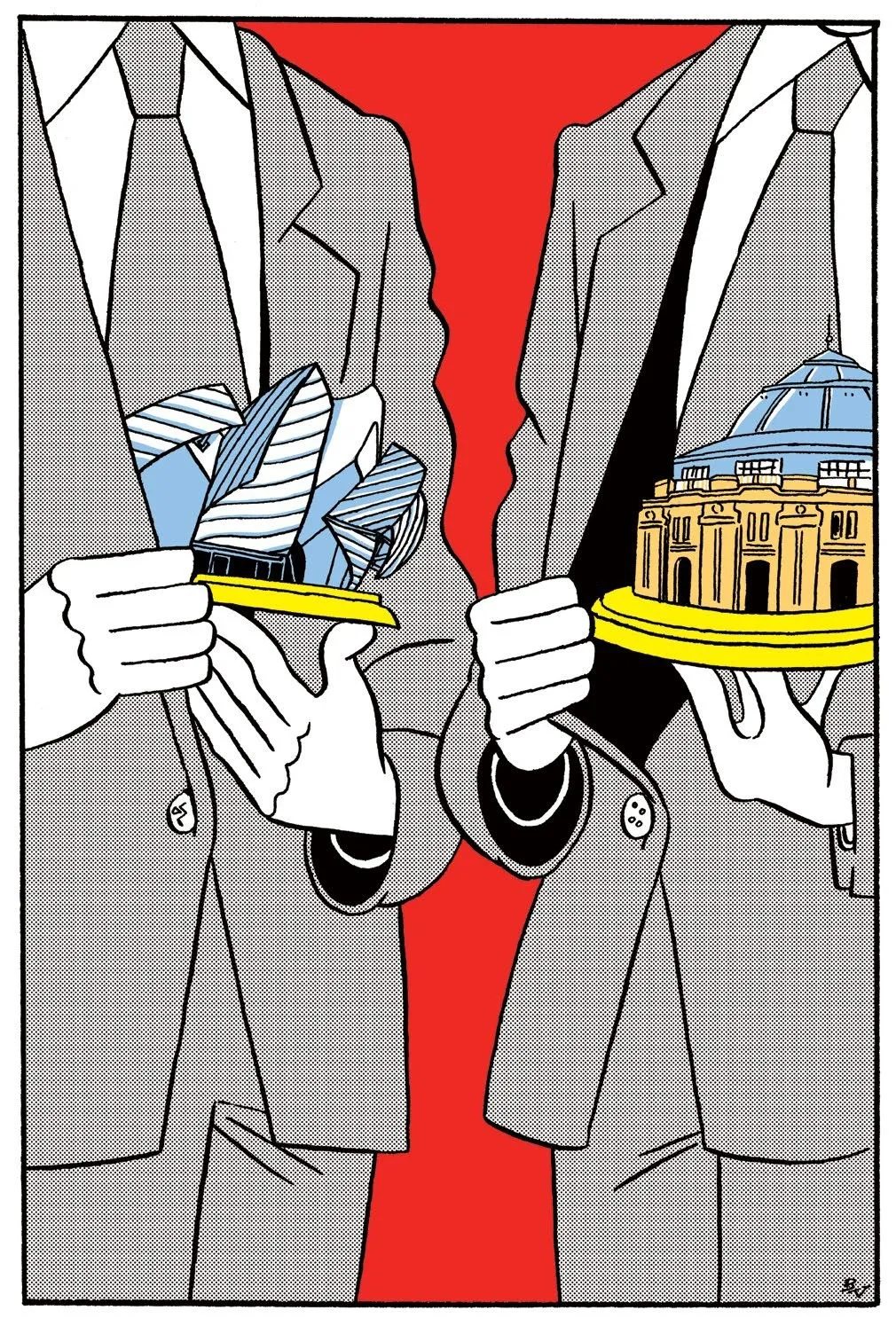
A number of private art foundations are once again putting Paris on the global map of contemporary art, while, at the same time, highlighting luxury brands. We look at how art, an extremely powerful medium, has become the preferred playing field for the world’s luxury leaders.
In history, the great French kings always highlighted the strength of their reign through art and architecture. It’s almost as if the act of constructing a grandiose building was the only means to affirm one’s power and to let subsequent generations inherit this power. Louis XIV gave us Versailles, Georges Pompidou has an arts centre to his name, François Mitterrand gave us the Louvre pyramid and Jacques Chirac the Quai Branly Museum. There’s no denying that art and power have always been intrinsically linked.
 L’Officiel India DigitalRead L’Officiel India in the digital libraryEvery issue and every cover story, on TCG Media.Read now
It is often said that politics has now given a lot of its power to industry and financial leaders. Let’s just say that only historians are in a position to judge. Be that as it may, it is right to say that Paris now boasts three exceptional spaces for contemporary art, thanks to the passion of three giants of the luxury industry. The fact that they have chosen Paris to showcase their respective collections seems appropriate for this city of love and creativity, which has contributed immensely to the success of these luxury groups. It appears that art is no longer an expression of a nation’s glory but much rather the pride of these companies, who, in turn, have become the pride of their nation.
THE PRECURSOR
In the luxury industry, everyone knows Alain Dominique Perrin. He is widely respected. He was the president of Cartier for over two decades, followed by a stint Richemont (the powerful Swiss group with Cartier, Van Cleef & Arpels, Piaget, as well as a number of prestigious watch brands). This bon vivant, a friend of Claude François, Lou Reed, Gérard Lenorman and François Pinault, as well as a native of Nantes, retired in 2003. He was the precursor of contemporary luxury. His one belief was, “Do not confuse expensive with luxury; fashion with luxury; they are not the same professions. Fashion goes out of style. Luxury is timeless.” Thanks to him, France put in place a law on corporate social responsibility in the constitution. Paris has the Fondation Cartier, an unprecedented concept at the time.
Back in 1984, Alain Dominique Perrin insisted that Cartier needed to leave its mark for the future generations as well as, be involved in the city’s cultural scene. Just like Denmark, which was the first country to pass a law on corporate social responsibility. At another level, he would later agree that he did not want Cartier to be rejected by the intelligentsia due to its status as purely a luxury brand. He wanted it to contribute to modernity and creativity. He never wanted to highlight Cartier through football, F1 or sailing. Cartier would work with artists. Following some strict rules and regulations, they decided that the artists showing at the Fondation would never be in contact with Cartier. Alain Dominique Perrin says, “Making an artist work on a commercial basis could run the risk of destroying him.” He goes as far as saying that the works of Jeff Koons or Murakami will not be around for posterity. “Some collectors are tired of seeing Murakami on accessories.”
A DAZZLING ICEBERG
October 2014. Exactly 30 years to the day after the opening of the Fondation Cartier, a crowd of famous people stood on the border between Paris and Neuilly, around an unusual building, shaped like a metallic iceberg, rising from the Bois de Boulogne. It was the Fondation Louis Vuitton, which was just inaugurated by François Hollande and Bernard Arnault, a gargantuan project led by the architect Frank Gehry. Bernard Arnault, the CEO of LVMH, is the most famous arts patron of France, and prefers to talk about his company over himself. He is passionate about mathematics, piano and architecture and never hesitates to talk about his love for contemporary art. Arnault has come a long way from the early ‘80s when he bought his first works of Picasso, Matisse, Calder and Rothko. Though he owns the British art dealership Phillips, the CEO of LVMH has always refused to work single-handedly in charity. He always believes in teamwork. Suzanne Pagé who was the director of the Paris Museum of Modern Art has been the creative director of Louis Vuitton since 2006. She insists on one thing–works that have been procured for this collection are not meant to be sold again. Bernard Arnault often thinks of himself as impatient but loves to talk about the idea of time. “In a hundred years, we will still appreciate Dom Pérignon, but one might not always remember Microsoft.”
LIFE AT THE STOCK EXCHANGE
“It’s a beautiful day!”, Anne Hidalgo says smiling at each of the journalists present at this morning press conference. It is April 27th. François Pinault is present as are his children. The mayor of Paris cannot conceal his joy. “This is a once-in-alifetime chance to see Monsieur Pinault’s collection in Paris.”
For the past few months, the rumour mills have been turning: François Pinault is looking for an art space in the heart of Paris. We could hardly believe our ears with the rumour, but the founder of the Kering Group (Gucci, Saint Laurent, Bottega Veneta, etc) did not disappoint. In 2005, a massive project for a museum at the site of the former Renault factories was scrapped. This was due to a number of clashing interests. The collector then went to Venice, where he took over the Palazzo Grassi and the Punta della Dogana to showcase a part of his personal collection. There is a well-known anecdote: in 2003, when he decided to retire and pass on the reins of his empire to his son, François-Henri Pinault, the latter asked the former, “But what are you going to do now?” People in Paris could hardly believe when the father took on responsibilities again after retirement. Surely, it was difficult. Some people close to the magnate even spoke of depression, but at the end of the day, art reigned supreme. This gave rise to a burning passion. Five years earlier, in June 1998, François Pinault had acquired Christie’s, the largest art auction house in the world. No one saw this coming. This opened up the doors of the art world to him and gave him the right contacts. Insiders even claim that this passion went back as early as the 1980s, when he went out and bought nondescript works of art.
Had François Pinault lost all hope of showcasing his personal collection in his home country? Not, at all. He was negotiating with the city of Paris to find a building for this, preferably at the heart of the French capital. He had even spoken about the Espace Pierre Cardin. But by the end of April, the suspense was over: it was the stock exchange of Paris. François Pinault promises to breathe new life into this superb 18th century building on the Rue du Louvre. Martin Béthenod will be the director of the space and Tadao Ando the architect of the project. Work will begin in January 2017 and the first exhibition will be in 2018. At around the same time, a few blocks away, the La Samaritaine building will finally resurrect from its slumber, as a new luxury project by the LVMH group. Art in its finest form!
From the August 2016 issue of L’Officiel India.
Spotted a mistake, or your photo used without permission? Report a correction