Moving Wonders
The world of art never ceases to fascinate us. Revel in these extraordinary installations that work on kinetic energy.





Kinetic art depends on movement for its grand effects, whether optical or mechanical. With origins in the Dadaist and Constructivist movements, Kinetic art first emerged in the 1910s. Inspiring new kinds of art that went beyond the boundaries of the traditional, handcrafted, static object, it encouraged the idea that beauty of an object could be the product of its movement.
A Million Times
 L’Officiel India DigitalRead L’Officiel India in the digital libraryEvery issue and every cover story, on TCG Media.Read now
It is an iconic work by Humans Since 1982 studio in Stockholm. A Million Times is an installation comprising hundreds of analogue clocks that create shifting monochrome patterns, letters and numbers. Locked in its functionality to show the time, the natural character inherent to an analogue clock with its two arms constantly dancing in slow motion around the centre, unveils hidden figurative qualities without denying its primary purpose. The result is, well, timeless.
The Bicycle Wheel
Often considered one of the first works of kinetic art, because the wheel fixed to the stool can be spun, the Bicycle Wheel is a classic example of Dadaism. The work is satirical too. For Duchamp, this movement was essential to the object’s effect and while the piece was made out of the context of kinetic art, it is certainly considered a part of it.
Blaze
Bridget Riley’s seemingly simple paintings are full of optical complexity. For instance, the zigzag black and white lines in Blaze create the perception of a vortex. As the brain interprets the image, the alternating pattern appears to shift back and forth. The interlocking lines add depth to the form as it rhythmically curves around the centre of the page. And, although the image is black and white, prismatic colour appears when the eye focuses on the image.
Curling Bridge
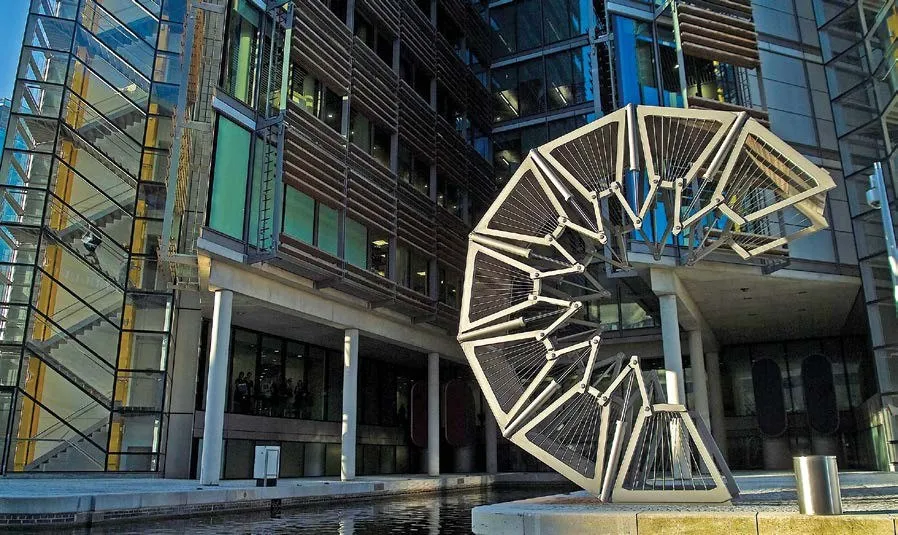
Thomas Heatherwick’s Curling Bridge has an astonishing design. Watching it move though is mesmerising as it’s like looking at a moving sculpture. When extended, it resembles a conventional steel and timber footbridge, and is 12-metre-long. To allow the passage of boats, the hydraulic pistons are activated and the bridge curls up until its two ends join, to form an octagonal shape.
Homage to New York
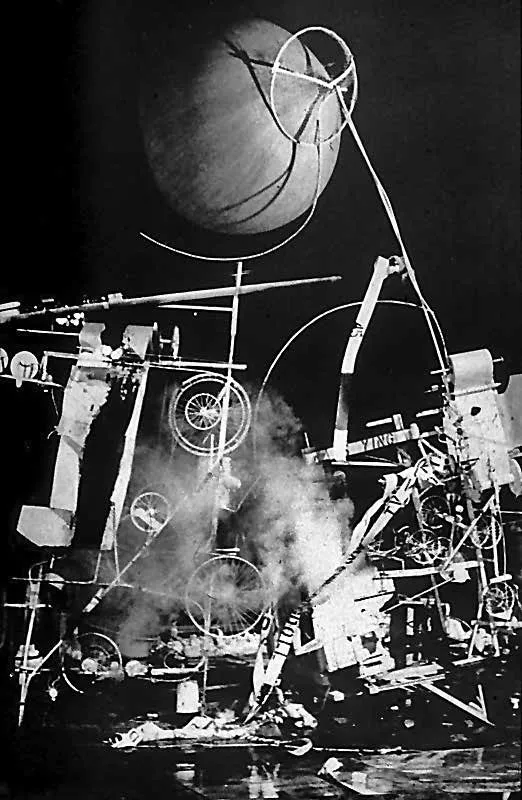
It was constructed in just three weeks in 1960 to be installed in the garden at the Museum of Modern Art, New York. It was blown to pieces in a public performance of noise and light in only 27 minutes. One of the most iconic works of kinetic art, Homage to New York depicts that what we create destroys us.
From the June–July 2018 issue of L’Officiel India.
Spotted a mistake, or your photo used without permission? Report a correction